Crop · Vegetable crop
Eggplant
Solanum melongena
Also known as: Aubergine, Brinjal
Eggplant is a warm-season solanaceous fruiting vegetable grown for its glossy, variably shaped and colored fruit, cultivated in open fields and protected culture across warm and temperate regions.
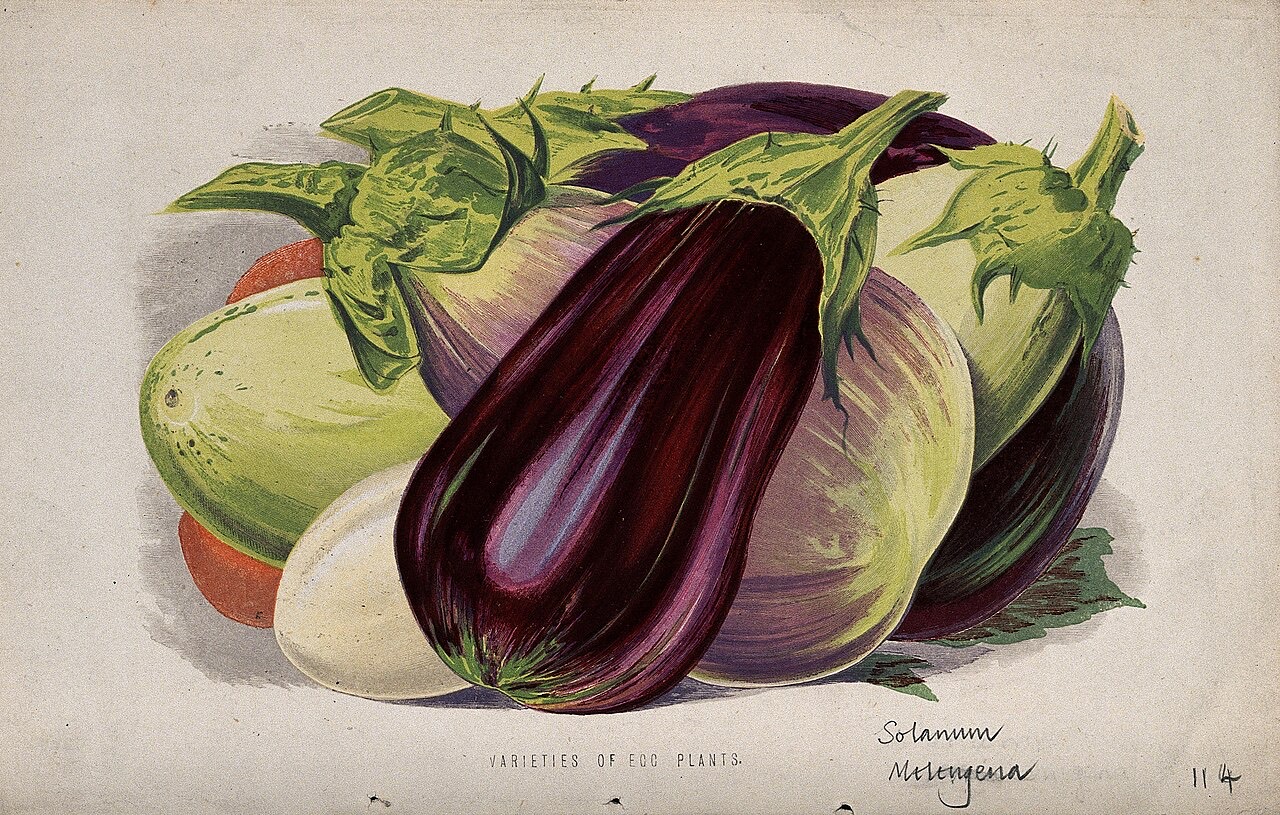
Eggplant is grown for its fleshy fruit, which varies widely by cultivar in size, shape, and color from the familiar large purple-black oval to smaller, slender, green, white, or striped types favored in different regional cuisines. Like tomato and sweet pepper, it belongs to the nightshade family and shares several of that family's pest and disease vulnerabilities.
Eggplant is a tender perennial in frost-free tropical climates but is grown as an annual crop across most of its commercial range, requiring warm temperatures throughout its growing period and being sensitive to cold and frost.
Overview
Eggplant is grown as a warm-season fruiting vegetable, typically raised from transplants and cropped over an extended harvest period as new fruit forms continuously through the season under favorable conditions.
Production spans open-field cultivation in warm climates and protected culture (greenhouses and high tunnels) in cooler regions, which extends the growing season and can improve fruit quality and pest management.
Botanical classification
- Family
- Solanaceae (nightshade family)
- Genus
- Solanum
- Principal species
- Solanum melongena (cultivated eggplant)
- Growth habit
- Woody-based perennial subshrub grown as a warm-season annual, bearing solitary or small clusters of fleshy fruit
Origin and distribution
Eggplant was domesticated in South and Southeast Asia from wild Solanum relatives, with a long history of cultivation and diversification across Asian cuisines before spreading to the Mediterranean, Africa, and eventually the Americas.
It is now grown widely across warm-temperate, subtropical, and tropical regions.
Climate requirements
Eggplant requires warm temperatures throughout its growing period, generally performing best under conditions similar to or slightly warmer than those favored by tomato and sweet pepper, and it is notably slow to establish and prone to chilling injury in cool conditions.
Frost kills the plant, so field production is timed to the local frost-free period, while protected culture allows earlier planting and extended harvest in cooler climates.
Soil requirements
Eggplant performs best on well-drained, fertile loams with good moisture-holding capacity. Like other solanaceous crops, it is vulnerable to soil-borne root diseases where drainage is poor or where susceptible crops have been grown repeatedly on the same land.
Establishment and crop management
Eggplant is typically established from transplants raised in a warm, protected environment and set out after frost risk has passed and soil has warmed, since the crop responds poorly to cold soil and air temperatures at planting.
- Cultivar selection matched to fruit type, market preference, and local season length
- Crop rotation with non-solanaceous crops to manage soil-borne disease risk
- Staking or support in some cultivars and growing systems to keep fruit off the ground
- Regular harvesting to encourage continued fruit set through the season
Nutrient considerations
Potassium supports fruit development and quality over an extended harvest period, while phosphorus contributes to root establishment and early growth; nitrogen is managed to balance vegetative vigor against fruit set.
Water and irrigation
Eggplant requires consistent moisture throughout fruit development, and water stress can reduce fruit size and increase bitterness or misshapen fruit. Drip irrigation is widely used to supply water efficiently to the root zone in both field and protected culture.
Common diseases and pests
Verticillium wilt is a significant soil-borne disease of eggplant, causing wilting and vascular discoloration, particularly where the crop or other susceptible hosts have been grown repeatedly. Bacterial leaf spot affects foliage and fruit under warm, wet conditions. The Colorado potato beetle, shared with other solanaceous crops, and aphids are among the notable insect pests.
Management combines resistant or grafted rootstocks, crop rotation, monitoring, and — where justified — locally authorized control products applied according to their labels.
Harvest
Eggplant fruit is harvested while still glossy and firm, before seeds inside mature and the flesh becomes bitter or spongy; overmature fruit loses market quality quickly. Harvest is typically by hand at regular intervals as fruit reaches marketable size.
Uses
- Fresh-market vegetable used in a wide range of regional cuisines
- Processed and preserved products in some markets
- Ornamental and specialty cultivars in home gardens
- Crop residues sometimes used as livestock feed in smallholder systems
Botanical identity
Species- Accepted name
- Solanum melongena
- Family
- Solanaceae
- Genus
- Solanum
- Harvested part
- fruit
- Agricultural use
- human food
- Crop group
- Vegetables
What the authorities say
- World Flora Online — Taxonomic Backbone
- Solanum melongena
- Plants of the World Online
- Solanum melongena
- The name Solanum melongena is a homonym: more than one published name matches it exactly, and they resolve to different taxa. The accepted one was selected; Solanum melongena Wall..
Botanical identity here is what the consulted taxonomic authorities publish, on the date they were read. Where authorities disagree, both readings are shown rather than one being chosen silently.
What AgricultureID holds for this crop
- 155 crop calendar records
- 1 verified extension resources
- 6 pests and diseases naming this crop as a host
- 2 soil references
- 1 climate references
- 4 related crops
Not held
- No published cultivars — not researched
- No official variety registrations — source exists not mapped
- No farm economics observations — source exists not mapped
- No market price series — source exists not mapped
An absence here means this corpus holds no such record, not that none exists.
How to read figures on this page
Production, area and trade figures for any crop change from season to season and are compiled by FAO and by national agricultural statistics agencies. Take current numbers from those primary sources, dated to the period you mean, rather than from a secondary summary — including this one.
Crop water requirements are estimated from reference evapotranspiration and local climate data, following methods published by FAO and national agricultural agencies. A requirement quoted without the reference method and the local climate behind it is not a number that can be applied to a field.
Part of
Related crops
- Same genus
- Gboma Eggplant, Potato, Scarlet Eggplant, Tomato
Planting and harvest calendar
Usual sowing and harvest windows across 155 jurisdictions, covering eggplant and eggplant — season 1 and eggplant — season 2 and eggplant — season 3.
Official extension guidance
1 resource indexed from public extension publishers. Each was written for a particular place; read it at the source.
Factsheet published by NC State Extension for North Carolina. It addresses eggplant. The source is organised around “Eggplant Flea Beetle” and “Eggplant Lace Bug”.
NC State Extension · Pest management · publisher states 2024-06-04
These are pointers to guidance published by others. Each was written for a particular place and season and is revised by its publisher; read it at the source, and check it applies where you farm.
Tools for this
Each tool shows its formula, constants and sources, and starts empty — nothing is filled in from this page.
- Seed-rate calculator
Convert a target plant stand into a seed rate, allowing for germination and establishment.
- Row spacing calculator
Work out in-row spacing and plants per metre of row for a target density.
- Production, area and yield calculator
Relate a harvested area and a yield to a production total, in either direction.
- Growing degree-days calculator
Accumulate heat units against a base temperature.
Relationships
Evidence-backed connections in the knowledge graph.
Nutrients required
Suitable soils
Climate sensitivity
Irrigation methods
Machinery
Farming systems
Related topics
Scope & limitations
Geographic scope: Global overview. Agronomic details (timing, rates, varieties) are region-specific and vary widely.
Climate context: Warm-season crop, frost-sensitive and slow to establish under cool conditions; grown in open fields and protected culture.
- Fruit shape, size, and color vary enormously by regional cultivar type; this entry covers the species generally rather than any single fruit type.
- Production statistics change annually and should be taken from primary datasets such as FAOSTAT.
Sources
This article draws on the following authoritative sources. See our sources & methodology for how they are selected.
- [1]FAO — Food and Agriculture Organization (opens in a new tab)Authoritative
Food and Agriculture Organization of the United Nations (FAO)
Cited for: Role of eggplant in vegetable production systems
- Type:
- Intergovernmental organization
- Jurisdiction:
- Global
- Accessed:
- 2026-07-12
- [2]FAOSTAT — FAO statistical database (opens in a new tab)Authoritative
Food and Agriculture Organization of the United Nations (FAO)
Cited for: Production, area, and trade statistics
- Type:
- Intergovernmental organization
- Jurisdiction:
- Global
- Accessed:
- 2026-07-12
- Authoritative
Cited for: Classification and nomenclature
- Type:
- Reference database
- Jurisdiction:
- United States
- Accessed:
- 2026-07-12
- [4]CABI Digital Library — Crop Protection Compendium (opens in a new tab)High
CABI (Centre for Agriculture and Bioscience International)
Cited for: Eggplant disease and pest compendium data
- Type:
- Reference database
- Jurisdiction:
- Global
- Accessed:
- 2026-07-12
- [5]UC Statewide Integrated Pest Management Program (UC IPM) (opens in a new tab)High
University of California Agriculture and Natural Resources (UC ANR)
Cited for: Integrated pest management guidelines for eggplant
- Type:
- University extension service
- Jurisdiction:
- United States (California)
- Accessed:
- 2026-07-12