Crop · Vegetable crop
Broccoli
Brassica oleracea var. italica
Also known as: Calabrese
Broccoli is a cool-season brassica grown for its immature flower heads, harvested before flowering and valued for reliable performance in temperate and Mediterranean climates.
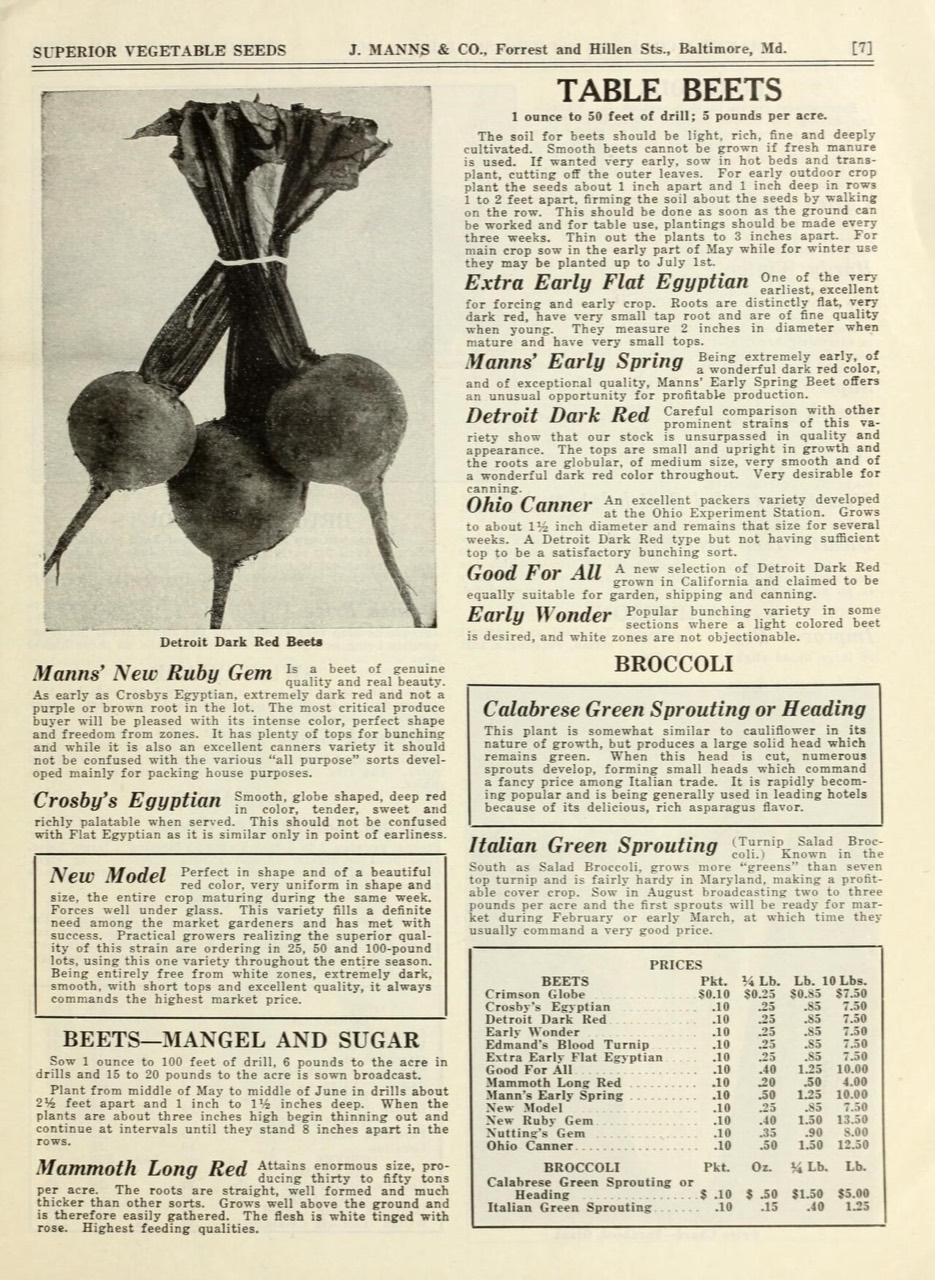
Broccoli is a cultivated variety of Brassica oleracea, the same species as cabbage, cauliflower, and kale, selected for a dense cluster of immature flower buds harvested as the edible head before the flowers open. It is grown as a cool-season crop, generally in spring or autumn plantings in temperate climates.
Like other members of the species, broccoli is botanically biennial — flowering and setting seed only after a period of cold the following season — but it is grown commercially as an annual, harvested for its head in the same season it is planted.
Overview
Broccoli is grown for its compact head of unopened flower buds and associated stalk, harvested at a stage judged by bud size and tightness before individual flowers begin to open. Modern hybrid cultivars dominate commercial production for their uniformity and disease resistance.
Production spans large-scale commercial fields supplying fresh and processing markets as well as smaller-scale and home garden cultivation, with planting timed around the cool conditions the crop requires for good head quality.
Botanical classification
- Family
- Brassicaceae (mustard family)
- Species
- Brassica oleracea
- Cultivar group
- Italica group (broccoli)
- Growth habit
- Biennial broadleaf plant grown as an annual, producing an edible cluster of immature flower buds on a thick central stalk
Origin and distribution
Broccoli was selected from wild cabbage populations native to the Mediterranean coast, with the Italica group developed in Italy before spreading through Europe and, more recently, becoming a major vegetable crop in the Americas, Asia, and elsewhere.
Climate requirements
Broccoli favors cool growing conditions; consistently warm or hot weather during head development commonly leads to smaller, looser, or discolored heads and premature flower opening ("bolting" of the head).
In many regions it is grown as a spring or autumn crop, or year-round in coastal or highland areas with consistently mild temperatures, to keep head development within the crop's preferred temperature range.
Soil requirements
Broccoli performs best on firm, fertile, well-drained loams with good moisture-holding capacity. Soil pH is an important management consideration, since more acidic, poorly drained soils favor clubroot, a serious soil-borne disease of brassicas.
Establishment and crop management
Broccoli is commonly established from transplants raised in trays or seedbeds and set out at a spacing and timing suited to local climate and market, though direct seeding is also used in some systems.
- Cultivar selection matched to season length, heat tolerance, and market use
- Crop rotation with non-brassica crops to reduce clubroot and other soil-borne disease risk
- Uniform transplanting and spacing to promote even head development
- Timely weed and moisture management, since check to growth can reduce head quality
Nutrient considerations
Nitrogen strongly influences leaf and head development, while boron and sulfur deficiencies are of particular concern in brassicas, since boron deficiency can cause internal stem disorders and sulfur supports the glucosinolate compounds characteristic of the family.
Water and irrigation
Broccoli has a relatively shallow root system and benefits from consistent soil moisture, particularly during head formation, when water stress can reduce head size and quality. Sprinkler and drip irrigation are both used depending on scale and region.
Common diseases and pests
Clubroot is one of the most damaging soil-borne diseases of broccoli and other brassicas, causing swollen, distorted roots and stunted growth, and can persist in soil for many years once established. Downy mildew affects foliage under cool, humid conditions, while flea beetles damage seedling leaves and armyworms feed on foliage and developing heads.
Management combines resistant cultivars, crop rotation, soil pH management, monitoring, and — where justified — locally authorized control products applied according to their labels.
Harvest
Broccoli is harvested by hand when heads reach the desired size with tightly closed buds, before individual flowers begin to open, since open, yellowing flowers indicate overmaturity and reduced market quality. Some cultivars also produce secondary side shoots that can be harvested after the main head.
Uses
- Fresh-market vegetable, eaten raw or cooked
- Frozen and other processed vegetable products
- Minimally processed and pre-cut retail formats
- Crop residues sometimes incorporated as green manure or livestock feed
Botanical identity
Cultivar group- Accepted name
- Brassica oleracea Italica Group
- Family
- Brassicaceae
- Genus
- Brassica
- Harvested part
- inflorescence
- Agricultural use
- human food
- Crop group
- Vegetables
What the authorities say
- World Flora Online — Taxonomic Backbone
- Brassica oleracea
- Plants of the World Online
- Brassica oleracea
Broccoli, cabbage, cauliflower, kale, kohlrabi and Brussels sprouts are all Brassica oleracea. Plants of the World Online sinks the cultivated forms into the species; World Flora Online keeps infraspecific epithets for them. AgricultureID publishes them as CULTIVAR GROUPS under the cultivated-plant code, which is what they are: selections of one species that differ in which organ was bred for size. Both authorities agree on the species, and neither is asked to carry a rank it does not recognise.
Botanical identity here is what the consulted taxonomic authorities publish, on the date they were read. Where authorities disagree, both readings are shown rather than one being chosen silently.
Traded as
This crop is traded as one commodity in this corpus.
No ingested price series for these commodities yet.
What AgricultureID holds for this crop
- 79 crop calendar records
- 4 verified extension resources
- 5 pests and diseases naming this crop as a host
- 2 soil references
- 1 climate references
- 11 related crops
Not held
- No published cultivars — not researched
- No official variety registrations — source exists not mapped
- No farm economics observations — source exists not mapped
- No market price series — source exists not mapped
An absence here means this corpus holds no such record, not that none exists.
How to read figures on this page
Production, area and trade figures for any crop change from season to season and are compiled by FAO and by national agricultural statistics agencies. Take current numbers from those primary sources, dated to the period you mean, rather than from a secondary summary — including this one.
Crop water requirements are estimated from reference evapotranspiration and local climate data, following methods published by FAO and national agricultural agencies. A requirement quoted without the reference method and the local climate behind it is not a number that can be applied to a field.
Part of
Brassica — one genus, many crops · Brassicaceae — the cabbage family · Vegetables
Related crops
- Same genus
- Brussels Sprouts, Cabbage, Cauliflower, Chinese Cabbage, Kale, Kohlrabi, Mustard, Oilseed rape, Pak Choi, Swede, Turnip
Planting and harvest calendar
Usual sowing and harvest windows across 79 jurisdictions, covering broccoli and broccoli — season 1 and broccoli — season 2.
Official extension guidance
4 resources indexed from public extension publishers. Each was written for a particular place; read it at the source.
Factsheet published by NC State Extension for North Carolina. It addresses broccoli. The source is organised around “Types and Cultivars” and “Postharvest Handling”.
NC State Extension · Cultivar selection, Harvest, Post-harvest · publisher states 2024-07-22
Factsheet published by Penn State Extension for Pennsylvania. It addresses broccoli. The source is organised around “Site Selection”, “Planting and Fertilization” and “Pest Control”.
Penn State Extension · Crop establishment, Nutrient management, Pest management, Harvest, Storage · publisher states 2005-06-20
Selecting, Storing, and Serving Ohio Broccoli, Brussels Sprouts, and Cauliflower
Factsheet published by Ohio State University Extension for Ohio. It addresses broccoli. The source is organised around “Serving Ideas”, “Cauliflower Rice:” and “Search form”.
Ohio State University Extension · Storage · publisher states no date; reachable 2026-08-27
Weed Management in Broccoli, Cabbage, and Cauliflower
Factsheet published by NC State Extension for North Carolina. It addresses broccoli. The source is organised around “Cultivation Options in Cole Crops”, “Herbicide Options in Cole Crops” and “Preplant and Preemergence”.
NC State Extension · Crop establishment, Soil preparation, Weed management · publisher states no date; reachable 2026-08-27
These are pointers to guidance published by others. Each was written for a particular place and season and is revised by its publisher; read it at the source, and check it applies where you farm.
Tools for this
Each tool shows its formula, constants and sources, and starts empty — nothing is filled in from this page.
- Seed-rate calculator
Convert a target plant stand into a seed rate, allowing for germination and establishment.
- Row spacing calculator
Work out in-row spacing and plants per metre of row for a target density.
- Production, area and yield calculator
Relate a harvested area and a yield to a production total, in either direction.
- Growing degree-days calculator
Accumulate heat units against a base temperature.
Relationships
Evidence-backed connections in the knowledge graph.
Susceptible to
Climate sensitivity
Machinery
Related topics
Harvested commodities
The traded commodities harvested from this crop. A commodity is the harvested lot, described by its own quality, grading, and storage evidence — not by the agronomy of the plant.
Scope & limitations
Geographic scope: Global overview. Agronomic details (timing, rates, varieties) are region-specific and vary widely.
Climate context: Cool-season brassica; heat during head development reduces head quality and can trigger premature flowering.
- Clubroot risk and soil pH management thresholds vary regionally and with local pathogen strains; local extension guidance should be consulted.
- Production statistics change annually and should be taken from primary datasets such as FAOSTAT.
Sources
This article draws on the following authoritative sources. See our sources & methodology for how they are selected.
- [1]FAO — Food and Agriculture Organization (opens in a new tab)Authoritative
Food and Agriculture Organization of the United Nations (FAO)
Cited for: Role of broccoli in vegetable production systems
- Type:
- Intergovernmental organization
- Jurisdiction:
- Global
- Accessed:
- 2026-07-12
- [2]FAOSTAT — FAO statistical database (opens in a new tab)Authoritative
Food and Agriculture Organization of the United Nations (FAO)
Cited for: Production, area, and trade statistics
- Type:
- Intergovernmental organization
- Jurisdiction:
- Global
- Accessed:
- 2026-07-12
- Authoritative
Cited for: Classification and nomenclature
- Type:
- Reference database
- Jurisdiction:
- United States
- Accessed:
- 2026-07-12
- [4]CABI Digital Library — Crop Protection Compendium (opens in a new tab)High
CABI (Centre for Agriculture and Bioscience International)
Cited for: Brassica disease and pest compendium data
- Type:
- Reference database
- Jurisdiction:
- Global
- Accessed:
- 2026-07-12
- [5]UC Statewide Integrated Pest Management Program (UC IPM) (opens in a new tab)High
University of California Agriculture and Natural Resources (UC ANR)
Cited for: Integrated pest management guidelines for broccoli
- Type:
- University extension service
- Jurisdiction:
- United States (California)
- Accessed:
- 2026-07-12