Climate Factor · Climate factor
Frost
Frost occurs when air or plant-surface temperatures fall to or below the freezing point of water, forming ice that can damage sensitive crop tissue; its timing relative to a crop’s growth stage often matters as much as its severity.
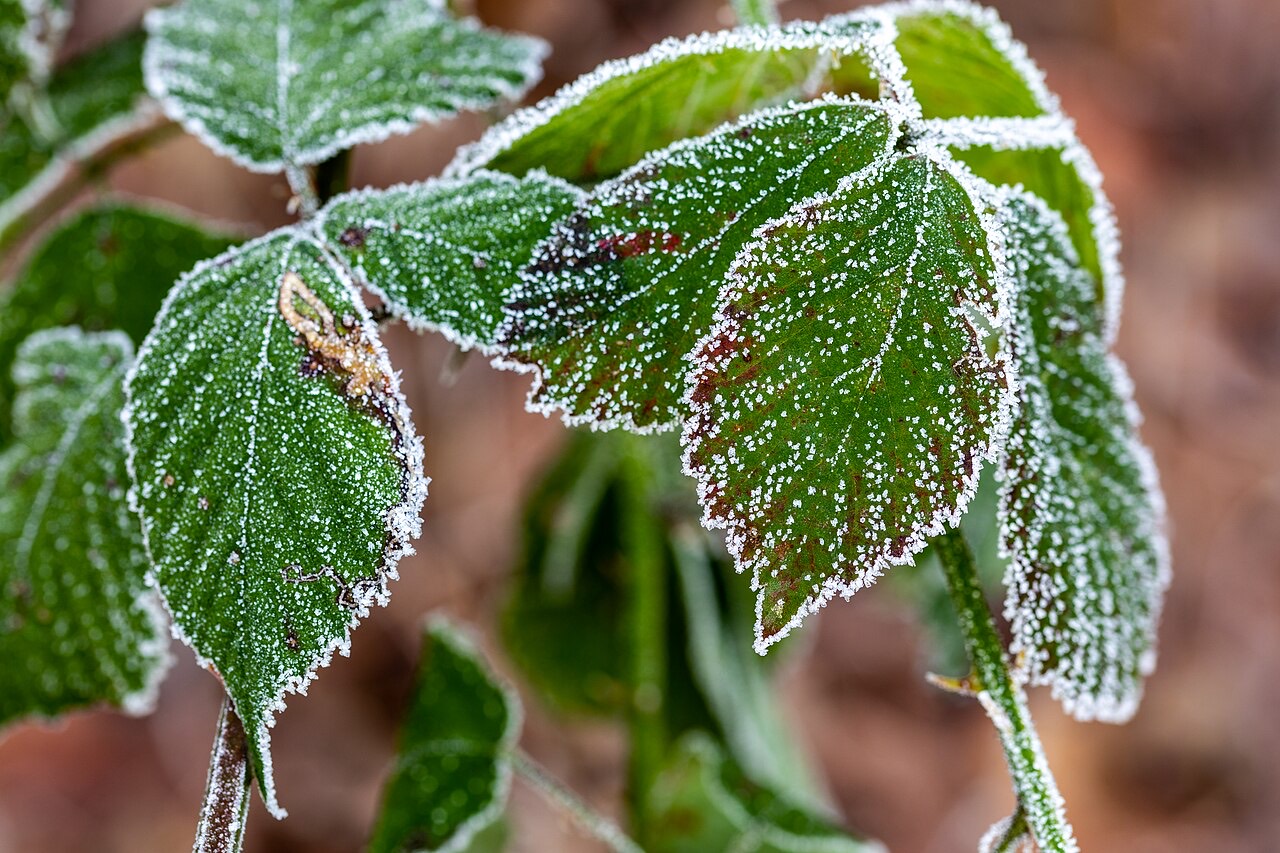
Frost forms when temperatures at or near the plant surface drop to 0°C (32°F) or below, allowing ice to form on or within plant tissue. Two broad types are commonly distinguished: radiative frost, which develops on calm, clear nights as surfaces lose heat rapidly to the sky, and advective frost, which occurs when a mass of cold air moves into an area regardless of cloud cover or wind. These forms behave differently and call for different protective responses.
The agricultural significance of frost depends heavily on timing relative to a crop’s phenology. A frost after bud break or flowering in spring, or before harvest is complete in autumn, can damage or destroy tender tissue even in a species that tolerates cold well once dormant, while the same temperature reached during full dormancy may cause little or no harm.
What frost is
- Radiative frost — heat loss from plant and soil surfaces on clear, calm nights, often the more localised and manageable type.
- Advective frost — arrival of a cold air mass, which can affect large areas regardless of wind or cloud and is harder to counter with local protection methods.
Why it matters for crops
Ice formation within plant cells can rupture cell membranes, while ice forming between cells can draw water out of tissue, both causing damage that ranges from minor leaf browning to the loss of buds, flowers, or entire plants. Because reproductive tissues such as flowers and young fruit are often more cold-sensitive than dormant wood, a frost event during or after flowering can be far more damaging than a colder event earlier in dormancy.
Effects
Frost damage can reduce yield directly, by destroying flowers or developing fruit, or indirectly, by damaging leaves needed for photosynthesis. Perennial fruit crops such as grapevines and top fruit are particularly exposed to spring frost risk after bud break, while many warm-season annual crops and tropical or subtropical species can be damaged or killed by even light frost. The economic impact of a single frost event can be substantial in regions where a crop’s flowering period regularly coincides with the local frost risk window.
Managing and adapting
- Site selection that avoids low-lying "frost pockets" where cold air pools
- Timing of planting, pruning, or flowering (through cultivar choice) to reduce overlap with typical frost dates
- Active protection methods such as wind machines, orchard heaters, or sprinkler-based ice protection that uses the latent heat released as water freezes
- Protected cultivation, such as greenhouses or row covers, for high-value or particularly sensitive crops
Monitoring and forecasting
National meteorological services issue frost warnings and track long-term first- and last-frost date statistics, which growers use alongside local microclimate knowledge to plan planting dates, protection measures, and cultivar selection. Because frost risk is highly local, on-farm or near-farm temperature monitoring often supplements regional forecasts.
Relationships
Evidence-backed connections in the knowledge graph.
Affects
Managed with
Related topics
Scope & limitations
Geographic scope: Global overview; frost risk, timing, and typical first/last frost dates vary greatly by latitude, altitude, and local topography.
- This is a general overview of frost as a climate factor, not a regional frost forecast or crop-specific protection plan.
- No universal "safe" temperature thresholds are given beyond the physical freezing point, since crop and growth-stage sensitivity vary.
Sources
This article draws on the following authoritative sources. See our sources & methodology for how they are selected.
- [1]WMO — World Meteorological Organization (opens in a new tab)Authoritative
World Meteorological Organization (WMO)
Cited for: Frost classification and meteorological standards
- Type:
- Intergovernmental organization
- Jurisdiction:
- Global
- Accessed:
- 2026-07-12
- [2]NOAA — National Oceanic and Atmospheric Administration (opens in a new tab)Authoritative
U.S. National Oceanic and Atmospheric Administration (NOAA)
Cited for: Frost and freeze monitoring data
- Type:
- Government agency
- Jurisdiction:
- United States
- Accessed:
- 2026-07-12
- [3]FAO — Food and Agriculture Organization (opens in a new tab)Authoritative
Food and Agriculture Organization of the United Nations (FAO)
Cited for: Frost impacts on crop production
- Type:
- Intergovernmental organization
- Jurisdiction:
- Global
- Accessed:
- 2026-07-12
- [4]USDA NASS — National Agricultural Statistics Service (opens in a new tab)Authoritative
USDA National Agricultural Statistics Service (NASS)
Cited for: Frost date records and crop condition context
- Type:
- Government agency
- Jurisdiction:
- United States
- Accessed:
- 2026-07-12
Related topics
Crops
- Adzuki Bean
- Almond
- Apple
- Apricot
- Arabica Coffee
- Artichoke
- Asian Pear
- Asparagus
- Avocado
- Banana
- Basil
- Birdsfoot Trefoil
- Black Cumin
- Blackberry
- Blackcurrant
- Blueberry
- Brussels Sprouts
- Buckwheat
- Cabbage
- Camelina
- Cape Gooseberry
- Carrot
- Castor Bean
- Chayote
- Cherry
- Chestnut
- Chia
- Chickpea
- Citrus
- Common Bean
- Cranberry
- Cucumber
- Daikon
- Einkorn
- Emmer
- Faba Bean
- Fenugreek
- Garlic
- Grape
- Grapefruit
- Groundnut
- Hazelnut
- Jackfruit
- Jerusalem Artichoke
- Kale
- Kiwifruit
- Kohlrabi
- Lavender
- Lemon
- Lentil
- Lima Bean
- Lime
- Loquat
- Lowbush Blueberry
- Macadamia
- Mandarin
- Mango
- Mashua
- Mustard
- Oats
- Oca
- Oilseed rape
- Olive
- Onion
- Orange
- Parsley
- Passion Fruit
- Pea
- Peach
- Pear
- Pecan
- Perilla
- Persimmon
- Plum
- Pomelo
- Quince
- Quinoa
- Ramie
- Raspberry
- Red Clover
- Rosemary
- Rye
- Sage
- Sainfoin
- Sea Buckthorn
- Sour Cherry
- Spelt
- Spinach
- Stevia
- Strawberry
- Sugar beet
- Swede
- Sweet Pepper
- Switchgrass
- Thyme
- Timothy
- Triticale
- Turnip
- Ulluco
- Walnut
- Yerba Mate