Pest · Insect pest
Stink Bugs
Family Pentatomidae (order Hemiptera)
Also known as: Shield bugs
Stink bugs are shield-shaped, sap-feeding insects that release a distinctive odour when disturbed, damaging developing seeds and fruit in soybean, rice, and tomato through piercing-sucking feeding.
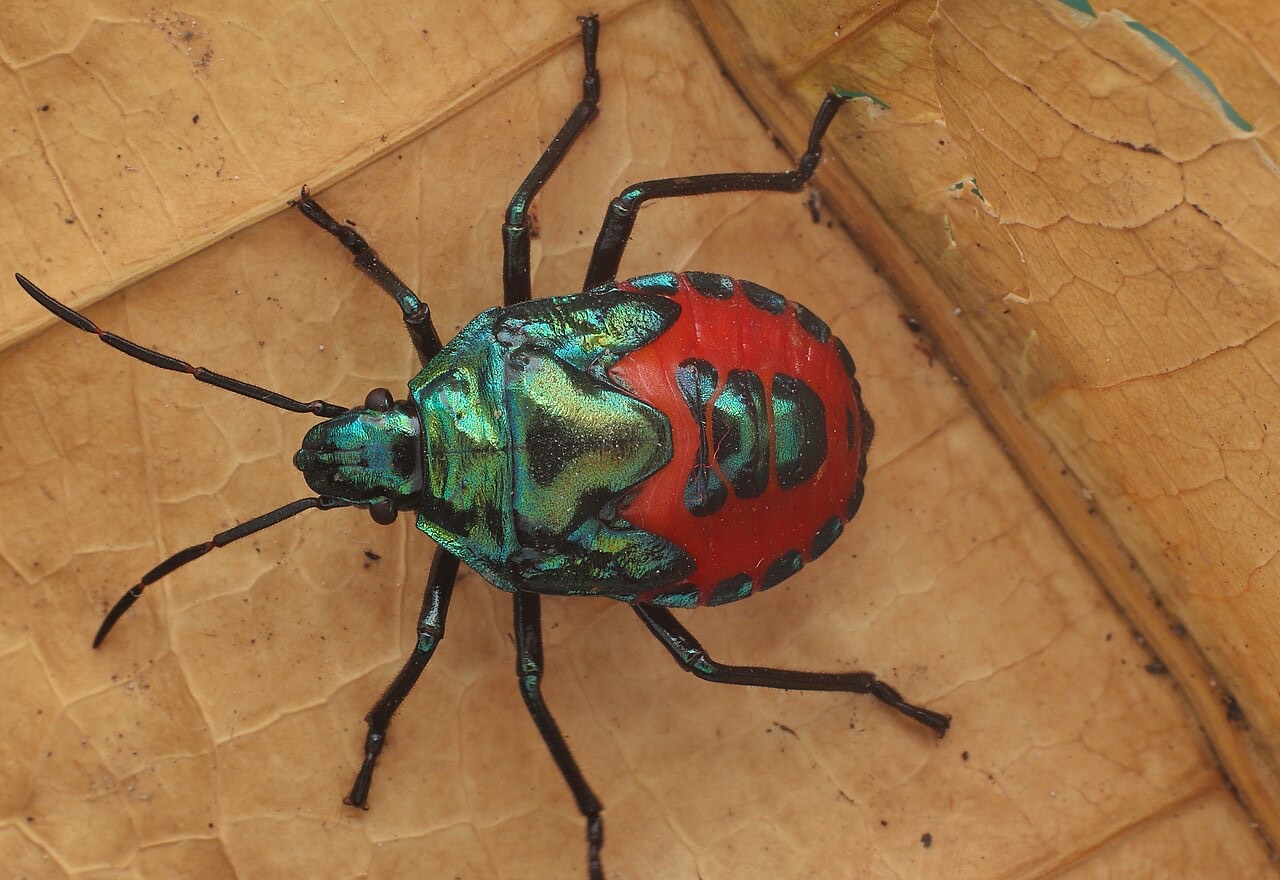
Stink bugs (family Pentatomidae) are shield-shaped insects named for the pungent defensive odour they release when disturbed or crushed. Both nymphs and adults use piercing-sucking mouthparts to feed on plant sap, with a strong preference for developing seeds, grain, and fruit.
Feeding punctures introduce saliva that can cause localised tissue collapse, discolouration, or malformed seeds, and in some crops also allows entry of secondary pathogens, so damage often affects quality as much as, or more than, overall yield.
Identification
Adult stink bugs have a broad, shield-shaped body, typically one to two centimetres long, in shades of green, brown, or grey depending on species. Nymphs resemble smaller, often more rounded and colourfully patterned versions of the adult, lacking fully developed wings.
Feeding leaves small, dark puncture marks on pods, grain, or fruit, and can cause shrivelled or discoloured seeds in grain and legume crops, or dimpled, distorted ("cat-faced") fruit in crops such as tomato.
Biology and life cycle
Females lay barrel-shaped eggs in clusters on leaves. Nymphs pass through several stages, feeding throughout, before becoming winged adults. Many species overwinter as adults in leaf litter, field margins, or woodland edges, moving into crops as host plants become suitable, often around flowering or pod- and grain-fill stages.
Damage and hosts
Feeding on developing seeds and grain can cause shrivelling, discolouration, and reduced germination, while feeding on fruit produces localised blemishes or malformation that reduce marketability even when overall yield loss is modest.
Host crops include soybean, rice, and tomato, along with many other legume, cereal, and fruiting vegetable crops.
Monitoring
Sweep-net sampling and visual counts of nymphs and adults, particularly around flowering and seed- or grain-fill stages, along with pheromone traps for some species, help track populations and inform decisions using local thresholds.
Management principles
Stink bug management focuses on monitoring around the vulnerable reproductive stages of the crop, combined with habitat and natural-enemy considerations.
- Scout fields around flowering and seed- or grain-fill, when damage risk is highest
- Conserve parasitoid wasps and flies and other natural enemies
- Manage weedy field margins that can host overwintering or migrating populations
- Use border or trap-crop strategies where locally validated
Relationships
Evidence-backed connections in the knowledge graph.
Risk increases under
Scope & limitations
Geographic scope: Found worldwide on legume, cereal, and fruiting vegetable crops; species present, host preference, and seasonal timing vary by region.
Climate context: Warm conditions generally support more generations per season, and populations often build as field margins and weedy hosts dry out, pushing insects into adjacent crops.
- This is a general overview of a large family of true bugs, not species-level guidance for a specific crop or region.
- Thresholds and control-product recommendations are jurisdiction-specific and are not provided here.
Sources
This article draws on the following authoritative sources. See our sources & methodology for how they are selected.
- [1]UC Statewide Integrated Pest Management Program (UC IPM) (opens in a new tab)High
University of California Agriculture and Natural Resources (UC ANR)
Cited for: Identification and IPM principles
- Type:
- University extension service
- Jurisdiction:
- United States (California)
- Accessed:
- 2026-07-12
- [2]CABI Digital Library — Crop Protection Compendium (opens in a new tab)High
CABI (Centre for Agriculture and Bioscience International)
Cited for: Biology, hosts, and distribution
- Type:
- Reference database
- Jurisdiction:
- Global
- Accessed:
- 2026-07-12
- [3]University of Minnesota Extension — Crop and pest resources (opens in a new tab)High
University of Minnesota Extension
Cited for: Monitoring and management context
- Type:
- University extension service
- Jurisdiction:
- United States (Minnesota)
- Accessed:
- 2026-07-12
- [4]Penn State Extension — Plant disease and pest resources (opens in a new tab)High
Penn State Extension, The Pennsylvania State University
Cited for: Field scouting guidance
- Type:
- University extension service
- Jurisdiction:
- United States (Pennsylvania)
- Accessed:
- 2026-07-12