Pest · Insect pest
Cotton Bollworm
Helicoverpa armigera (order Lepidoptera, family Noctuidae)
Also known as: American bollworm, Old World bollworm, Corn earworm (related species)
Cotton bollworm (Helicoverpa armigera) is a highly polyphagous caterpillar that bores into cotton bolls and the fruiting structures of many other crops, causing direct fruit and seed loss and posing a well-documented risk of insecticide resistance.
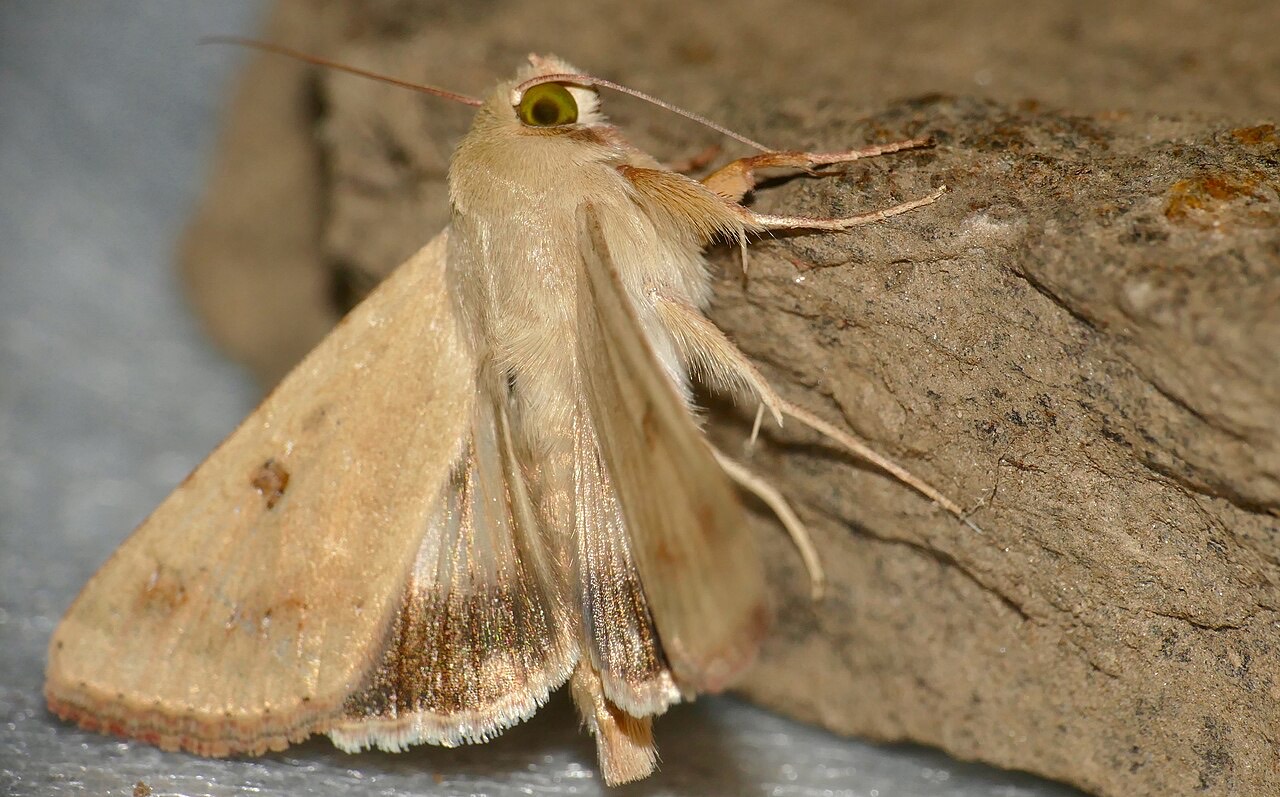
Cotton bollworm, Helicoverpa armigera, is one of the most economically significant caterpillar pests worldwide, attacking cotton bolls as well as the fruiting parts of many other crops. It is highly mobile and polyphagous, moving between crops and regions as host availability changes through the season.
The species is well known for developing resistance to multiple classes of insecticides in various regions, which has made resistance management and integrated, non-chemical tactics a central part of modern control strategies.
Identification
Larvae vary considerably in colour, from green or yellow-brown to pink, often with faint dark stripes along the body, and reach around four centimetres at maturity. A round entry hole with frass on the surface of a boll or fruit, and a larva feeding within, are the clearest field signs.
Adult moths are stout-bodied and pale brown with darker markings, and are night-flying, so scouting typically relies on eggs, larvae, and damage signs rather than adult sightings.
Biology and life cycle
Females lay eggs singly on leaves, flower buds, and fruiting structures. Young larvae feed briefly on foliage and flowers before moving into bolls or fruit, where later instars cause the most damage. Multiple overlapping generations typically occur within a season in warm climates.
The species can migrate over considerable distances as an adult, and can also enter a resting (diapause) stage in some regions to survive unfavourable seasons.
Damage and hosts
Larvae feeding on flower buds cause them to drop, while boring into bolls destroys developing lint and seed and creates entry points for secondary rots. Larvae typically move between several bolls or fruit during development, damaging more than they consume.
Host crops include cotton, tomato, maize, and sorghum, among many others, reflecting the species’ unusually broad host range.
Monitoring
Pheromone traps for adult moths, combined with regular field scouting for eggs and small larvae on squares, flowers, and young bolls, are the basis of monitoring programmes and help time any intervention before larvae bore into fruiting structures.
Management principles
Because Helicoverpa armigera has repeatedly developed resistance to insecticides, management emphasises diversified, integrated tactics rather than reliance on chemical control alone.
- Scout regularly and target the vulnerable egg and young-larval stages
- Conserve parasitoid wasps and flies, predatory bugs, and other natural enemies
- Use resistant or tolerant varieties and trap crops where available
- Rotate modes of action and follow local resistance-management guidance where insecticides are used
Regulatory status
Official listings recorded for this organism. Listing is a regulatory fact and is separate from where the organism actually occurs.
EPPO A2 Listversion 2025-09
Listed as: Helicoverpa armigera
EPPO region · recorded status: recommended for regulation · verified 2026-08-20
- EPPO A1 and A2 entries are recommendations to EPPO member countries, not statutory quarantine status in any particular country. Confirm the position with the national plant health authority.
- A2 pests are listed by EPPO as present but locally distributed in the EPPO region. Listing does not establish presence in any particular country.
EPPO A2 List of pests recommended for regulation as quarantine pestsEPPO Global Database
Regulatory status is jurisdiction-specific and changes. Confirm the current position with the responsible plant health authority before acting on it. All recorded listings
Relationships
Evidence-backed connections in the knowledge graph.
Risk increases under
Scope & limitations
Geographic scope: Widespread across Africa, Asia, Europe, and Oceania on cotton and many other crops; a closely related species (Helicoverpa zea) fills a similar niche in the Americas.
Climate context: Warm conditions shorten generation time and support more generations per season; the species can migrate long distances and, in some regions, oversummer or overwinter in a resting stage.
- This entry focuses on Helicoverpa armigera and does not cover every regional bollworm species affecting cotton in detail.
- Thresholds and control-product recommendations are jurisdiction-specific and are not provided here.
Sources
This article draws on the following authoritative sources. See our sources & methodology for how they are selected.
- [1]CABI Digital Library — Crop Protection Compendium (opens in a new tab)High
CABI (Centre for Agriculture and Bioscience International)
Cited for: Biology, hosts, and distribution
- Type:
- Reference database
- Jurisdiction:
- Global
- Accessed:
- 2026-07-12
- [2]EPPO Global Database (opens in a new tab)Authoritative
European and Mediterranean Plant Protection Organization (EPPO)
Cited for: Species nomenclature and distribution
- Type:
- Reference database
- Jurisdiction:
- Global
- Accessed:
- 2026-07-12
- [3]UC Statewide Integrated Pest Management Program (UC IPM) (opens in a new tab)High
University of California Agriculture and Natural Resources (UC ANR)
Cited for: Identification and IPM principles
- Type:
- University extension service
- Jurisdiction:
- United States (California)
- Accessed:
- 2026-07-12
- [4]USDA APHIS — Animal and Plant Health Inspection Service (opens in a new tab)Authoritative
USDA Animal and Plant Health Inspection Service (APHIS)
Cited for: Regulatory and distribution context
- Type:
- Government agency
- Jurisdiction:
- United States
- Accessed:
- 2026-07-12