Crop · Tree nut crop
Pistachio
Pistacia vera
Also known as: Pistachio nut tree
Pistachio is a deciduous, dioecious tree adapted to hot, arid, continental climates that nonetheless carries a genuine winter chilling requirement. Male and female trees are interplanted for wind pollination, and the crop is well known for pronounced alternate bearing.
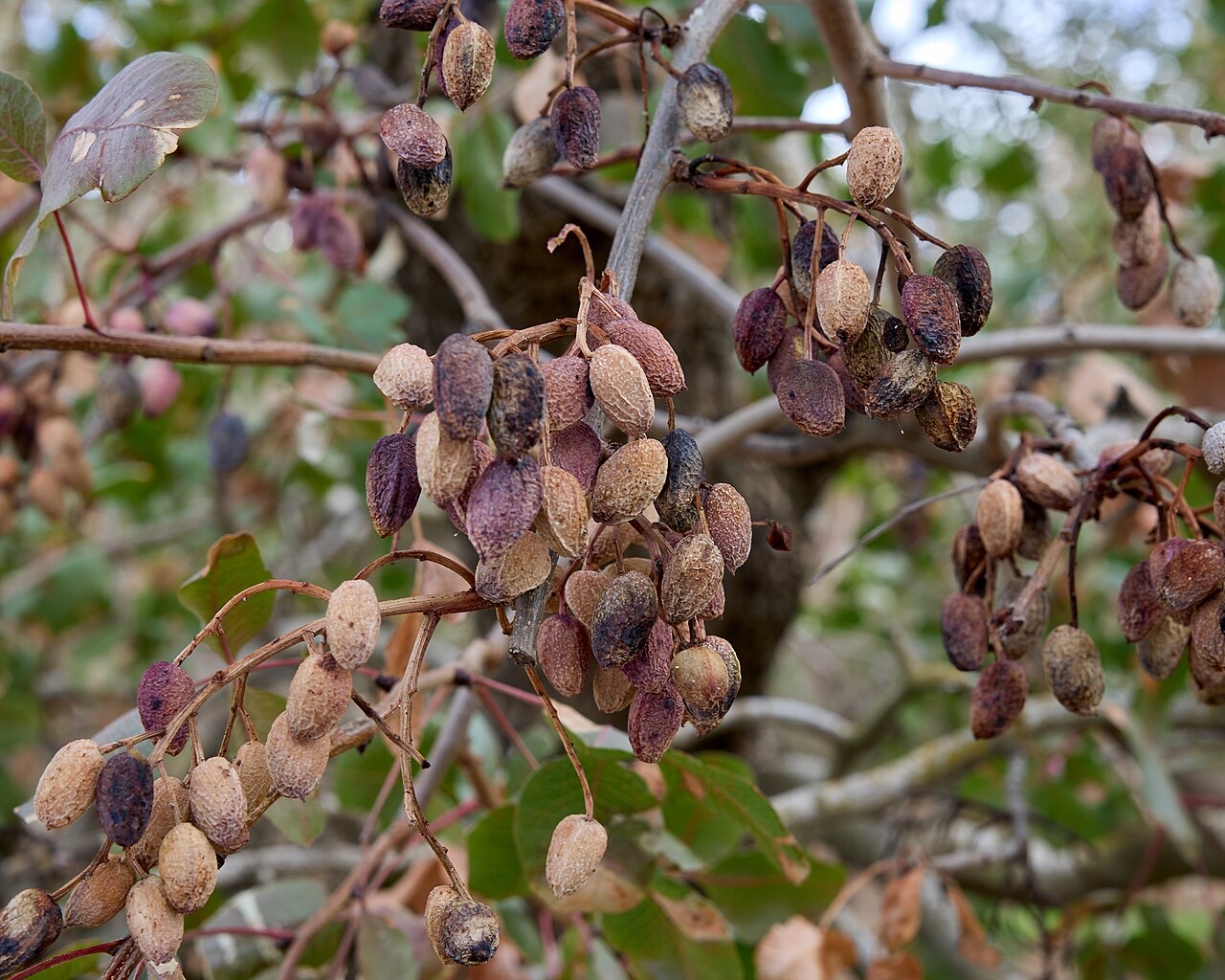
Pistachio is a deciduous tree adapted to arid and semi-arid continental climates, tolerating notable heat and drought once established while still requiring a period of winter chilling to flower and leaf out normally each spring. This combination of arid-zone adaptation and a genuine chilling need is one of the more distinctive features of the crop.
Pistachio is dioecious, meaning individual trees are either male or female, unlike most other tree nut crops in which a single tree bears both. Commercial orchards therefore interplant a proportion of male pollinizer trees among the female, nut-bearing trees, relying on wind rather than insects to carry pollen between them.
Overview
Pistachio is grown as a long-lived, deciduous perennial, established from grafted trees selected for nut quality and adaptation to arid, continental climates. Orchard-level decisions such as rootstock, the ratio and placement of male pollinizer trees, and training system are made at establishment and shape management for decades afterward.
Because the species combines arid-zone tolerance with a real winter chilling requirement, suitable growing regions are those with both a sufficiently cold winter and a hot, dry summer, a combination found in relatively few production areas worldwide.
Botanical classification
- Family
- Anacardiaceae (sumac/cashew family)
- Genus
- Pistacia
- Principal species
- Pistacia vera (cultivated pistachio)
- Sex expression
- Dioecious, with separate male and female trees; female trees bear the nut crop and are wind-pollinated by nearby male trees
- Growth habit
- Deciduous tree, commercially propagated by grafting a selected cultivar onto a chosen rootstock
Origin and distribution
Pistacia vera is native to a region spanning Central and Southwest Asia, where it has been cultivated for millennia in arid and semi-arid areas. Cultivation has since spread to other regions with a similarly hot, arid, continental climate.
Climate requirements
Pistachio is well adapted to hot, arid, continental climates and shows notable tolerance of drought and heat once trees are established. At the same time, the species has a genuine winter chilling requirement to break dormancy properly, an interesting combination in which the same crop needs both a cold winter and a hot, dry summer to perform well.
Regions lacking adequate winter chill can see uneven or delayed bud break and flowering, even though the crop is otherwise well suited to arid conditions, illustrating why chilling and heat/drought tolerance should be considered together when assessing site suitability.
Soil requirements
Pistachio performs best on deep, well-drained soils; sandy soils and loams are generally favored, and the species is notably tolerant of some soil salinity relative to many other tree crops. It has limited tolerance for waterlogging, which restricts rooting and increases the risk of root diseases.
Orchard establishment and management
A pistachio planting is a fifty-year commitment made on rootstock choice, because the species is grown on saline and alkaline ground that would kill most orchard crops and the rootstock is what survives it. Because the species is dioecious, orchard design must include a number of male pollinizer trees interplanted among the predominantly female planting, positioned to allow wind to carry pollen effectively to female flowers during bloom.
| Consideration | Why it matters |
|---|---|
| Male pollinizer trees | Pistachio is dioecious; female trees cannot set nuts without pollen from nearby male trees |
| Bloom-timing overlap | Male and female bloom periods must overlap for effective pollination |
| Wind pollination | Pollen transfer depends on wind rather than insects, so male-tree placement relative to prevailing winds is a design factor |
| Male-to-female tree ratio | Orchards allocate a portion of planting positions to male trees rather than nut-bearing females, a trade-off weighed at establishment |
- Rootstock selection for vigor, salinity tolerance, and site adaptation
- Male pollinizer placement and ratio planning for effective wind pollination
- Training and pruning system matched to planting density and mechanization
- Long-term canopy and orchard floor management across many productive years
Nutrient considerations
Nitrogen supports vegetative growth and nut development, while potassium contributes to nut fill and overall tree condition. Boron and zinc are micronutrients of particular relevance to pistachio, since deficiencies in either can affect flowering and fruit set.
Water and irrigation
Pistachio is grown predominantly under irrigation in most commercial production regions, reflecting the arid climates in which it is typically cultivated, with water demand rising through nut development. Drip irrigation is widely used to apply water efficiently to the root zone.
Irrigation scheduling aims to avoid water stress during sensitive growth stages, while the crop’s underlying drought tolerance can allow some flexibility in water-limited seasons compared with less drought-tolerant tree crops.
Common diseases and pests
Anthracnose can affect leaves, shoots, and developing nuts under humid conditions. Root rot, often linked to poorly drained or waterlogged sites, can weaken or kill trees over time. Among insect pests, stink bugs are a documented pistachio pest group associated with kernel staining and quality issues in some regions, while aphids and weevils can additionally affect foliage, shoots, or nuts.
Management combines resistant or tolerant rootstocks where available, orchard sanitation, monitoring, and — where justified — locally authorized control products applied according to their labels.
Harvest
Pistachio nuts are harvested once the shell naturally splits at maturity, a distinctive trait that serves as a key indicator of readiness and is commercially important for kernel quality. Pistachio also shows a well-documented tendency toward pronounced alternate bearing, with heavier and lighter crop years tending to alternate, which growers account for in long-term orchard planning.
Uses
- Raw and roasted kernels for direct consumption
- Confectionery and dessert ingredients
- Savory culinary uses, including as a garnish or ingredient in prepared foods
- Processed products such as pistachio paste used in confectionery
Botanical identity
Species- Accepted name
- Pistacia vera
- Family
- Anacardiaceae
- Genus
- Pistacia
- Harvested part
- seed
- Agricultural use
- human food
- Crop group
- Nuts
What the authorities say
- World Flora Online — Taxonomic Backbone
- Pistacia vera
- Plants of the World Online
- Pistacia vera
Botanical identity here is what the consulted taxonomic authorities publish, on the date they were read. Where authorities disagree, both readings are shown rather than one being chosen silently.
Traded as
This crop is traded as one commodity in this corpus.
What AgricultureID holds for this crop
- 2 soil references
- 3 climate references
- 189 market price series
Not held
- No crop calendar records — source exists not mapped
- No published cultivars — not researched
- No official variety registrations — source exists not mapped
- No verified extension resources — source exists not ingested
- No pests and diseases naming this crop as a host — source exists not ingested
- No farm economics observations — source exists not mapped
- No related crops — not applicable
An absence here means this corpus holds no such record, not that none exists.
How to read figures on this page
Production, area and trade figures for any crop change from season to season and are compiled by FAO and by national agricultural statistics agencies. Take current numbers from those primary sources, dated to the period you mean, rather than from a secondary summary — including this one.
Crop water requirements are estimated from reference evapotranspiration and local climate data, following methods published by FAO and national agricultural agencies. A requirement quoted without the reference method and the local climate behind it is not a number that can be applied to a field.
Tools for this
Each tool shows its formula, constants and sources, and starts empty — nothing is filled in from this page.
- Seed-rate calculator
Convert a target plant stand into a seed rate, allowing for germination and establishment.
- Row spacing calculator
Work out in-row spacing and plants per metre of row for a target density.
- Production, area and yield calculator
Relate a harvested area and a yield to a production total, in either direction.
- Growing degree-days calculator
Accumulate heat units against a base temperature.
Relationships
Evidence-backed connections in the knowledge graph.
Susceptible to
Suitable soils
Climate sensitivity
Irrigation methods
Machinery
Harvested commodities
The traded commodities harvested from this crop. A commodity is the harvested lot, described by its own quality, grading, and storage evidence — not by the agronomy of the plant.
Scope & limitations
Geographic scope: Global overview, focused on arid and semi-arid continental production zones. Male pollinizer ratios and chilling needs are region- and site-specific.
Climate context: Deciduous tree adapted to hot, arid, continental climates with notable drought and heat tolerance, but requiring a genuine winter chilling period.
- Male pollinizer ratio and placement, rootstock choice, and chilling-hour specifics are cultivar- and region-specific decisions not covered by universal values here.
- Production and cultivar-popularity statistics change over time and should be taken from primary datasets such as FAOSTAT.
Sources
This article draws on the following authoritative sources. See our sources & methodology for how they are selected.
- [1]FAO — Food and Agriculture Organization (opens in a new tab)Authoritative
Food and Agriculture Organization of the United Nations (FAO)
Cited for: Global pistachio production and trade context
- Type:
- Intergovernmental organization
- Jurisdiction:
- Global
- Accessed:
- 2026-07-12
- [2]FAOSTAT — FAO statistical database (opens in a new tab)Authoritative
Food and Agriculture Organization of the United Nations (FAO)
Cited for: Production and area statistics
- Type:
- Intergovernmental organization
- Jurisdiction:
- Global
- Accessed:
- 2026-07-12
- [3]CABI Digital Library — Crop Protection Compendium (opens in a new tab)High
CABI (Centre for Agriculture and Bioscience International)
Cited for: Pistachio pest and disease compendium data
- Type:
- Reference database
- Jurisdiction:
- Global
- Accessed:
- 2026-07-12
- [4]UC Statewide Integrated Pest Management Program (UC IPM) (opens in a new tab)High
University of California Agriculture and Natural Resources (UC ANR)
Cited for: Integrated pest management guidelines for pistachio
- Type:
- University extension service
- Jurisdiction:
- United States (California)
- Accessed:
- 2026-07-12
- Authoritative
Cited for: Classification and nomenclature
- Type:
- Reference database
- Jurisdiction:
- United States
- Accessed:
- 2026-07-12