Crop · Legume crop
Chickpea
Cicer arietinum
Also known as: Garbanzo bean, Bengal gram
Chickpea is an annual pulse legume grown for its protein-rich seed, cultivated in two principal market types across semi-arid regions worldwide, and valued in rotation for its nitrogen-fixing ability.
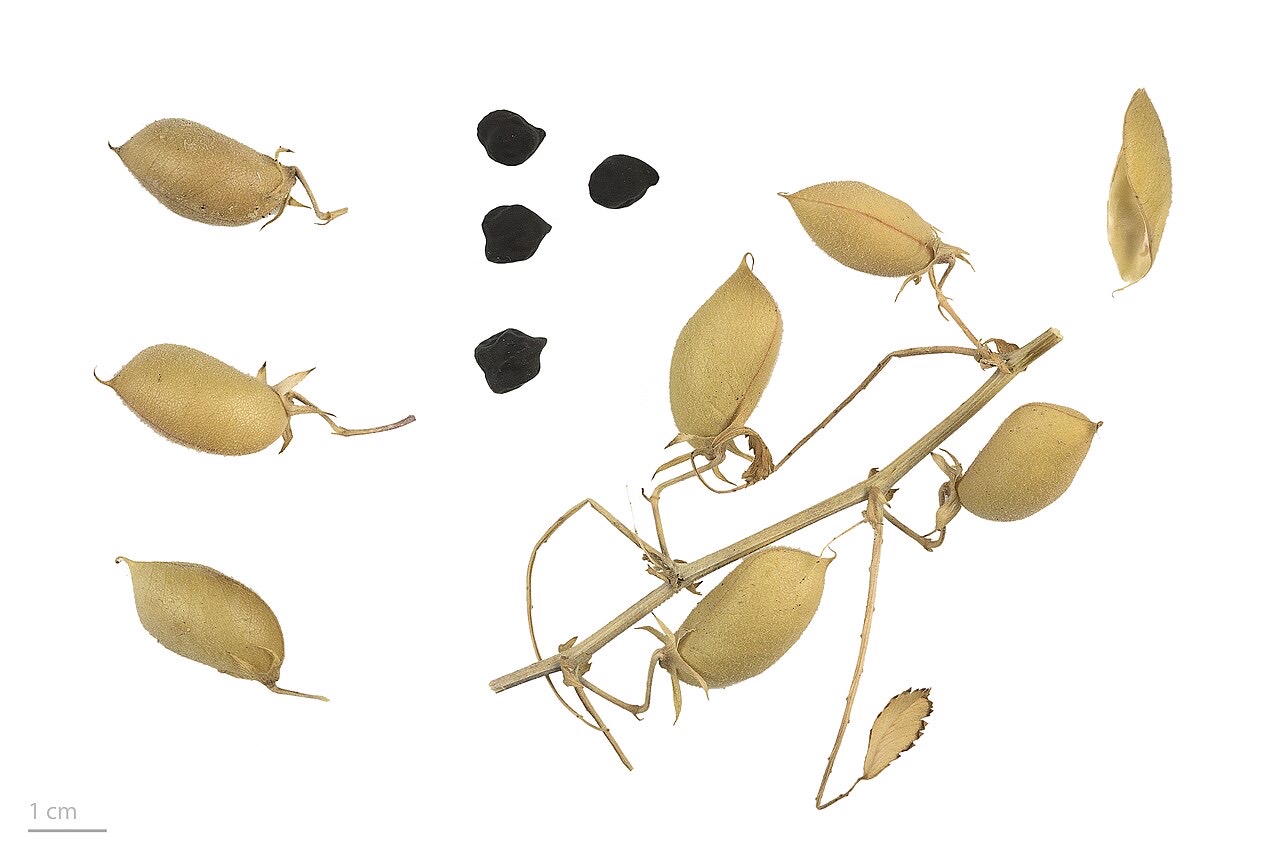
Chickpea is grown in two broad market types: desi, with smaller, angular, darker-coated seed and predominant in South Asian production and cuisine, and kabuli, with larger, lighter-coated, ram’s-head-shaped seed more common in Mediterranean, Middle Eastern, and North American production.
The foliage of chickpea is covered in fine glandular hairs that exude organic acids, a distinctive trait among grain legumes. As with other legumes, chickpea forms a symbiotic relationship with compatible rhizobia in root nodules, enabling biological nitrogen fixation.
Overview
Chickpea is grown mainly as a dry pulse crop, harvested at full maturity for its seed, and is a staple protein source in many diets, particularly across South Asia, the Middle East, and the Mediterranean.
Because desi and kabuli types differ in seed characteristics, market destination, and, to some extent, regional adaptation, cultivar market type is a central choice in production planning.
Botanical classification
- Family
- Fabaceae (legume family)
- Genus and species
- Cicer arietinum
- Root system
- Taproot bearing nodules that host nitrogen-fixing Mesorhizobium bacteria
| Type | Seed characteristics | Predominant use and region |
|---|---|---|
| Desi | Smaller, angular, darker seed coat | Widely grown and consumed across South Asia, often split (dal) or ground into flour |
| Kabuli | Larger, lighter-colored, ram’s-head-shaped seed | Common in Mediterranean, Middle Eastern, and North American production; often used whole or canned |
Origin and distribution
Chickpea was domesticated in the Fertile Crescent, in what is now southeastern Turkey, as one of the founder crops of Near Eastern agriculture, and spread in antiquity to South Asia and the Mediterranean, regions that remain major production centers.
Climate requirements
Chickpea is grown as a rainfed winter or spring crop depending on region, and it is comparatively drought-tolerant relative to many other pulses, though yield remains sensitive to terminal drought and heat during pod fill.
Frost can damage flowers and young pods in exposed sowings, so planting timing is set locally to balance the benefit of a longer growing season against frost risk at flowering.
Soil requirements
Chickpea performs best on well-drained loams of moderate fertility. It is sensitive to waterlogging, which restricts root and nodule development and is associated with increased pressure from soilborne disease, particularly Fusarium wilt.
Establishment and crop management
Chickpea is direct-seeded, and seed is often treated with a compatible Mesorhizobium inoculant in fields without a recent history of chickpea production. Rotation with cereals is a standard practice in semi-arid cropping systems to help manage soilborne disease.
- Market type selection (desi or kabuli) matched to intended market and regional adaptation
- Inoculation with compatible Mesorhizobium strains in fields new to chickpea production
- Crop rotation with cereals to manage soilborne diseases, particularly Fusarium wilt
- Planting timing balanced against local frost risk at flowering
Nutrient considerations
Biological nitrogen fixation can supply a significant share of the crop’s nitrogen requirement where nodulation is effective. Phosphorus availability is often a limiting factor, particularly on alkaline soils common in many chickpea-growing regions.
Water and irrigation
Chickpea roots deeply and is grown largely on stored soil moisture, which is why it occupies the drier end of the pulse rotation. Ascochyta blight is the constraint that most often decides the crop: it is seed-borne and splashed through the canopy by rain, so a wet season in a susceptible variety can take a crop that had adequate water and nutrition.
Common diseases and pests
Fusarium wilt is widely regarded as the single most damaging disease of chickpea, and gray mold (Botrytis) can cause significant losses under humid conditions, particularly in dense canopies. Aphids and root-knot nematodes are among the notable pests affecting the crop.
Management combines resistant cultivars, crop rotation, field monitoring, and, where warranted, locally authorized control measures applied according to their labels.
Harvest
Chickpea is cut when the plant has dried standing, and the desi and kabuli types diverge at this point: kabuli seed is large, thin-coated and bruises into a downgrade, so it is handled gently and often threshed at reduced cylinder speed. Shattering and lodging can cause losses, so harvest timing and method are matched to local conditions and equipment.
Uses
- Dry seed used whole, split, or ground into flour in a wide range of dishes
- Canned chickpeas and prepared foods such as hummus and falafel
- Roasted chickpeas as a snack food in some markets
- Crop residues used in some regions as animal feed
Botanical identity
Species- Accepted name
- Cicer arietinum
- Family
- Fabaceae
- Genus
- Cicer
- Harvested part
- seed
- Agricultural use
- human food
- Crop group
- Pulses and grain legumes
What the authorities say
- World Flora Online — Taxonomic Backbone
- Cicer arietinum
- Plants of the World Online
- Cicer arietinum
Botanical identity here is what the consulted taxonomic authorities publish, on the date they were read. Where authorities disagree, both readings are shown rather than one being chosen silently.
Traded as
This crop is traded as one commodity in this corpus.
What AgricultureID holds for this crop
- 77 crop calendar records
- 1 pests and diseases naming this crop as a host
- 2 soil references
- 3 climate references
- 247 market price series
Not held
- No published cultivars — not researched
- No official variety registrations — source exists not mapped
- No verified extension resources — source exists not ingested
- No farm economics observations — source exists not mapped
- No related crops — not applicable
An absence here means this corpus holds no such record, not that none exists.
How to read figures on this page
Production, area and trade figures for any crop change from season to season and are compiled by FAO and by national agricultural statistics agencies. Take current numbers from those primary sources, dated to the period you mean, rather than from a secondary summary — including this one.
Crop water requirements are estimated from reference evapotranspiration and local climate data, following methods published by FAO and national agricultural agencies. A requirement quoted without the reference method and the local climate behind it is not a number that can be applied to a field.
Part of
Planting and harvest calendar
Usual sowing and harvest windows across 77 jurisdictions, covering chick-pea and chick-pea — season 1 and chick-pea — season 2.
Tools for this
Each tool shows its formula, constants and sources, and starts empty — nothing is filled in from this page.
- Seed-rate calculator
Convert a target plant stand into a seed rate, allowing for germination and establishment.
- Row spacing calculator
Work out in-row spacing and plants per metre of row for a target density.
- Production, area and yield calculator
Relate a harvested area and a yield to a production total, in either direction.
- Growing degree-days calculator
Accumulate heat units against a base temperature.
Relationships
Evidence-backed connections in the knowledge graph.
Susceptible to
Nutrients required
Suitable soils
Climate sensitivity
Machinery
Harvested commodities
The traded commodities harvested from this crop. A commodity is the harvested lot, described by its own quality, grading, and storage evidence — not by the agronomy of the plant.
Scope & limitations
Geographic scope: Global overview. Market type (desi or kabuli), sowing timing, and input levels are region-specific.
Climate context: Cool-season, drought-tolerant pulse legume grown as a rainfed winter or spring crop across semi-arid and Mediterranean-type regions.
- Market type selection and sowing timing are region- and market-specific decisions not reduced to universal guidance here.
- Terminal drought and heat stress at pod fill are recurring, often unavoidable constraints in rain-fed production.
- Disease and pest control should follow locally authorized guidance and product labels.
Sources
This article draws on the following authoritative sources. See our sources & methodology for how they are selected.
- [1]FAO — Food and Agriculture Organization (opens in a new tab)Authoritative
Food and Agriculture Organization of the United Nations (FAO)
Cited for: Role of chickpea in global food systems
- Type:
- Intergovernmental organization
- Jurisdiction:
- Global
- Accessed:
- 2026-07-12
- [2]FAOSTAT — FAO statistical database (opens in a new tab)Authoritative
Food and Agriculture Organization of the United Nations (FAO)
Cited for: Production, area, and trade statistics
- Type:
- Intergovernmental organization
- Jurisdiction:
- Global
- Accessed:
- 2026-07-12
- Authoritative
Cited for: Classification and nomenclature
- Type:
- Reference database
- Jurisdiction:
- United States
- Accessed:
- 2026-07-12
Cited for: Pulse crop research in semi-arid systems
- Type:
- Research institute
- Jurisdiction:
- Global
- Accessed:
- 2026-07-12
- [5]UC Statewide Integrated Pest Management Program (UC IPM) (opens in a new tab)High
University of California Agriculture and Natural Resources (UC ANR)
Cited for: Integrated pest management for pulse crops
- Type:
- University extension service
- Jurisdiction:
- United States (California)
- Accessed:
- 2026-07-12