Crop · Beverage crop
Cocoa
Theobroma cacao
Also known as: Cacao
Cocoa is a tropical understory tree grown for the seeds inside its large pods, which are fermented, dried, and processed into cocoa and chocolate products, traditionally cultivated under a canopy of taller shade trees.
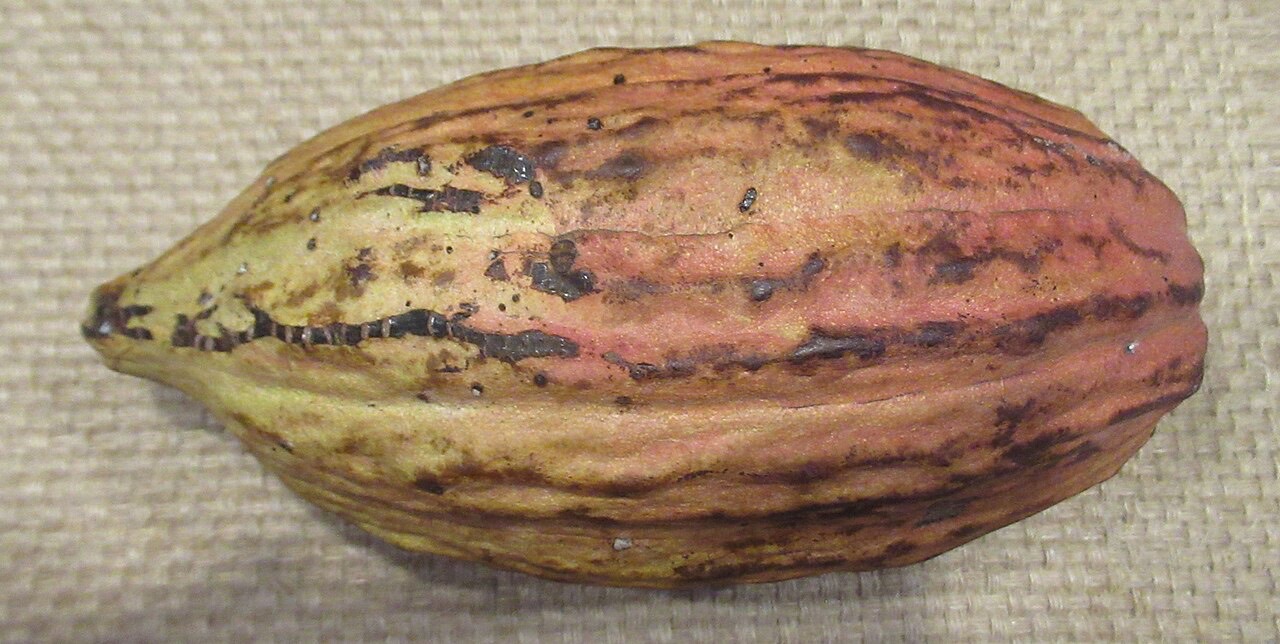
Cocoa is a small, shade-tolerant tree native to tropical forest understories, where it naturally grows beneath a taller canopy; this origin is reflected in traditional cultivation systems that grow cocoa alongside shade trees, often including other productive species.
Flowers and, subsequently, pods form directly on the trunk and older branches (cauliflory), an unusual growth pattern among cultivated tree crops. Each pod contains a number of seeds embedded in sweet pulp, which are removed, fermented, and dried before further processing.
Overview
Cocoa is grown predominantly by smallholder farmers across the humid tropics, with major production in West Africa, Southeast Asia, and Latin America, often as part of diversified farm systems that include other tree and food crops.
Traditional shade-grown systems mimic the tree’s native forest-understory habitat, while more intensive, higher-input systems with reduced shade have also been developed to increase yield, involving different management trade-offs.
Botanical classification
- Family
- Malvaceae (mallow family)
- Genus and species
- Theobroma cacao
- Genetic groups
- Criollo, Forastero, and Trinitario (a Criollo–Forastero hybrid group), differing in flavor, yield, and disease tolerance
- Growth habit
- Small evergreen understory tree bearing flowers and pods directly on the trunk and branches (cauliflory)
Origin and distribution
Cocoa is native to the understory of tropical rainforests in the Amazon basin of South America, where it was domesticated in pre-Columbian times before spreading through Central America and, later, to West Africa and Southeast Asia during the colonial and post-colonial periods.
West Africa, particularly Côte d’Ivoire and Ghana, now accounts for the large majority of global production, with significant cultivation also in Southeast Asia and Latin America.
Climate requirements
Cocoa requires consistently warm, humid conditions typical of equatorial lowland tropics, without a pronounced dry season, reflecting its origin as an understory species in ever-wet rainforest environments.
The crop has essentially no cold or frost tolerance, and prolonged dry periods can cause flower and young pod loss, reducing yield in the following months.
Soil requirements
Cocoa performs best on deep, fertile, well-drained soils with good moisture retention, including rich loams and, in some regions, volcanic soils, reflecting its high nutrient and water demand.
Plantation establishment and management
New plantings are established from seedlings or grafted planting material under an established or newly planted shade canopy, with shade level managed according to genetic group, local climate, and desired yield-versus-input balance.
- Genetic group and clone selection for yield, flavor, and disease tolerance
- Shade-tree establishment or retention appropriate to the local climate and farming system
- Pruning to manage tree architecture and light penetration for pod development
- Long-term integration with other food and tree crops in diversified smallholder systems
Nutrient considerations
Potassium is closely linked to pod development and bean quality, while nitrogen supports vegetative growth, particularly in young or less-shaded plantings with higher light exposure and growth rates.
Water and irrigation
Cocoa is grown predominantly under rain-fed conditions in consistently humid equatorial regions, with supplemental drip irrigation used in some plantations, particularly during establishment or in areas with a more pronounced dry season.
Because the crop is sensitive to both drought stress and waterlogging, site drainage is managed alongside water supply.
Common diseases and pests
Anthracnose can affect pods, leaves, and stems, particularly under wet conditions, while root rot can weaken or kill trees in poorly drained soils. Mealybugs feed on foliage and pods and can vector cocoa swollen shoot virus in affected regions, and the cocoa pod borer tunnels into developing pods, reducing bean recovery and quality.
Management combines resistant or tolerant genetic material where available, field sanitation, monitoring, and — where justified — locally authorized control products applied according to their labels.
Harvest
Ripe pods are cut from the trunk and branches by hand, then opened to remove the seeds and surrounding pulp, which are fermented over several days and subsequently dried before sale or further processing.
Uses
- Fermented, dried beans processed into cocoa liquor, cocoa butter, and cocoa powder
- Chocolate manufacturing for confectionery and food products
- Pod husks and other by-products used locally as mulch, animal feed, or in composting
- Shade trees in agroforestry cocoa systems providing additional food, timber, or fuelwood
Botanical identity
Species- Accepted name
- Theobroma cacao
- Family
- Malvaceae
- Genus
- Theobroma
- Harvested part
- seed
- Agricultural use
- beverage, human food
- Crop group
- Beverage crops
What the authorities say
- World Flora Online — Taxonomic Backbone
- Theobroma cacao
- Plants of the World Online
- Theobroma cacao
Botanical identity here is what the consulted taxonomic authorities publish, on the date they were read. Where authorities disagree, both readings are shown rather than one being chosen silently.
Traded as
This crop is traded as one commodity in this corpus.
What AgricultureID holds for this crop
- 3 crop calendar records
- 1 pests and diseases naming this crop as a host
- 2 soil references
- 1 climate references
- 185 market price series
Not held
- No published cultivars — not researched
- No official variety registrations — source exists not mapped
- No verified extension resources — source exists not ingested
- No farm economics observations — source exists not mapped
- No related crops — not applicable
An absence here means this corpus holds no such record, not that none exists.
How to read figures on this page
Production, area and trade figures for any crop change from season to season and are compiled by FAO and by national agricultural statistics agencies. Take current numbers from those primary sources, dated to the period you mean, rather than from a secondary summary — including this one.
Crop water requirements are estimated from reference evapotranspiration and local climate data, following methods published by FAO and national agricultural agencies. A requirement quoted without the reference method and the local climate behind it is not a number that can be applied to a field.
Planting and harvest calendar
Usual sowing and harvest windows across 3 jurisdictions, covering cocoa.
Tools for this
Each tool shows its formula, constants and sources, and starts empty — nothing is filled in from this page.
- Seed-rate calculator
Convert a target plant stand into a seed rate, allowing for germination and establishment.
- Row spacing calculator
Work out in-row spacing and plants per metre of row for a target density.
- Production, area and yield calculator
Relate a harvested area and a yield to a production total, in either direction.
- Growing degree-days calculator
Accumulate heat units against a base temperature.
Relationships
Evidence-backed connections in the knowledge graph.
Susceptible to
Suitable soils
Climate sensitivity
Irrigation methods
Farming systems
Related topics
Harvested commodities
The traded commodities harvested from this crop. A commodity is the harvested lot, described by its own quality, grading, and storage evidence — not by the agronomy of the plant.
Scope & limitations
Geographic scope: Global overview of equatorial tropical production, concentrated in West Africa, Southeast Asia, and Latin America.
Climate context: Warm, humid understory tree crop requiring consistent moisture without a pronounced dry season; no frost tolerance.
- Genetic group, shade level, and fermentation practice vary substantially by region and are not detailed here.
- Production and trade statistics change annually and should be taken from primary datasets such as FAOSTAT.
Sources
This article draws on the following authoritative sources. See our sources & methodology for how they are selected.
- [1]FAO — Food and Agriculture Organization (opens in a new tab)Authoritative
Food and Agriculture Organization of the United Nations (FAO)
Cited for: Global cocoa production and smallholder role
- Type:
- Intergovernmental organization
- Jurisdiction:
- Global
- Accessed:
- 2026-07-12
- [2]FAOSTAT — FAO statistical database (opens in a new tab)Authoritative
Food and Agriculture Organization of the United Nations (FAO)
Cited for: Production and area statistics
- Type:
- Intergovernmental organization
- Jurisdiction:
- Global
- Accessed:
- 2026-07-12
- [3]CABI Digital Library — Crop Protection Compendium (opens in a new tab)High
CABI (Centre for Agriculture and Bioscience International)
Cited for: Cocoa disease and pest compendium data
- Type:
- Reference database
- Jurisdiction:
- Global
- Accessed:
- 2026-07-12
- Authoritative
Cited for: Classification and nomenclature
- Type:
- Reference database
- Jurisdiction:
- United States
- Accessed:
- 2026-07-12
Cited for: Cocoa genetic resources and agronomy research
- Type:
- Research institute
- Jurisdiction:
- Global
- Accessed:
- 2026-07-12