Crop · Beverage crop
Tea
Camellia sinensis
Also known as: Tea plant
Tea is a perennial evergreen shrub maintained through regular pruning as a low, flat-topped "plucking table," grown mainly in highland and monsoon-influenced regions for its young leaves and buds.
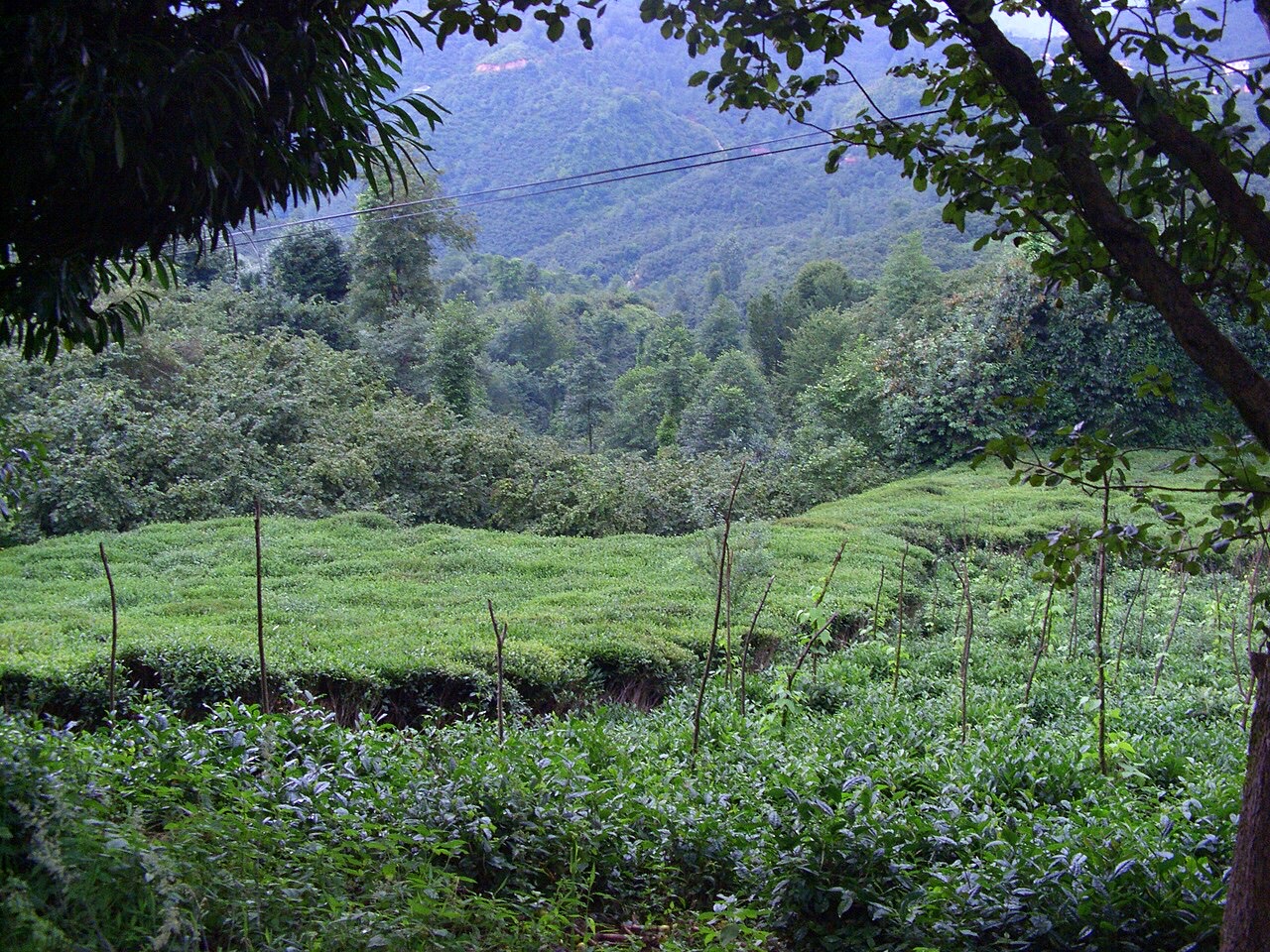
Tea is grown as a long-lived perennial shrub that, left unpruned, would grow into a small tree; commercial cultivation instead maintains plants through regular pruning at a low, flat-topped height known as the plucking table, from which young shoots are repeatedly harvested.
All traditional tea types — including black, green, oolong, and white tea — are produced from the same species, Camellia sinensis, with differences arising mainly from processing methods rather than from different source plants.
Overview
Tea is grown across highland and monsoon-influenced regions of Asia and, to a lesser extent, parts of Africa and Latin America, on both large estates and smallholder plots, with the crop typically remaining productive for many decades under regular management.
Because tea is harvested as young, actively growing shoots rather than a single seasonal crop, well-managed plantations can be plucked repeatedly across much of the year in favorable climates.
Botanical classification
- Family
- Theaceae (tea family)
- Genus and species
- Camellia sinensis
- Varietal groups
- var. sinensis (China type, smaller leaf, more cold-tolerant) and var. assamica (Assam type, larger leaf, more tropical)
- Growth habit
- Evergreen shrub maintained by pruning at a low picking height in commercial cultivation
Origin and distribution
Tea originates from the region spanning southwestern China and the eastern Himalayas, where wild and semi-wild populations of Camellia sinensis are found; cultivation and processing knowledge subsequently spread across Asia and, from the colonial era, to other tropical and subtropical highland regions.
Major production today is concentrated in China, India, Kenya, Sri Lanka, and other parts of Asia and East Africa.
Climate requirements
Tea requires warm temperatures, high humidity, and well-distributed rainfall, and is often grown at higher elevations within the tropics and subtropics, where cooler temperatures are associated with slower shoot growth and, in many regions, more delicate flavor characteristics.
Production in monsoon-influenced regions follows marked seasonal flushes of growth tied to the rains, with distinct harvest periods (flushes) recognized in some origins for their flavor characteristics.
Soil requirements
Tea requires deep, well-drained soils with strongly acidic pH, a distinctive requirement compared with most other perennial crops; volcanic soils and acidic highland loams are widely used in major producing regions.
Plantation establishment and management
New tea gardens are established from cuttings of selected clones or, less commonly today, from seed, with young plants trained through early pruning to develop the low, spreading frame needed for a productive plucking table.
- Clonal selection for yield, quality, and pest or disease tolerance
- Formative pruning to establish a low, spreading plucking table
- Ongoing maintenance pruning cycles to sustain young shoot production
- Shade-tree management in some traditional and agroforestry-style tea systems
Nutrient considerations
Nitrogen strongly influences shoot growth rate and yield, since the crop is harvested as young vegetative tissue rather than fruit or seed. Maintaining strongly acidic soil conditions is central to nutrient availability and long-term plantation health.
Water and irrigation
Tea is grown predominantly under rain-fed conditions in monsoon-influenced and consistently humid regions, with shoot growth closely tracking seasonal rainfall patterns.
Supplemental sprinkler irrigation is used in some drier tea-growing areas to maintain more consistent shoot flushing across the year.
Common diseases and pests
Leaf and stem diseases including anthracnose can affect foliage and young shoots under humid conditions, while root rot can weaken or kill plants in poorly drained soils. Spider mites and thrips are common pests of tea foliage, with feeding damage affecting both shoot growth and leaf quality.
Management combines resistant or tolerant clones where available, canopy and shade management, monitoring, and — where justified — locally authorized control products applied according to their labels.
Harvest
Tea is harvested by plucking young shoots, typically the terminal bud and the two youngest leaves, either by hand or with mechanical shears or harvesters, at intervals of one to two weeks depending on growth rate and desired quality.
Uses
- Processed leaf for black, green, oolong, and white tea beverages
- Instant and ready-to-drink tea products
- Extracts used in some food, beverage, and personal-care formulations
- Pruning residues and processing waste used in composting or mulch
Botanical identity
Species- Accepted name
- Camellia sinensis
- Family
- Theaceae
- Genus
- Camellia
- Harvested part
- leaf
- Agricultural use
- beverage
- Crop group
- Beverage crops
What the authorities say
- World Flora Online — Taxonomic Backbone
- Camellia sinensis
- Plants of the World Online
- Camellia sinensis
Botanical identity here is what the consulted taxonomic authorities publish, on the date they were read. Where authorities disagree, both readings are shown rather than one being chosen silently.
Traded as
This crop is traded as one commodity in this corpus.
What AgricultureID holds for this crop
- 1 pests and diseases naming this crop as a host
- 2 soil references
- 2 climate references
- 233 market price series
Not held
- No crop calendar records — source exists not mapped
- No published cultivars — not researched
- No official variety registrations — source exists not mapped
- No verified extension resources — source exists not ingested
- No farm economics observations — source exists not mapped
- No related crops — not applicable
An absence here means this corpus holds no such record, not that none exists.
How to read figures on this page
Production, area and trade figures for any crop change from season to season and are compiled by FAO and by national agricultural statistics agencies. Take current numbers from those primary sources, dated to the period you mean, rather than from a secondary summary — including this one.
Crop water requirements are estimated from reference evapotranspiration and local climate data, following methods published by FAO and national agricultural agencies. A requirement quoted without the reference method and the local climate behind it is not a number that can be applied to a field.
Tools for this
Each tool shows its formula, constants and sources, and starts empty — nothing is filled in from this page.
- Seed-rate calculator
Convert a target plant stand into a seed rate, allowing for germination and establishment.
- Row spacing calculator
Work out in-row spacing and plants per metre of row for a target density.
- Production, area and yield calculator
Relate a harvested area and a yield to a production total, in either direction.
- Growing degree-days calculator
Accumulate heat units against a base temperature.
Relationships
Evidence-backed connections in the knowledge graph.
Susceptible to
Nutrients required
Suitable soils
Irrigation methods
Farming systems
Related topics
Harvested commodities
The traded commodities harvested from this crop. A commodity is the harvested lot, described by its own quality, grading, and storage evidence — not by the agronomy of the plant.
Scope & limitations
Geographic scope: Global overview of production concentrated in Asian and East African highland and monsoon-influenced regions.
Climate context: Warm, humid perennial shrub requiring strongly acidic soils; growth follows monsoon-driven seasonal flushes in many origins.
- Clonal selection, pruning cycle, and flush timing are highly region- and estate-specific and are not detailed here.
- Production and trade statistics change annually and should be taken from primary datasets such as FAOSTAT.
Sources
This article draws on the following authoritative sources. See our sources & methodology for how they are selected.
- [1]FAO — Food and Agriculture Organization (opens in a new tab)Authoritative
Food and Agriculture Organization of the United Nations (FAO)
Cited for: Global tea production and trade context
- Type:
- Intergovernmental organization
- Jurisdiction:
- Global
- Accessed:
- 2026-07-12
- [2]FAOSTAT — FAO statistical database (opens in a new tab)Authoritative
Food and Agriculture Organization of the United Nations (FAO)
Cited for: Production and area statistics
- Type:
- Intergovernmental organization
- Jurisdiction:
- Global
- Accessed:
- 2026-07-12
- [3]CABI Digital Library — Crop Protection Compendium (opens in a new tab)High
CABI (Centre for Agriculture and Bioscience International)
Cited for: Tea disease and pest compendium data
- Type:
- Reference database
- Jurisdiction:
- Global
- Accessed:
- 2026-07-12
- Authoritative
Cited for: Classification and nomenclature
- Type:
- Reference database
- Jurisdiction:
- United States
- Accessed:
- 2026-07-12