Crop · Tropical fruit crop
Pineapple
Ananas comosus
Also known as: Pina
Pineapple is a tropical, herbaceous perennial bromeliad grown for its compound fruit. Plantings are established from vegetative propagating material rather than seed and are commonly cropped over a plant cycle plus one or more ratoon cycles.
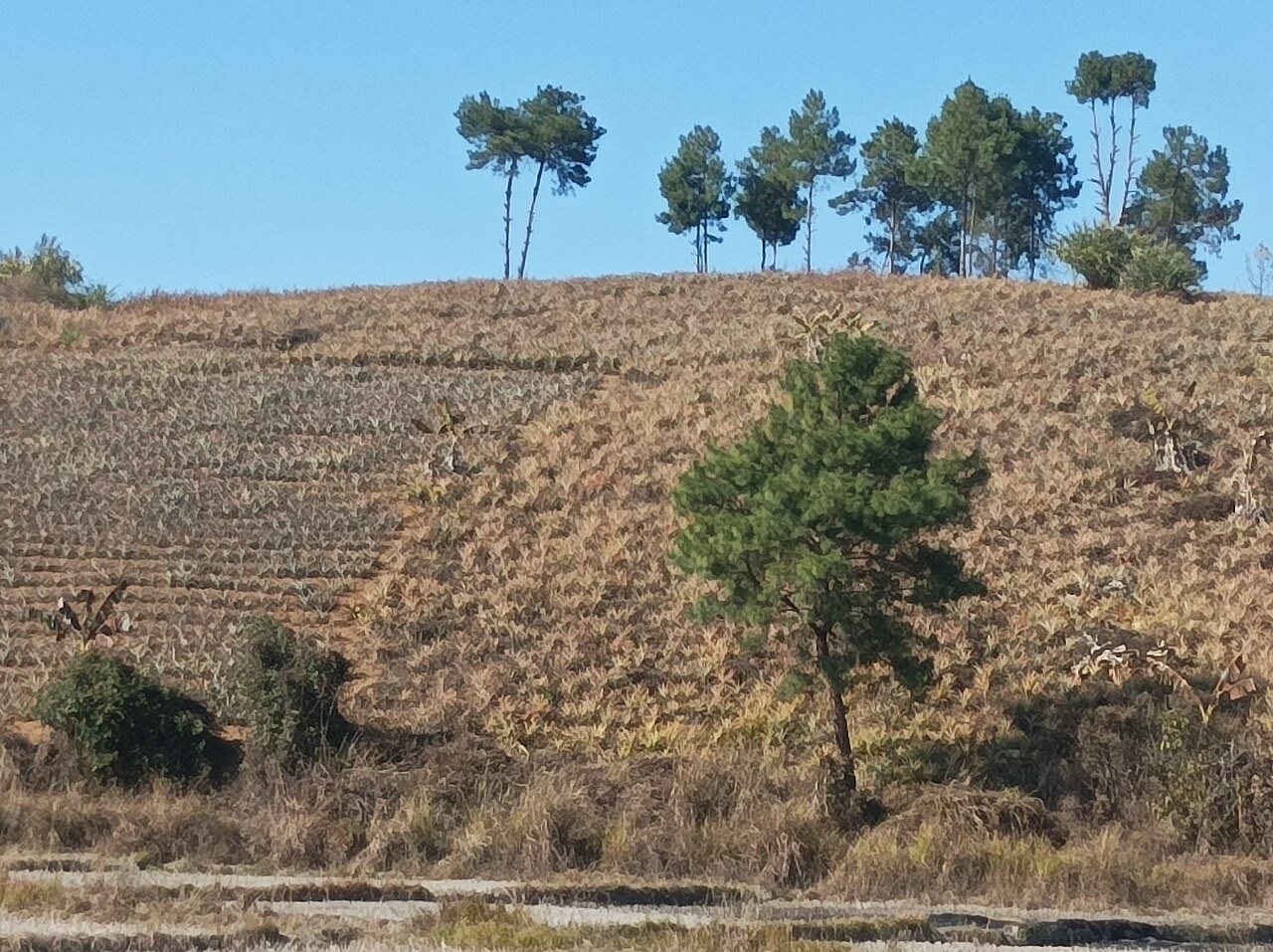
Pineapple is a tropical fruit crop belonging to the bromeliad family, distinguishing it botanically from most other commercially important fruit crops, which belong to different plant families entirely. The plant grows as a low, rosette-forming perennial herb rather than a tree or vine, and its familiar fruit is a compound structure formed from many individually pollinated flowers fusing together around a central core.
Commercial pineapple is propagated vegetatively, using crowns (the leafy top of the fruit), slips (shoots from the fruit stalk), or suckers (shoots from the base of the plant), rather than from seed. A single planting is typically carried through an initial "plant crop" and one or more subsequent "ratoon crops" grown from the same root system before the field is replanted.
Overview
Pineapple is grown as a long-lived herbaceous perennial, with individual plants remaining productive across a plant crop and one or more ratoon crops before a field is replanted with fresh propagating material. Its rosette growth habit, characteristic of the bromeliad family, stores water and nutrients in thick, strap-like leaves.
Because propagation is entirely vegetative, planting material quality and type strongly influence field uniformity and the timing of subsequent harvests. Commercial production ranges from smallholder plots to large plantation systems using uniform planting material and, in many operations, chemically induced flowering.
Botanical classification
- Family
- Bromeliaceae (bromeliad family)
- Genus
- Ananas
- Principal species
- Ananas comosus (cultivated pineapple)
- Growth habit
- Herbaceous perennial forming a low rosette of stiff, strap-shaped leaves around a central stem, characteristic of the bromeliad family; the fruit is a compound (multiple) fruit formed from fused individual flowers
Origin and distribution
Pineapple originated in South America, where wild and semi-domesticated Ananas relatives are found, and was carried by indigenous peoples throughout the tropics of the Americas well before European contact. It subsequently spread through global trade to become a major tropical fruit crop grown across suitable regions of Asia, Africa, and Latin America.
Climate requirements
Pineapple is adapted to tropical and warm subtropical climates and is intolerant of frost, which can severely damage or kill plants. It tolerates a range of rainfall conditions but performs best with consistent moisture and warmth throughout its growth cycle.
Because pineapple grows over a long, multi-year cycle spanning a plant crop and ratoon crops, cumulative climate conditions across that period, rather than a single season, shape overall field performance.
Soil requirements
Pineapple is grown across a range of soils but performs best on deep, well-drained, aerated soils such as sandy loams and lateritic soils, both widely used in major production regions. The crop is notably intolerant of waterlogging, which quickly leads to root decline.
Establishment and propagation
Pineapple fields are established using vegetative propagating material rather than seed, since seed-grown plants are variable and slow to reach a productive size. Growers select among crowns, slips, and suckers depending on availability, uniformity needs, and time to first harvest.
- Selection of propagating material — crowns, slips, or suckers — based on availability and desired uniformity
- Field spacing and planting density set according to cultivar and the propagating material used
- Management of the plant crop (the first harvest from newly planted material) followed by one or more ratoon crops from the same base plants
- Use of ethylene-generating treatments, natural or applied, to induce more uniform and synchronized flowering across a field
| Material | Source on the plant | General characteristics |
|---|---|---|
| Crown | Leafy top of the harvested fruit | Widely available at harvest; generally takes longer to reach first flowering than slips or suckers |
| Slip | Shoot arising from the fruit stalk (peduncle) | Intermediate size and time to flowering between crowns and suckers |
| Sucker | Shoot arising from the base of the mother plant | Often larger at planting; can reach first flowering more quickly than crowns |
Nutrient considerations
Nitrogen and potassium are both important to pineapple growth and fruit development, with potassium closely linked to fruit quality. Boron is a micronutrient of particular relevance to pineapple, since deficiency can affect fruit and plant development.
Water and irrigation
Pineapple is grown both under rain-fed conditions in humid tropical areas and with supplemental irrigation in drier regions. Drip irrigation is used in many commercial operations to deliver water efficiently to the root zone while limiting the risk of waterlogging.
Because the crop spans a long multi-year cycle, water management needs to account for the differing demands of establishment, vegetative growth, flower induction, and fruit development phases.
Common diseases and pests
Root rot, associated with poorly drained or waterlogged soils, is a serious concern for pineapple given the crop’s strong intolerance of excess soil moisture. Fusariosis, caused by Fusarium guttiforme, is a major disease of pineapple in the Americas, affecting fruit and stems and capable of significant crop loss where susceptible cultivars are grown.
Mealybugs are a particularly important pest group in pineapple because certain species are associated with a wilt disease complex: mealybug feeding, combined with an associated virus, can cause a decline known as mealybug wilt, making mealybug management a disease-prevention measure as well as direct pest control. Scale insects are also common pests, affecting plant vigor and fruit appearance.
Management combines clean, disease-free propagating material, field sanitation, drainage management, monitoring, and — where justified — locally authorized control products applied according to their labels.
Harvest
Pineapple fruit is harvested by hand once it reaches a suitable maturity, assessed through indicators such as skin color change and fruit firmness, since the crop’s long, variable growth cycle makes a universal days-to-harvest figure unreliable across cultivars and regions. Fruit intended for fresh markets is often picked at a different maturity stage than fruit destined for processing.
Uses
- Fresh-market whole and cut fruit
- Canned pineapple and pineapple juice
- Dried and other processed pineapple products
- Fiber and by-products from leaves and processing waste in some production systems
Botanical identity
Species- Accepted name
- Ananas comosus
- Family
- Bromeliaceae
- Genus
- Ananas
- Harvested part
- fruit
- Agricultural use
- human food
- Crop group
- Fruit
What the authorities say
- World Flora Online — Taxonomic Backbone
- Ananas comosus
- Plants of the World Online
- Ananas comosus
Botanical identity here is what the consulted taxonomic authorities publish, on the date they were read. Where authorities disagree, both readings are shown rather than one being chosen silently.
Traded as
This crop is traded as one commodity in this corpus.
What AgricultureID holds for this crop
- 21 crop calendar records
- 3 soil references
- 2 climate references
- 253 market price series
Not held
- No published cultivars — not researched
- No official variety registrations — source exists not mapped
- No verified extension resources — source exists not ingested
- No pests and diseases naming this crop as a host — source exists not ingested
- No farm economics observations — source exists not mapped
- No related crops — not applicable
An absence here means this corpus holds no such record, not that none exists.
How to read figures on this page
Production, area and trade figures for any crop change from season to season and are compiled by FAO and by national agricultural statistics agencies. Take current numbers from those primary sources, dated to the period you mean, rather than from a secondary summary — including this one.
Crop water requirements are estimated from reference evapotranspiration and local climate data, following methods published by FAO and national agricultural agencies. A requirement quoted without the reference method and the local climate behind it is not a number that can be applied to a field.
Part of
Planting and harvest calendar
Usual sowing and harvest windows across 21 jurisdictions, covering pineapple and pineapple — season 1 and pineapple — season 2.
Authorised inputs (France)
The French register records 10 currently authorised products whose authorised use names this crop, held by 9 authorisation holders. This is a count of what exists on the register, not a recommendation and not a shortlist.
By function
- Fongicide 7
- Insecticide 2
- Herbicide 1
Targets named on the register
- Phytophthora 5
- Champignons (pythiacées) 3
- Cochenilles 2
- Acariens 1
Use scope is recorded as the register writes it. Collective terms cover several crops at once and are left unmapped rather than expanded, because expanding one entry into several would invent authorisations that were never granted.
Authorisation is specific to one jurisdiction, one legal object and one moment. It is not a recommendation, and it says nothing about how a product may be used: always read the current official label at the source before acting.
Tools for this
Each tool shows its formula, constants and sources, and starts empty — nothing is filled in from this page.
- Seed-rate calculator
Convert a target plant stand into a seed rate, allowing for germination and establishment.
- Row spacing calculator
Work out in-row spacing and plants per metre of row for a target density.
- Production, area and yield calculator
Relate a harvested area and a yield to a production total, in either direction.
- Growing degree-days calculator
Accumulate heat units against a base temperature.
Relationships
Evidence-backed connections in the knowledge graph.
Susceptible to
Suitable soils
Climate sensitivity
Irrigation methods
Machinery
Managed with
Harvested commodities
The traded commodities harvested from this crop. A commodity is the harvested lot, described by its own quality, grading, and storage evidence — not by the agronomy of the plant.
Scope & limitations
Geographic scope: Global overview. Propagating-material choice, spacing, flower-induction timing, and input rates are region-specific.
Climate context: Tropical and warm-subtropical perennial crop; intolerant of frost and sensitive to waterlogging.
- Propagating-material selection, spacing, and flower-induction timing are examples of region-specific decisions not covered by universal values here.
- Production and yield statistics change over time and should be taken from primary datasets such as FAOSTAT.
- Disease and pest pressure, including fusariosis and mealybug wilt, varies by region and should be assessed against local monitoring and extension guidance.
Sources
This article draws on the following authoritative sources. See our sources & methodology for how they are selected.
- [1]FAO — Food and Agriculture Organization (opens in a new tab)Authoritative
Food and Agriculture Organization of the United Nations (FAO)
Cited for: Global pineapple production and agronomy context
- Type:
- Intergovernmental organization
- Jurisdiction:
- Global
- Accessed:
- 2026-07-12
- [2]FAOSTAT — FAO statistical database (opens in a new tab)Authoritative
Food and Agriculture Organization of the United Nations (FAO)
Cited for: Production and area statistics
- Type:
- Intergovernmental organization
- Jurisdiction:
- Global
- Accessed:
- 2026-07-12
- [3]CABI Digital Library — Crop Protection Compendium (opens in a new tab)High
CABI (Centre for Agriculture and Bioscience International)
Cited for: Pineapple pest and disease compendium data
- Type:
- Reference database
- Jurisdiction:
- Global
- Accessed:
- 2026-07-12
- [4]UC Statewide Integrated Pest Management Program (UC IPM) (opens in a new tab)High
University of California Agriculture and Natural Resources (UC ANR)
Cited for: Integrated pest management guidance relevant to pineapple pests
- Type:
- University extension service
- Jurisdiction:
- United States (California)
- Accessed:
- 2026-07-12
- Authoritative
Cited for: Classification and nomenclature
- Type:
- Reference database
- Jurisdiction:
- United States
- Accessed:
- 2026-07-12