Crop · Tree crop
Coconut
Cocos nucifera
Also known as: Coconut palm
Coconut is a tall tropical palm grown across coastal and lowland tropical regions for its versatile fruit, yielding oil, food, fiber, and shell products from a single long-lived tree.
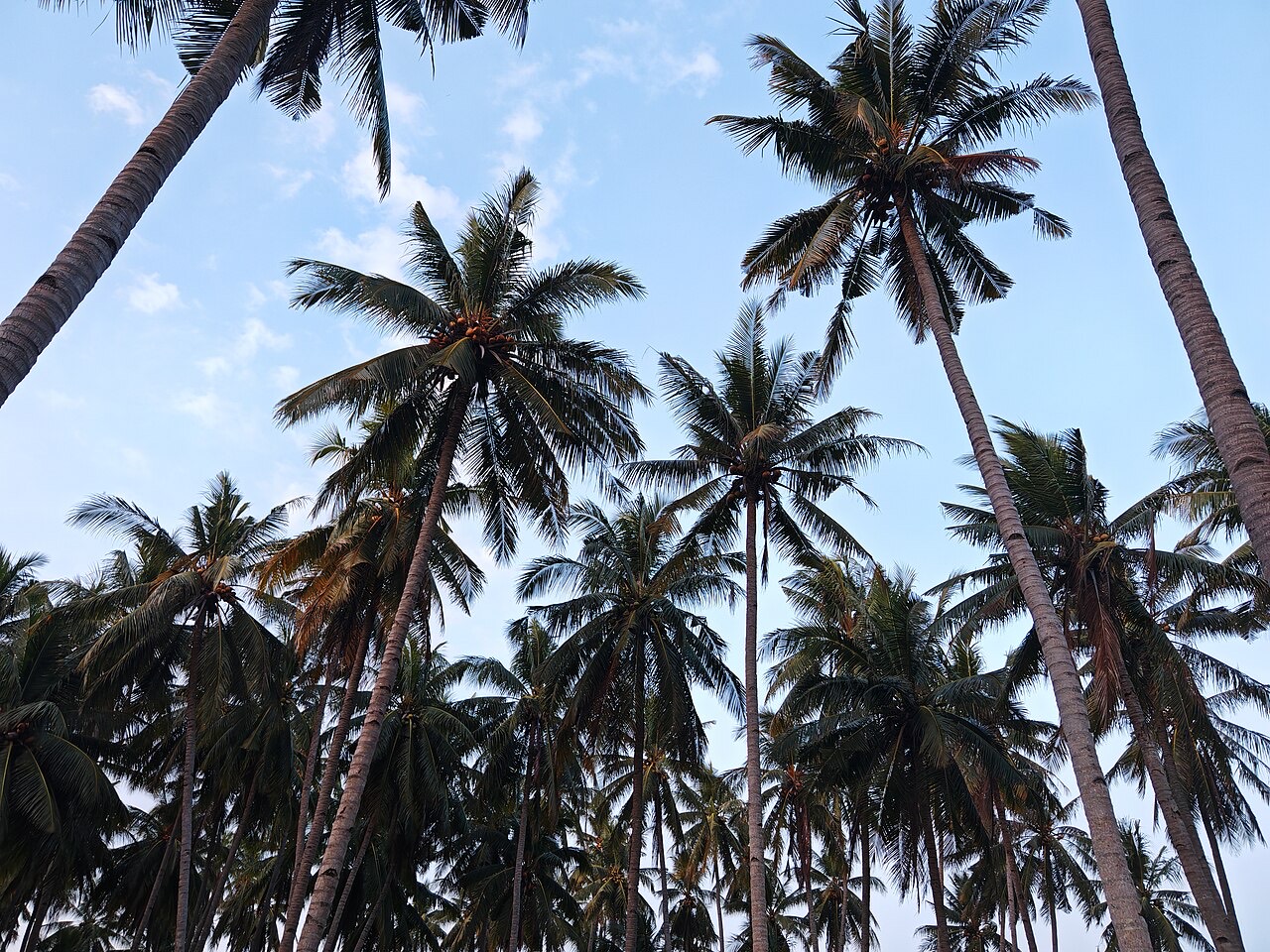
Coconut palm is a single-stemmed perennial tree that can remain productive for many decades, producing fruit (the coconut) year-round once mature. Its wide distribution across tropical coastlines and islands reflects both natural seed dispersal by floating fruit and long-standing cultivation.
Nearly every part of the coconut fruit and tree has a traditional or commercial use, from the oil-rich kernel (copra) to the fibrous husk (coir) and the hard shell, which supports diverse smallholder and industrial value chains.
Overview
Coconut is grown throughout the humid tropics, especially in coastal lowlands and on islands, by a mix of smallholder farmers, who account for the majority of global production, and larger commercial plantations.
Because the palm takes several years to reach bearing age and then remains productive for decades, coconut is a long-term perennial investment, and stand renewal and replanting programs are important where old, low-yielding palms dominate a growing area.
Botanical classification
- Family
- Arecaceae (palm family)
- Genus and species
- Cocos nucifera
- Varietal groups
- Tall (typically cross-pollinated, longer-lived) and dwarf (typically self-pollinated, earlier bearing) types, and hybrids between them
- Growth habit
- Single-stemmed perennial palm producing a continuous succession of fruit bunches from the crown
Origin and distribution
The precise origin of coconut is debated, with evidence pointing to the Indo-Pacific region; the fruit’s buoyancy and salt tolerance allowed it to disperse naturally along tropical coastlines long before humans expanded its cultivation.
Coconut is now grown throughout the tropics, with major production in South and Southeast Asia and significant cultivation across the Pacific, Africa, and Latin America.
Climate requirements
Coconut requires consistently warm, humid tropical conditions and has no meaningful frost or cold tolerance, restricting commercial production to tropical and near-tropical lowland zones, typically close to sea level.
Well-distributed rainfall or reliable groundwater supports steady nut production; prolonged drought can reduce yield, although mature palms tolerate dry spells better than many other tree crops.
Soil requirements
Coconut is grown on a wide range of soils, including sandy coastal soils, alluvial floodplain soils, and lateritic soils, reflecting its adaptation to varied tropical coastal environments. It is notably tolerant of saline soil and irrigation water conditions compared with most other tree crops.
Plantation establishment and management
New plantings are established from selected seed nuts or hybrid seedlings raised in nurseries, with spacing set according to variety (tall or dwarf) and whether intercropping is planned.
- Selection of tall, dwarf, or hybrid planting material suited to the site and market
- Wide spacing appropriate to the mature canopy size of tall-type palms
- Intercropping with other crops or livestock during the long juvenile and early bearing period
- Replanting and rehabilitation programs where senile, low-yielding stands dominate
Nutrient considerations
Potassium is required in large amounts by coconut and strongly influences nut yield, while coconut is unusual among crops in having a well-documented, substantial requirement for chlorine, which supports water relations and yield.
Water and irrigation
Coconut is grown both rain-fed, where rainfall is well distributed, and under irrigation in drier tropical areas, since consistent moisture supports steady flowering and nut development throughout the year.
Drip irrigation is used in some commercial plantations to apply water efficiently, particularly on sandy soils with limited water-holding capacity.
Common diseases and pests
Basal and root rots can affect palm stability and yield, and anthracnose can cause leaf and fruit lesions under humid conditions. Weevils, including large palm weevils, can bore into the trunk and crown, while scale insects can build up on leaves and fruit, weakening the palm.
Management relies on resistant or tolerant planting material where available, field sanitation, monitoring, and — where justified — locally authorized control products applied according to their labels.
Harvest
Nuts are harvested by climbing the palm or using long poles or trained animals in some regions, with harvest timing and maturity stage set according to whether the nuts are destined for fresh consumption, copra production, or fiber extraction.
Uses
- Coconut oil pressed from dried kernel (copra) for food and industrial use
- Fresh coconut water and meat for direct consumption and food processing
- Coir fiber from the husk for rope, mats, and horticultural growing media
- Shell used for charcoal, activated carbon, and handicrafts; leaves and trunk used locally in construction
Botanical identity
Species- Accepted name
- Cocos nucifera
- Family
- Arecaceae
- Genus
- Cocos
- Harvested part
- fruit, seed
- Agricultural use
- human food, oilseed, industrial raw material
- Crop group
- Nuts, Oilseeds
What the authorities say
- World Flora Online — Taxonomic Backbone
- Cocos nucifera
- Plants of the World Online
- Cocos nucifera
Botanical identity here is what the consulted taxonomic authorities publish, on the date they were read. Where authorities disagree, both readings are shown rather than one being chosen silently.
What AgricultureID holds for this crop
- 35 crop calendar records
- 3 soil references
- 2 climate references
Not held
- No published cultivars — not researched
- No official variety registrations — source exists not mapped
- No verified extension resources — source exists not ingested
- No pests and diseases naming this crop as a host — source exists not ingested
- No farm economics observations — source exists not mapped
- No market price series — source exists not mapped
- No related crops — not applicable
An absence here means this corpus holds no such record, not that none exists.
How to read figures on this page
Production, area and trade figures for any crop change from season to season and are compiled by FAO and by national agricultural statistics agencies. Take current numbers from those primary sources, dated to the period you mean, rather than from a secondary summary — including this one.
Crop water requirements are estimated from reference evapotranspiration and local climate data, following methods published by FAO and national agricultural agencies. A requirement quoted without the reference method and the local climate behind it is not a number that can be applied to a field.
Part of
Planting and harvest calendar
Usual sowing and harvest windows across 35 jurisdictions, covering coconut.
Tools for this
Each tool shows its formula, constants and sources, and starts empty — nothing is filled in from this page.
- Seed-rate calculator
Convert a target plant stand into a seed rate, allowing for germination and establishment.
- Row spacing calculator
Work out in-row spacing and plants per metre of row for a target density.
- Production, area and yield calculator
Relate a harvested area and a yield to a production total, in either direction.
- Growing degree-days calculator
Accumulate heat units against a base temperature.
Relationships
Evidence-backed connections in the knowledge graph.
Susceptible to
Suitable soils
Irrigation methods
Farming systems
Related topics
Scope & limitations
Geographic scope: Global overview of tropical lowland and coastal production, concentrated in South and Southeast Asia, the Pacific, Africa, and Latin America.
Climate context: Warm, humid tropical palm with no frost tolerance; notably tolerant of coastal salinity and moderate drought once established.
- Tall, dwarf, and hybrid variety choice and intercropping systems vary substantially by region and are not detailed here.
- Production statistics change annually and should be taken from primary datasets such as FAOSTAT.
Sources
This article draws on the following authoritative sources. See our sources & methodology for how they are selected.
- [1]FAO — Food and Agriculture Organization (opens in a new tab)Authoritative
Food and Agriculture Organization of the United Nations (FAO)
Cited for: Global coconut production and smallholder role
- Type:
- Intergovernmental organization
- Jurisdiction:
- Global
- Accessed:
- 2026-07-12
- [2]FAOSTAT — FAO statistical database (opens in a new tab)Authoritative
Food and Agriculture Organization of the United Nations (FAO)
Cited for: Production and area statistics
- Type:
- Intergovernmental organization
- Jurisdiction:
- Global
- Accessed:
- 2026-07-12
- [3]CABI Digital Library — Crop Protection Compendium (opens in a new tab)High
CABI (Centre for Agriculture and Bioscience International)
Cited for: Coconut disease and pest compendium data
- Type:
- Reference database
- Jurisdiction:
- Global
- Accessed:
- 2026-07-12
- Authoritative
Cited for: Classification and nomenclature
- Type:
- Reference database
- Jurisdiction:
- United States
- Accessed:
- 2026-07-12
Cited for: Palm genetic resources and agronomy research
- Type:
- Research institute
- Jurisdiction:
- Global
- Accessed:
- 2026-07-12