Crop · Root and tuber crop
Sweet Potato
Ipomoea batatas
Also known as: Kumara
Sweet potato is a tropical and subtropical vining crop grown for its starchy, nutrient-dense storage roots, valued for good performance on lighter soils and reasonable drought tolerance.
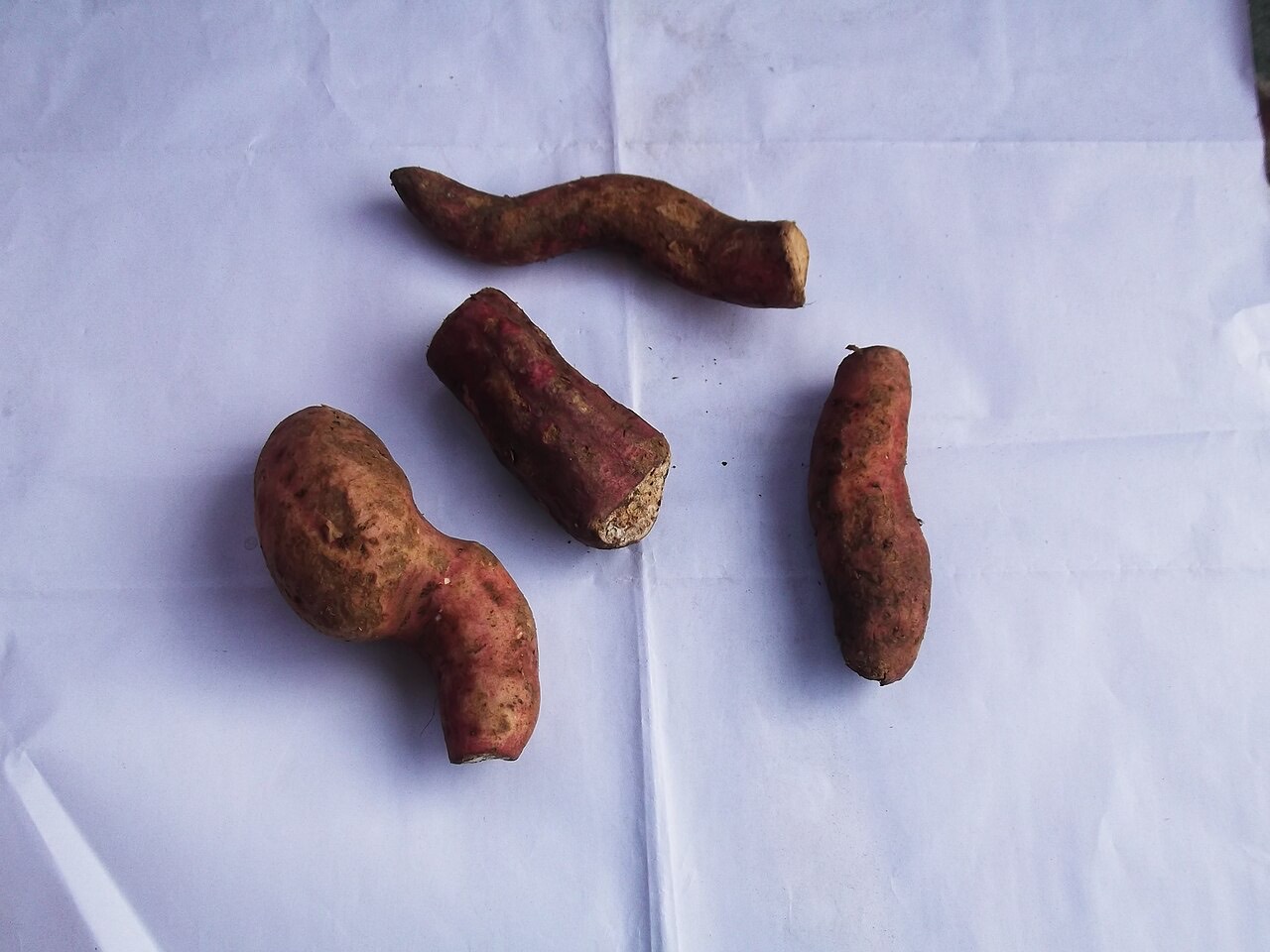
Sweet potato is a trailing or vining plant grown for its swollen storage roots, which vary in flesh color from white through yellow, orange, and purple depending on cultivar, reflecting differences in carotenoid and anthocyanin content. It belongs to the morning glory family and is unrelated botanically to the potato.
Although sweet potato is a perennial in frost-free tropical conditions, it is grown as an annual crop across most of its commercial range, propagated vegetatively from vine cuttings or rooted sprouts (slips) rather than from true seed.
Overview
Sweet potato is grown for its edible storage roots, produced along a spreading or trailing vine, and is propagated vegetatively using vine cuttings or slips grown from a stored root rather than by direct seeding.
Production spans large-scale mechanized systems in some countries and smallholder cultivation in many tropical and subtropical regions, where it serves as an important food-security crop due to its reasonable yield under modest input levels.
Botanical classification
- Family
- Convolvulaceae (morning glory family)
- Genus
- Ipomoea
- Principal species
- Ipomoea batatas (sweet potato)
- Growth habit
- Trailing or vining perennial herb, propagated vegetatively and cultivated for its swollen adventitious storage roots
Origin and distribution
Sweet potato is believed to have originated in Central or South America, where it was domesticated in antiquity, before spreading to the Pacific Islands, Asia, and Africa through both pre-Columbian and later trade routes, becoming a major staple crop in many of these regions.
It is now grown across the tropics and warm-temperate zones worldwide.
Climate requirements
Sweet potato requires warm temperatures throughout its growing period and is sensitive to frost and chilling injury, both in the field and during storage. It shows reasonable tolerance of heat and intermittent drought once established, compared with many other root and tuber crops.
Day length can influence flowering and, in some cultivars, root development, adding a further region-specific dimension to cultivar choice.
Soil requirements
Sweet potato performs best on loose, well-drained sandy loams that allow storage roots to expand freely and develop a smooth, marketable shape; heavier or compacted soils can produce misshapen or constricted roots and complicate harvest.
Establishment and crop management
Sweet potato is established by planting vine cuttings or rooted slips into ridges or mounds, a practice that improves drainage and eases later harvest, at spacing and timing suited to local climate and cultivar.
- Cultivar selection matched to flesh color, market use, and local day-length and disease pressure
- Use of disease-free planting material, since vegetative propagation can carry over pathogens between crops
- Ridging or mounding to promote well-shaped roots and ease of harvest
- Crop rotation to manage soil-borne pests and diseases
Nutrient considerations
Potassium strongly influences storage-root development and quality, while phosphorus supports early root establishment; excessive nitrogen can favor vine growth at the expense of root yield.
Water and irrigation
Sweet potato is grown both rain-fed and under irrigation, with reasonable tolerance of short dry spells once established, though consistent moisture during storage-root bulking supports better yield and root shape. Furrow and drip irrigation are both used depending on scale and region.
Common diseases and pests
Root rot diseases and common scab can affect storage-root quality, particularly in poorly drained or previously infested soils. Root-knot nematodes are a significant below-ground pest, causing root galling and reduced quality, while white grubs and wireworms damage roots directly in the soil.
Management combines resistant cultivars, disease-free planting material, crop rotation, monitoring, and — where justified — locally authorized control products applied according to their labels.
Harvest
Sweet potato is harvested once roots have reached marketable size, typically by lifting with hand tools in smallholder systems or with mechanized diggers in larger operations, taking care to minimize skinning and bruising, which affect storage life and market quality.
Uses
- Fresh-market and cooked root vegetable
- Processed products including flour, chips, and canned or dehydrated forms
- Starch extraction for food and industrial uses
- Vines and root residues used as livestock feed in some smallholder systems
Botanical identity
Species- Accepted name
- Ipomoea batatas
- Family
- Convolvulaceae
- Genus
- Ipomoea
- Harvested part
- tuber, leaf
- Agricultural use
- human food, animal feed
- Crop group
- Roots and tubers
What the authorities say
- World Flora Online — Taxonomic Backbone
- Ipomoea batatas
- Plants of the World Online
- Ipomoea batatas
Botanical identity here is what the consulted taxonomic authorities publish, on the date they were read. Where authorities disagree, both readings are shown rather than one being chosen silently.
Traded as
This crop is traded as one commodity in this corpus.
What AgricultureID holds for this crop
- 159 crop calendar records
- 2 pests and diseases naming this crop as a host
- 2 soil references
- 2 climate references
- 256 market price series
- 1 related crops
Not held
- No published cultivars — not researched
- No official variety registrations — source exists not mapped
- No verified extension resources — source exists not ingested
- No farm economics observations — source exists not mapped
An absence here means this corpus holds no such record, not that none exists.
How to read figures on this page
Production, area and trade figures for any crop change from season to season and are compiled by FAO and by national agricultural statistics agencies. Take current numbers from those primary sources, dated to the period you mean, rather than from a secondary summary — including this one.
Crop water requirements are estimated from reference evapotranspiration and local climate data, following methods published by FAO and national agricultural agencies. A requirement quoted without the reference method and the local climate behind it is not a number that can be applied to a field.
Part of
Related crops
- Same genus
- Water Spinach
Planting and harvest calendar
Usual sowing and harvest windows across 159 jurisdictions, covering sweet potato and sweet potato — season 1 and sweet potato — season 2.
Tools for this
Each tool shows its formula, constants and sources, and starts empty — nothing is filled in from this page.
- Seed-rate calculator
Convert a target plant stand into a seed rate, allowing for germination and establishment.
- Row spacing calculator
Work out in-row spacing and plants per metre of row for a target density.
- Production, area and yield calculator
Relate a harvested area and a yield to a production total, in either direction.
- Growing degree-days calculator
Accumulate heat units against a base temperature.
Relationships
Evidence-backed connections in the knowledge graph.
Susceptible to
Nutrients required
Suitable soils
Climate sensitivity
Irrigation methods
Machinery
Related topics
Harvested commodities
The traded commodities harvested from this crop. A commodity is the harvested lot, described by its own quality, grading, and storage evidence — not by the agronomy of the plant.
Scope & limitations
Geographic scope: Global overview. Agronomic details (timing, rates, varieties) are region-specific and vary widely.
Climate context: Warm-season tropical and subtropical crop, frost-sensitive with reasonable heat and moderate drought tolerance.
- Day-length sensitivity and flowering behavior vary by cultivar and are not covered by universal values here.
- Production statistics change annually and should be taken from primary datasets such as FAOSTAT.
Sources
This article draws on the following authoritative sources. See our sources & methodology for how they are selected.
- [1]FAO — Food and Agriculture Organization (opens in a new tab)Authoritative
Food and Agriculture Organization of the United Nations (FAO)
Cited for: Role of sweet potato in global food security
- Type:
- Intergovernmental organization
- Jurisdiction:
- Global
- Accessed:
- 2026-07-12
- [2]FAOSTAT — FAO statistical database (opens in a new tab)Authoritative
Food and Agriculture Organization of the United Nations (FAO)
Cited for: Production, area, and trade statistics
- Type:
- Intergovernmental organization
- Jurisdiction:
- Global
- Accessed:
- 2026-07-12
- Authoritative
Cited for: Classification and nomenclature
- Type:
- Reference database
- Jurisdiction:
- United States
- Accessed:
- 2026-07-12
- High
Cited for: Sweet potato breeding and agronomy research
- Type:
- Research institute
- Jurisdiction:
- Global
- Accessed:
- 2026-07-12
- [5]CABI Digital Library — Crop Protection Compendium (opens in a new tab)High
CABI (Centre for Agriculture and Bioscience International)
Cited for: Sweet potato disease and pest compendium data
- Type:
- Reference database
- Jurisdiction:
- Global
- Accessed:
- 2026-07-12