Pest · Insect pest
Weevils
Family Curculionidae (order Coleoptera)
Also known as: Snout beetles, True weevils
Weevils are beetles with an elongated snout used for feeding and egg-laying, and the family includes species that damage sweet potato and cotton in the field and infest stored rice and other grain.
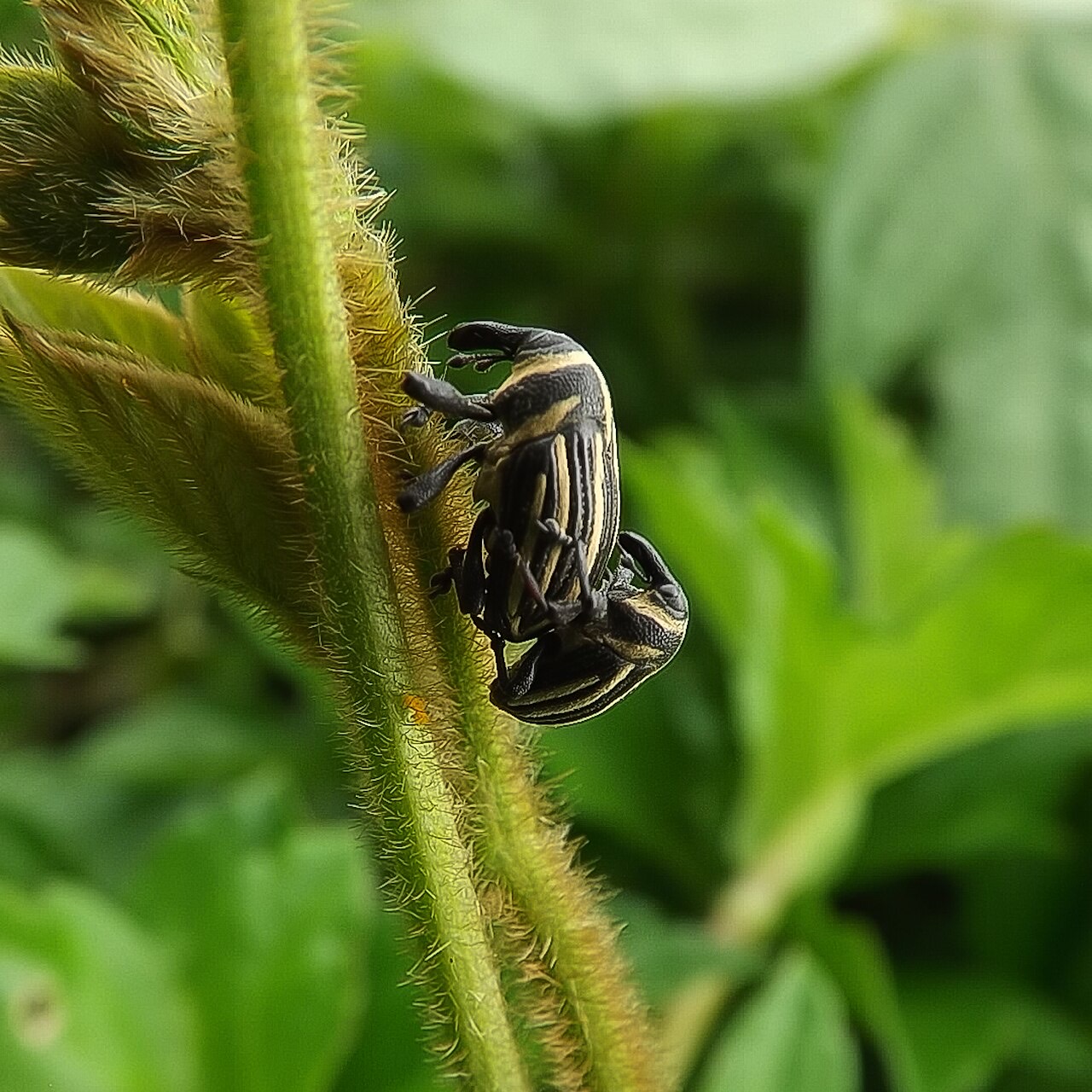
True weevils (family Curculionidae) are one of the largest beetle families, unified by a distinctive elongated snout (rostrum) tipped with chewing mouthparts, which females also use to bore small holes for egg-laying. The family includes species that attack living plants in the field as well as species that infest stored grain and other commodities.
Because feeding and egg-laying habits vary widely by species — from root- and stem-boring larvae to internal grain feeders — weevil damage is correspondingly diverse, ranging from tunnelled roots and tubers to hollowed-out stored grain kernels.
Identification
Adult weevils are recognisable by their elongated snout and elbowed antennae, with body size and colour varying enormously by species. Larvae are typically legless, C-shaped grubs found inside plant tissue, soil, or stored grain, depending on species habit.
Field signs include distinctive notched or scalloped leaf margins from adult feeding and internal tunnels in roots or tubers, while stored-grain species leave small round exit holes and fine dust in infested kernels.
Biology and life cycle
Females use their snout to chew a small cavity in plant tissue or a grain kernel before depositing an egg inside. Larvae develop within this protected site, feeding until pupation, and for species affecting root and tuber crops, larvae often complete development in the soil near the host plant.
Damage and hosts
In the field, larval tunnelling into roots and tubers causes internal damage and scarring that reduces marketability, while adult feeding on foliage and stems can reduce vigour. In storage, internal grain feeders reduce weight, germination, and quality, and can render grain unmarketable if infestations are heavy.
Host crops include sweet potato and cotton in the field, and stored rice and other cereal grain, reflecting the range of habits across this large family.
Monitoring
Pheromone traps are available for several economically important weevil species and help track field or storage populations. Inspecting roots, tubers, and stems for tunnelling, and sampling stored grain for internal feeding and exit holes, complete a monitoring programme.
Management principles
Because weevil species range from field pests to stored-product pests, management combines field sanitation, timing, and storage hygiene as appropriate to the species involved.
- Use clean, weevil-free planting material and rotate away from known high-risk sequences
- Harvest promptly and handle roots and tubers carefully to limit entry points for infestation
- Store grain clean, dry, and in sealed conditions to limit stored-grain weevil populations
- Conserve parasitoid wasps and other natural enemies where relevant
Official extension guidance
1 resource indexed from public extension publishers. Each was written for a particular place; read it at the source.
Management of pea and bean weevils in peas and field beans
Guide published by AHDB for Great Britain. It addresses weevils. The source is organised around “Risk factors in peas and field beans”, “Weevil identification” and “Pea and bean weevil life cycle and crop damage”.
Agriculture and Horticulture Development Board · Pest management · publisher states no date; reachable 2026-08-27
These are pointers to guidance published by others. Each was written for a particular place and season and is revised by its publisher; read it at the source, and check it applies where you farm.
Relationships
Evidence-backed connections in the knowledge graph.
Affects
Risk increases under
Scope & limitations
Geographic scope: One of the largest beetle families, found worldwide across field crops and stored commodities; species, habits, and host importance vary widely by region.
Climate context: Warm, humid conditions generally favour faster development in the field and, for stored-grain species, more rapid population growth in storage unless grain is kept cool and dry.
- This is a general overview of an extremely large and diverse beetle family, not species-level guidance for a specific crop, storage system, or region.
- Thresholds and control-product recommendations are jurisdiction-specific and are not provided here.
Sources
This article draws on the following authoritative sources. See our sources & methodology for how they are selected.
- [1]CABI Digital Library — Crop Protection Compendium (opens in a new tab)High
CABI (Centre for Agriculture and Bioscience International)
Cited for: Biology, hosts, and distribution
- Type:
- Reference database
- Jurisdiction:
- Global
- Accessed:
- 2026-07-12
- [2]UC Statewide Integrated Pest Management Program (UC IPM) (opens in a new tab)High
University of California Agriculture and Natural Resources (UC ANR)
Cited for: Identification and IPM principles
- Type:
- University extension service
- Jurisdiction:
- United States (California)
- Accessed:
- 2026-07-12
- [3]EPPO Global Database (opens in a new tab)Authoritative
European and Mediterranean Plant Protection Organization (EPPO)
Cited for: Species nomenclature and distribution
- Type:
- Reference database
- Jurisdiction:
- Global
- Accessed:
- 2026-07-12
- [4]USDA APHIS — Animal and Plant Health Inspection Service (opens in a new tab)Authoritative
USDA Animal and Plant Health Inspection Service (APHIS)
Cited for: Regulatory and quarantine context
- Type:
- Government agency
- Jurisdiction:
- United States
- Accessed:
- 2026-07-12