Crop · Root and tuber crop
Yam
Dioscorea spp., principally Dioscorea rotundata, D. alata, and D. cayenensis
Also known as: Guinea yam, White yam, Water yam
Yam is a climbing tropical vine grown for its starchy underground tubers, propagated from seed tubers or setts and a staple and culturally significant crop across parts of West Africa, the Caribbean, and Asia-Pacific.
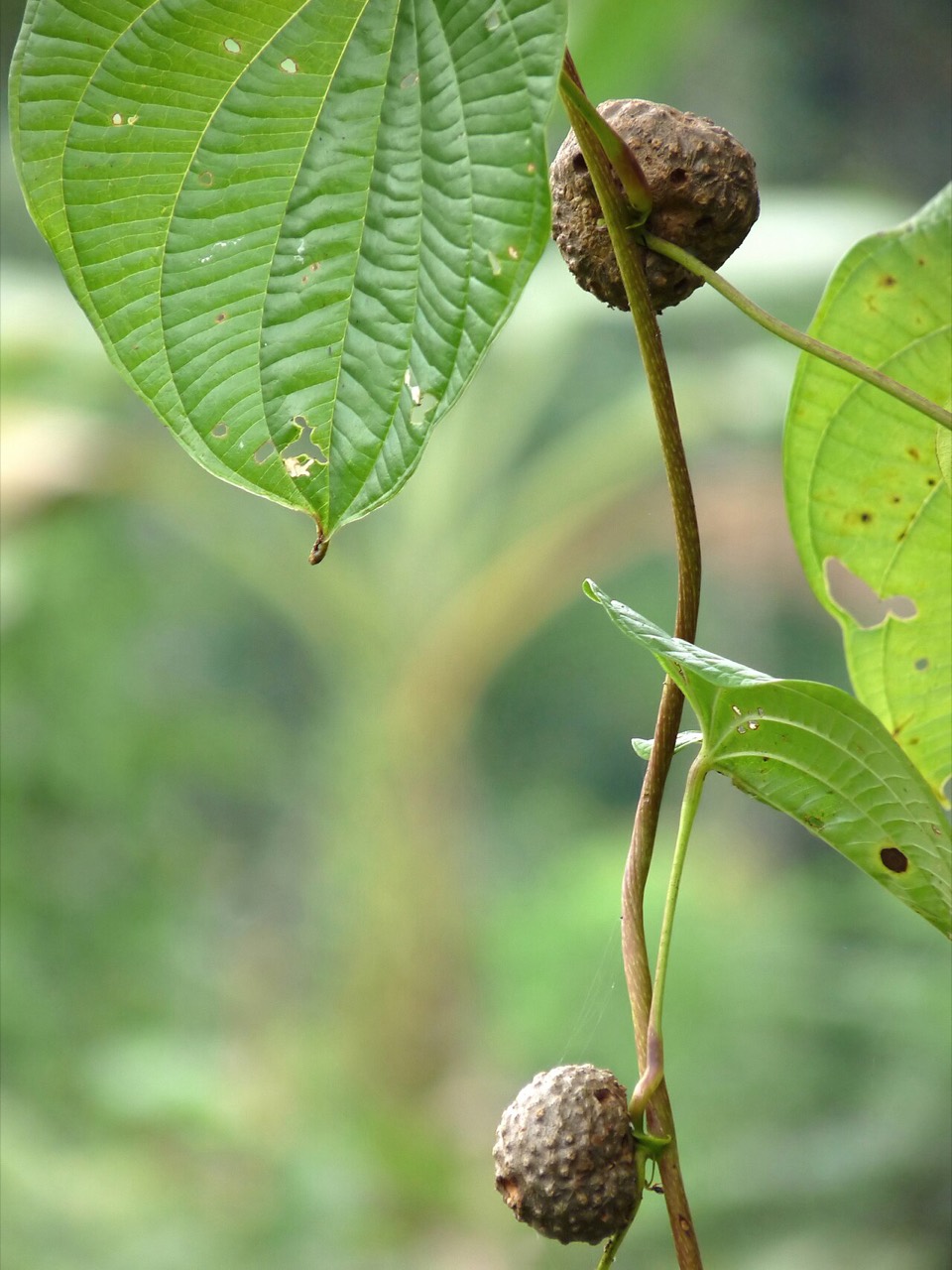
Yam is grown for its large, starchy tubers, which are produced underground by a climbing vine typically trained onto stakes or living support. The genus Dioscorea includes several cultivated species with different tuber shapes, skin colors, and regional importance.
Unlike many root crops, yam is propagated from seed tubers or tuber pieces ("setts") rather than stem cuttings, and a substantial share of each harvest is typically retained as planting material for the following season, which is a major factor in yam production economics.
Overview
Yam is a major staple and cash crop in parts of West Africa, where it also carries strong cultural and ceremonial significance, alongside production in the Caribbean and tropical Asia-Pacific.
Production is labor-intensive, involving mounding or ridging, staking of the climbing vines, and careful handling of seed tubers, which makes yam more input- and labor-demanding than many other root and tuber crops.
Botanical classification
- Family
- Dioscoreaceae (yam family)
- Genus
- Dioscorea
- Principal species
- Dioscorea rotundata and D. cayenensis (white and yellow Guinea yams), D. alata (water yam)
- Growth habit
- Herbaceous climbing vine producing one or more underground storage tubers per plant
Origin and distribution
Yam species were independently domesticated in West Africa and in Southeast Asia, giving rise to distinct groups of cultivated Dioscorea species that later spread through trade and migration to other tropical regions, including the Caribbean.
West Africa remains the leading production region today, with significant cultivation also found in the Caribbean, tropical Asia, and the Pacific.
Climate requirements
Yam requires a warm, humid growing season for vine and tuber development, followed by a distinct dry period that triggers vine senescence and tuber maturity, making rainfall seasonality as important as total rainfall.
The crop has essentially no frost or cold tolerance and is restricted to tropical and warm subtropical growing zones.
Soil requirements
Yam performs best on deep, loose, well-drained sandy loam soils that allow tubers to expand freely; compacted, stony, or heavy clay soils restrict tuber growth and can cause misshapen tubers.
Establishment and crop management
Fields are typically prepared into mounds or ridges to give tubers a deep, loose rooting zone, and seed tubers or setts are planted at the start of the rains.
- Selection of healthy, disease-free seed tubers or setts for planting
- Mounding or ridging to provide a loose, well-drained rooting zone
- Staking of vines onto poles or living supports to improve light interception
- Weed control during early growth, before the vine canopy closes over the stakes
Nutrient considerations
Potassium supports tuber bulking and starch accumulation, while nitrogen contributes to vine growth, particularly early in the season. Yam is often grown with organic amendments incorporated during mound or ridge preparation.
Water and irrigation
Yam is grown predominantly under rain-fed conditions timed to the wet season, with the following dry season used for tuber maturation and harvest. Supplemental surface irrigation is used in some production systems to extend planting windows or support establishment.
Excess soil moisture late in the season can promote tuber rot, so drainage is managed alongside water supply.
Common diseases and pests
Anthracnose, causing leaf and stem lesions and dieback, is one of the most damaging foliar diseases of yam, particularly on water yam. Root-knot nematodes damage tubers and reduce marketable quality and storability, while yam weevils attack tubers both in the field and in storage.
Management relies on clean, disease-free seed tubers, resistant varieties where available, field sanitation, and — where justified — locally authorized control products applied according to their labels.
Harvest
Yam tubers are lifted by hand, carefully to avoid bruising and wounds that shorten storage life, once vines have senesced during the dry season. A portion of the harvest is set aside as seed tubers for the next planting.
Uses
- Staple food starch, boiled, pounded, roasted, or fried
- Processed into flour and other convenience products in some markets
- Seed tubers retained for the following planting cycle
- Cultural and ceremonial significance in parts of West Africa
What this page covers
species complexThis page covers yam as a crop. Several cultivated Dioscorea species are traded as yam and they differ in region, season length and storage; publishing one of them as "yam" would invent a taxon the trade name does not have.
The species boundaries under this name are contested by the authorities themselves, so no single accepted binomial can carry the page.
| Taxon | In this corpus | Role |
|---|---|---|
| Dioscorea cayenensis subsp. rotundataWhite yam | held as a verified taxon — listed in the taxa register, no page of its own | Most West African production. Both authorities place it as an infraspecific taxon under yellow yam rather than as a species of its own. |
| Dioscorea alataWater yam | held as a verified taxon — listed in the taxa register, no page of its own | The most widely distributed species, grown across Asia, the Pacific and the Caribbean. |
| Dioscorea cayenensisYellow yam | held as a verified taxon — listed in the taxa register, no page of its own | West African; the species under which white yam is placed. |
| Dioscorea esculentaLesser yam | held as a verified taxon — listed in the taxa register, no page of its own | Smaller tubers, shorter season. |
| Dioscorea bulbiferaAerial yam | held as a verified taxon — listed in the taxa register, no page of its own | Bears aerial bulbils rather than a single underground tuber. |
When a taxon here earns its own page: White yam is the obvious candidate on production alone, and Wave 32 reviewed and refused it: because the authorities place it under yellow yam, promoting it alone would leave the concept incoherent while its own parent species stayed inside. Any split here has to take the cayenensis group as a whole.
Botanical identity
Species complex- Accepted name
- DioscoreaPlum. ex L.
- Family
- Dioscoreaceae
- Genus
- Dioscorea
- Harvested part
- tuber
- Agricultural use
- human food
- Crop group
- Roots and tubers
What the authorities say
- Plants of the World Online
- Dioscorea
"Yam" is not one species. Five cultivated Dioscorea species are held separately with verified identities — D. rotundata, D. alata, D. cayenensis, D. esculenta and D. bulbifera — and they differ in region, season length, tuber form and storage behaviour. Publishing a single species identity for "yam" would be inventing a taxon the trade name does not have.
- "Yam" covers several cultivated Dioscorea species with materially different agronomy. It is also a name applied to sweet potato in parts of North America, which is a different plant in a different family.
Botanical identity here is what the consulted taxonomic authorities publish, on the date they were read. Where authorities disagree, both readings are shown rather than one being chosen silently.
Traded as
This crop is traded as one commodity in this corpus.
What AgricultureID holds for this crop
- 43 crop calendar records
- 2 soil references
- 1 climate references
- 118 market price series
Not held
- No published cultivars — not researched
- No official variety registrations — source exists not mapped
- No verified extension resources — source exists not ingested
- No pests and diseases naming this crop as a host — source exists not ingested
- No farm economics observations — source exists not mapped
- No related crops — not applicable
An absence here means this corpus holds no such record, not that none exists.
How to read figures on this page
Production, area and trade figures for any crop change from season to season and are compiled by FAO and by national agricultural statistics agencies. Take current numbers from those primary sources, dated to the period you mean, rather than from a secondary summary — including this one.
Crop water requirements are estimated from reference evapotranspiration and local climate data, following methods published by FAO and national agricultural agencies. A requirement quoted without the reference method and the local climate behind it is not a number that can be applied to a field.
Part of
Planting and harvest calendar
Usual sowing and harvest windows across 43 jurisdictions, covering yam and yam — season 1 and yam — season 2.
Tools for this
Each tool shows its formula, constants and sources, and starts empty — nothing is filled in from this page.
- Seed-rate calculator
Convert a target plant stand into a seed rate, allowing for germination and establishment.
- Row spacing calculator
Work out in-row spacing and plants per metre of row for a target density.
- Production, area and yield calculator
Relate a harvested area and a yield to a production total, in either direction.
- Growing degree-days calculator
Accumulate heat units against a base temperature.
Relationships
Evidence-backed connections in the knowledge graph.
Susceptible to
Suitable soils
Climate sensitivity
Irrigation methods
Farming systems
Related topics
Harvested commodities
The traded commodities harvested from this crop. A commodity is the harvested lot, described by its own quality, grading, and storage evidence — not by the agronomy of the plant.
Scope & limitations
Geographic scope: Global overview of tropical production, concentrated in West Africa, the Caribbean, and tropical Asia-Pacific.
Climate context: Warm, humid tropical vine requiring a marked wet-to-dry seasonal transition; no frost tolerance.
- Species and cultivar diversity, mound/ridge practices, and seed-tuber management vary substantially by region and are not detailed here.
- Production statistics change annually and should be taken from primary datasets such as FAOSTAT.
Sources
This article draws on the following authoritative sources. See our sources & methodology for how they are selected.
- [1]FAO — Food and Agriculture Organization (opens in a new tab)Authoritative
Food and Agriculture Organization of the United Nations (FAO)
Cited for: Global yam production and food-security role
- Type:
- Intergovernmental organization
- Jurisdiction:
- Global
- Accessed:
- 2026-07-12
- [2]FAOSTAT — FAO statistical database (opens in a new tab)Authoritative
Food and Agriculture Organization of the United Nations (FAO)
Cited for: Production and area statistics
- Type:
- Intergovernmental organization
- Jurisdiction:
- Global
- Accessed:
- 2026-07-12
- High
Cited for: Root and tuber crop research and agronomy
- Type:
- Research institute
- Jurisdiction:
- Global
- Accessed:
- 2026-07-12
- [4]CABI Digital Library — Crop Protection Compendium (opens in a new tab)High
CABI (Centre for Agriculture and Bioscience International)
Cited for: Yam disease and pest compendium data
- Type:
- Reference database
- Jurisdiction:
- Global
- Accessed:
- 2026-07-12
- Authoritative
Cited for: Classification and nomenclature
- Type:
- Reference database
- Jurisdiction:
- United States
- Accessed:
- 2026-07-12