Crop · Root and tuber crop
Cassava
Manihot esculenta
Also known as: Manioc, Yuca, Tapioca plant
Cassava is a woody perennial shrub grown throughout the tropics for its starchy storage roots, valued for drought tolerance and its ability to crop on soils too poor for many other staples.
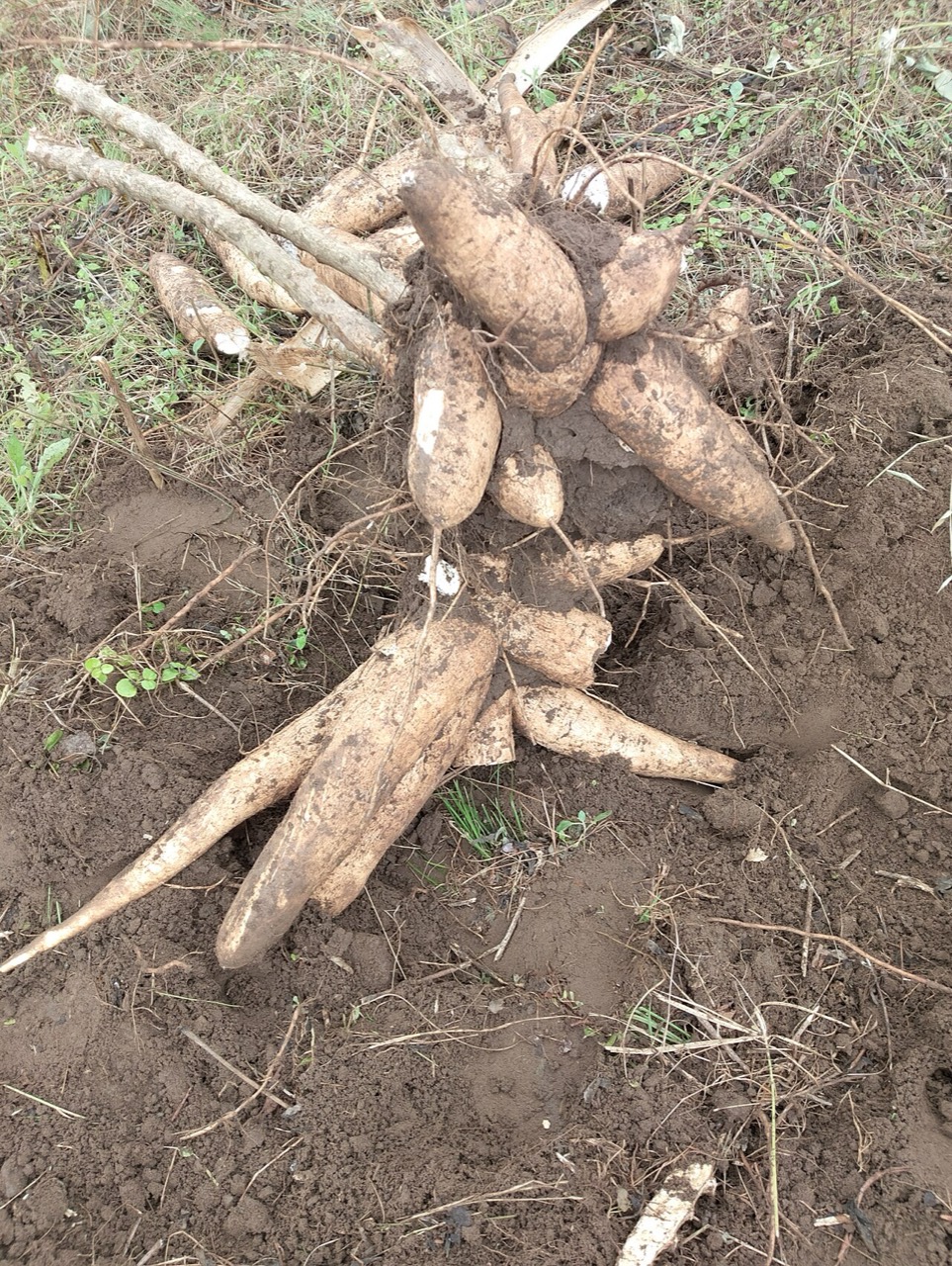
Cassava is propagated vegetatively from stem cuttings rather than from seed, and its enlarged storage roots accumulate starch that makes it a major source of dietary calories across much of the tropics, particularly in food-security contexts where other staples struggle.
Cultivars are broadly grouped as "sweet" or "bitter" according to the concentration of cyanogenic glucosides in the roots; bitter types require processing such as grating, pressing, and cooking or fermentation before consumption to reduce these compounds to safe levels, an important agronomic and food-safety distinction rather than a health claim.
Overview
Cassava is grown predominantly by smallholder farmers across the tropics, prized for its flexibility: roots can often be left in the ground beyond physiological maturity and harvested as needed, functioning as a form of on-farm food storage.
Its tolerance of poor soils, erratic rainfall, and low-input management makes it an important food-security crop, though yields respond substantially to improved varieties and better agronomic practice where these are available.
Botanical classification
- Family
- Euphorbiaceae (spurge family)
- Genus
- Manihot
- Principal species
- Manihot esculenta (cultivated cassava)
- Growth habit
- Woody perennial shrub propagated from stem cuttings, grown for enlarged starchy storage roots
Origin and distribution
Cassava originates from South America, where it was domesticated by indigenous peoples, and was subsequently introduced to Africa and Asia by traders, becoming deeply embedded in food systems across the tropics.
It is now grown across tropical Africa, Asia, and Latin America, with Africa accounting for a large share of global production.
Climate requirements
Cassava is well adapted to warm, humid to subhumid tropical climates and tolerates extended dry periods better than most staple crops, shedding leaves under drought stress and resuming growth once moisture returns.
The crop is frost-sensitive and cold intolerant, restricting production to frost-free tropical and warm subtropical zones.
Soil requirements
Cassava tolerates a wide range of soils, including sandy and lateritic soils of relatively low fertility, and is often grown on marginal land where other crops perform poorly. Well-drained soils are preferred, since waterlogging can cause root rot.
Establishment and crop management
Cassava is established by planting mature stem cuttings, selected from disease-free plants, either horizontally, at an angle, or vertically depending on local practice and soil moisture conditions.
- Selection of clean, disease-free planting material from healthy stems
- Land preparation appropriate to soil type, often involving mounding or ridging in heavier or wetter soils
- Weed control during early establishment, when the crop canopy has not yet closed
- Intercropping with legumes or vegetables during the early growth phase in many smallholder systems
Nutrient considerations
Potassium is removed in large amounts by cassava roots and strongly influences root bulking and starch content, while nitrogen supports canopy development. Cassava can produce a harvest on low-fertility soils, but yields respond to improved nutrient management.
Water and irrigation
Cassava is grown predominantly under rain-fed conditions given its drought tolerance, though supplemental irrigation can improve establishment and yield in areas with pronounced dry seasons or on very sandy soils.
Water stress during root bulking has less impact on cassava than on many other staple crops, a key reason for its role in drought-prone farming systems.
Common diseases and pests
Cassava bacterial blight causes wilting and dieback and can spread rapidly under wet, windy conditions, while anthracnose affects stems and can weaken planting material for the following season. Mealybugs and whiteflies are significant sap-feeding pests; whiteflies are also vectors of important cassava viruses.
Management relies on clean planting material, resistant or tolerant varieties where available, field sanitation, and — where justified — locally authorized control products applied according to their labels.
Harvest
Roots are typically harvested by hand, lifted from the soil, from around eight months to two years after planting depending on cultivar and intended use. Because roots deteriorate rapidly once lifted, harvest is often timed close to processing or sale.
Uses
- Staple food starch, consumed fresh, dried, or processed (e.g. as flour or granules)
- Industrial starch for food and non-food manufacturing
- Animal feed from roots, leaves, and processing by-products
- Planting stems retained as propagation material for the next crop cycle
Botanical identity
Species- Accepted name
- Manihot esculenta
- Family
- Euphorbiaceae
- Genus
- Manihot
- Harvested part
- root, leaf
- Agricultural use
- human food, starch, animal feed, industrial raw material
- Crop group
- Roots and tubers
What the authorities say
- World Flora Online — Taxonomic Backbone
- Manihot esculenta
- Plants of the World Online
- Manihot esculenta
Botanical identity here is what the consulted taxonomic authorities publish, on the date they were read. Where authorities disagree, both readings are shown rather than one being chosen silently.
Traded as
This crop is traded as one commodity in this corpus.
What AgricultureID holds for this crop
- 133 crop calendar records
- 2 published cultivars
- 3 pests and diseases naming this crop as a host
- 2 soil references
- 2 climate references
- 64 market price series
Not held
- No official variety registrations — source exists not mapped
- No verified extension resources — source exists not ingested
- No farm economics observations — source exists not mapped
- No related crops — not applicable
An absence here means this corpus holds no such record, not that none exists.
How to read figures on this page
Production, area and trade figures for any crop change from season to season and are compiled by FAO and by national agricultural statistics agencies. Take current numbers from those primary sources, dated to the period you mean, rather than from a secondary summary — including this one.
Crop water requirements are estimated from reference evapotranspiration and local climate data, following methods published by FAO and national agricultural agencies. A requirement quoted without the reference method and the local climate behind it is not a number that can be applied to a field.
Part of
Planting and harvest calendar
Usual sowing and harvest windows across 133 jurisdictions, covering cassava and cassava — season 1 and cassava — season 2.
Tools for this
Each tool shows its formula, constants and sources, and starts empty — nothing is filled in from this page.
- Seed-rate calculator
Convert a target plant stand into a seed rate, allowing for germination and establishment.
- Row spacing calculator
Work out in-row spacing and plants per metre of row for a target density.
- Production, area and yield calculator
Relate a harvested area and a yield to a production total, in either direction.
- Growing degree-days calculator
Accumulate heat units against a base temperature.
Relationships
Evidence-backed connections in the knowledge graph.
Susceptible to
Nutrients required
Suitable soils
Climate sensitivity
Machinery
Managed with
Farming systems
Related topics
Notable cultivars
Documented varieties tied to this species, with registry status and sources on each page. Not an exhaustive list.
- TME 419TME 419 is an IITA-disseminated improved cassava variety associated with cassava mosaic disease resistance and among the most widely grown varieties by farmers in Nigeria.
- TMS 30572TMS 30572 is an IITA-bred improved cassava variety of the TMS series, selected for cassava mosaic disease resistance and widely disseminated in Nigeria and West Africa.
Harvested commodities
The traded commodities harvested from this crop. A commodity is the harvested lot, described by its own quality, grading, and storage evidence — not by the agronomy of the plant.
Scope & limitations
Geographic scope: Global overview of tropical production. Cultivar choice, processing methods, and cropping cycles vary widely by region.
Climate context: Warm, humid-to-subhumid tropical crop with strong drought tolerance and no cold or frost tolerance.
- Cyanogenic potential and required processing steps differ substantially between sweet and bitter cultivars and are not detailed here.
- Production statistics change annually and should be taken from primary datasets such as FAOSTAT.
Sources
This article draws on the following authoritative sources. See our sources & methodology for how they are selected.
- [1]FAO — Food and Agriculture Organization (opens in a new tab)Authoritative
Food and Agriculture Organization of the United Nations (FAO)
Cited for: Global cassava production and food-security role
- Type:
- Intergovernmental organization
- Jurisdiction:
- Global
- Accessed:
- 2026-07-12
- [2]FAOSTAT — FAO statistical database (opens in a new tab)Authoritative
Food and Agriculture Organization of the United Nations (FAO)
Cited for: Production and area statistics
- Type:
- Intergovernmental organization
- Jurisdiction:
- Global
- Accessed:
- 2026-07-12
- High
Cited for: Root and tuber crop research and agronomy
- Type:
- Research institute
- Jurisdiction:
- Global
- Accessed:
- 2026-07-12
- [4]CABI Digital Library — Crop Protection Compendium (opens in a new tab)High
CABI (Centre for Agriculture and Bioscience International)
Cited for: Cassava disease and pest compendium data
- Type:
- Reference database
- Jurisdiction:
- Global
- Accessed:
- 2026-07-12
- Authoritative
Cited for: Classification and nomenclature
- Type:
- Reference database
- Jurisdiction:
- United States
- Accessed:
- 2026-07-12