Crop · Vegetable crop
Chili pepper
Capsicum annuum (and related cultivated Capsicum species)
Also known as: Chile pepper, Chilli
Chili pepper is a fruiting Solanaceous crop grown for pods ranging from mild to intensely pungent, used fresh, dried, or processed as a vegetable and spice across a wide range of climates.
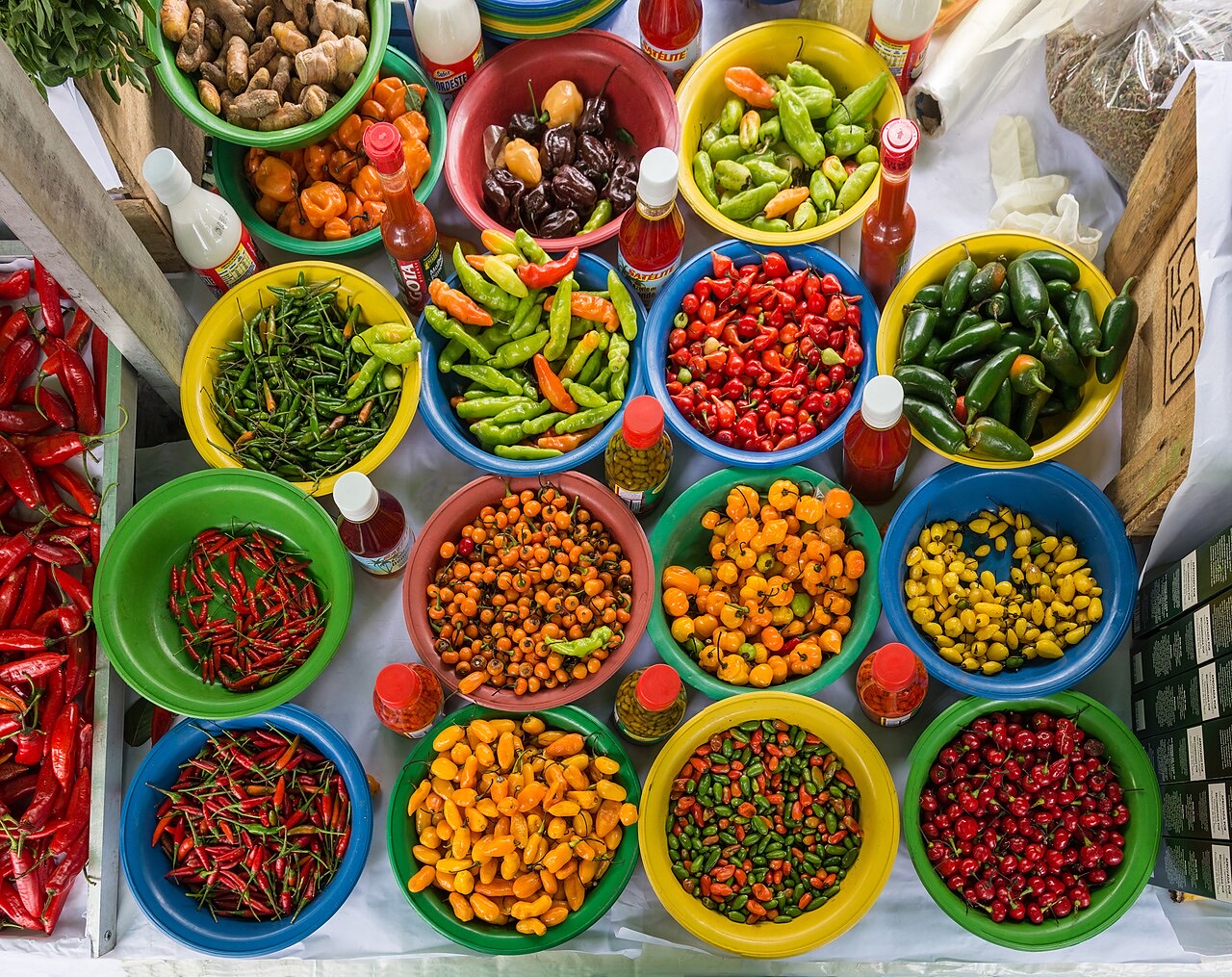
Chili pepper belongs to the same genus as sweet (bell) pepper but includes cultivars selected for pungency, driven by capsaicinoid compounds concentrated mainly in the internal placental tissue of the fruit rather than the flesh.
Although chili pepper is a tender perennial shrub in frost-free climates, it is most often grown commercially as an annual crop, established from transplants and harvested within a single growing season in temperate regions.
Overview
Chili pepper is grown across a wide range of climates, from open-field production in warm regions to protected cultivation under greenhouses or high tunnels in cooler climates, reflecting its broad culinary and commercial importance.
Cultivars vary enormously in pod shape, size, color, and pungency, supporting both fresh-market vegetable use and dried, powdered, and processed spice products.
Botanical classification
- Family
- Solanaceae (nightshade family)
- Genus
- Capsicum
- Principal species
- Capsicum annuum, with related cultivated species including C. frutescens and C. chinense
- Growth habit
- Tender perennial shrub commonly grown as an annual, producing fruit whose pungency is concentrated in internal placental tissue
Origin and distribution
Chili peppers originate from Central and South America, where they were domesticated over thousands of years before being spread globally following European contact, becoming deeply integrated into cuisines across Asia, Africa, and the Americas.
The crop is grown today across warm cropping regions worldwide.
Climate requirements
Chili pepper requires warm growing conditions and is sensitive to frost, restricting outdoor field production to the frost-free season in temperate climates or year-round cultivation in warmer regions and protected structures.
Extreme heat during flowering can cause flower and young fruit drop, while cool temperatures slow growth and fruit development.
Soil requirements
Chili pepper performs best on well-drained loam and sandy loam soils with good structure, supporting the crop’s moderate but sensitive root system.
Establishment and crop management
Chili pepper is typically established from transplants raised in trays or seedbeds, set out once the risk of frost has passed and soil temperatures have warmed sufficiently for good root establishment.
- Cultivar selection for pungency level, pod type, and market use
- Transplanting timed to frost-free conditions and adequate soil warmth
- Staking or support in some production systems to manage fruit load
- Rotation away from other Solanaceous crops to manage shared soil-borne diseases
Nutrient considerations
Nitrogen supports vegetative growth and fruit set, while calcium status is closely linked to fruit quality, since deficiency or inconsistent uptake is associated with blossom end rot, a common fruit disorder in Solanaceous vegetables.
Water and irrigation
Chili pepper benefits from consistent soil moisture, particularly during flowering and fruit development, since irregular watering is associated with fruit disorders such as blossom end rot.
Drip irrigation is widely used in both open-field and protected production to apply water precisely and maintain even soil moisture.
Common diseases and pests
Bacterial leaf spot can cause lesions on leaves and fruit, reducing marketable quality, while anthracnose affects ripening fruit, particularly under warm, humid conditions. Thrips are significant pests both for direct feeding damage and as vectors of certain viruses, and aphids can also transmit viruses while feeding on foliage.
Management combines resistant or tolerant cultivars where available, sanitation, monitoring, and — where justified — locally authorized control products applied according to their labels.
Harvest
Pods are hand-picked at green (immature) or fully colored (mature) stages depending on cultivar and market, with some production also harvested for drying, in which pods are left to mature and dry further before processing.
Uses
- Fresh-market vegetable use in a wide range of cuisines
- Dried and powdered spice products
- Processing into sauces, pastes, and preserved products
- Oleoresin extraction for food-industry flavoring and coloring
What this page covers
genus conceptThis page covers the pungent peppers, which in cultivation means the Longum Group of Capsicum annuum and, in trade and in kitchens, four other domesticated Capsicum species that are grown and sold the same way. Sweet pepper is a separate cultivar group of the same species and has its own page.
The page covers several cultivated species of one genus. Each is a real, separately verifiable taxon; the page exists because the trade name covers all of them.
| Taxon | In this corpus | Role |
|---|---|---|
| Capsicum chinenseHabanero pepper | held as a verified taxon — listed in the taxa register, no page of its own | The most pungent of the domesticated species, of the Yucatán and the Caribbean. Held as a taxon; its distinguishing material is pungency and cultivar branding rather than agronomy. |
| Capsicum frutescensTabasco pepper | held as a verified taxon — listed in the taxa register, no page of its own | A small-fruited domesticate grown for sauce, held as a taxon for the same reason. |
| Capsicum baccatumAjí pepper | held as a verified taxon — listed in the taxa register, no page of its own | The South American domesticate, distinguished in the field by the yellow-green spots in the corolla rather than by how it is grown. |
| Capsicum pubescensRocoto pepper | held as a verified taxon — listed in the taxa register, no page of its own | The one that is genuinely different: black seeds, cold tolerance, cropping at Andean altitudes where the other four do not, and no interfertility with them. Deferred rather than refused. |
When a taxon here earns its own page: A Capsicum species earns its own page when it is grown differently, not when it tastes different. Rocoto is the only one of the four that has an argument — altitude, cold tolerance and reproductive isolation — and Wave 40 deferred it on evidence rather than declining it. The other three would repeat this page with a pungency figure attached.
Botanical identity
Cultivar group- Accepted name
- Capsicum annuum Longum Group
- Family
- Solanaceae
- Genus
- Capsicum
- Harvested part
- fruit
- Agricultural use
- human food, spice
- Crop group
- Vegetables, Spices and herbs
What the authorities say
- World Flora Online — Taxonomic Backbone
- Capsicum annuum
- Plants of the World Online
- Capsicum annuum
Sweet peppers and most chilli peppers are the same species, Capsicum annuum, differing in pungency and fruit shape rather than in taxon. Publishing them as separate species would assert a botanical difference that does not exist; publishing them as one crop would lose a distinction every market makes. They are cultivar groups. Four other cultivated Capsicum species — chinense, frutescens, baccatum and pubescens — are genuinely separate and held as such.
- Chilli peppers are grown from five cultivated Capsicum species. This record covers the Capsicum annuum forms only; C. chinense, C. frutescens, C. baccatum and C. pubescens are held separately.
Botanical identity here is what the consulted taxonomic authorities publish, on the date they were read. Where authorities disagree, both readings are shown rather than one being chosen silently.
Traded as
This crop is traded as one commodity in this corpus.
What AgricultureID holds for this crop
- 264 crop calendar records
- 2 soil references
- 1 climate references
- 227 market price series
- 1 related crops
Not held
- No published cultivars — not researched
- No official variety registrations — source exists not mapped
- No verified extension resources — source exists not ingested
- No pests and diseases naming this crop as a host — source exists not ingested
- No farm economics observations — source exists not mapped
An absence here means this corpus holds no such record, not that none exists.
How to read figures on this page
Production, area and trade figures for any crop change from season to season and are compiled by FAO and by national agricultural statistics agencies. Take current numbers from those primary sources, dated to the period you mean, rather than from a secondary summary — including this one.
Crop water requirements are estimated from reference evapotranspiration and local climate data, following methods published by FAO and national agricultural agencies. A requirement quoted without the reference method and the local climate behind it is not a number that can be applied to a field.
Part of
Related crops
- Same genus
- Sweet Pepper
Planting and harvest calendar
Usual sowing and harvest windows across 264 jurisdictions, covering chilli and chilli — season 1 and chilli — season 2 and chilli — season 3 and chilli — season 4 and chilli, dry and chilli, dry — season 1 and chilli, dry — season 2 and chilli, dry — season 3 and chilli, dry — season 4 and pepper, cherry and pepper, chili and pepper, chili — season 1 and pepper, chili — season 2 and pepper, chili — season 3 and pepper, chili — season 4.
Tools for this
Each tool shows its formula, constants and sources, and starts empty — nothing is filled in from this page.
- Seed-rate calculator
Convert a target plant stand into a seed rate, allowing for germination and establishment.
- Row spacing calculator
Work out in-row spacing and plants per metre of row for a target density.
- Production, area and yield calculator
Relate a harvested area and a yield to a production total, in either direction.
- Growing degree-days calculator
Accumulate heat units against a base temperature.
Relationships
Evidence-backed connections in the knowledge graph.
Susceptible to
Suitable soils
Climate sensitivity
Irrigation methods
Machinery
Farming systems
Related topics
Harvested commodities
The traded commodities harvested from this crop. A commodity is the harvested lot, described by its own quality, grading, and storage evidence — not by the agronomy of the plant.
Scope & limitations
Geographic scope: Global overview of production spanning open-field and protected cultivation across warm and temperate regions.
Climate context: Warm-season, frost-sensitive fruiting vegetable; grown as an annual across most commercial production regions.
- Pungency level, cultivar type, and processing method vary enormously by region and market and are not detailed here.
- Production statistics change annually and should be taken from primary datasets such as FAOSTAT.
Sources
This article draws on the following authoritative sources. See our sources & methodology for how they are selected.
- [1]FAO — Food and Agriculture Organization (opens in a new tab)Authoritative
Food and Agriculture Organization of the United Nations (FAO)
Cited for: Global chili pepper production context
- Type:
- Intergovernmental organization
- Jurisdiction:
- Global
- Accessed:
- 2026-07-12
- [2]FAOSTAT — FAO statistical database (opens in a new tab)Authoritative
Food and Agriculture Organization of the United Nations (FAO)
Cited for: Production and area statistics
- Type:
- Intergovernmental organization
- Jurisdiction:
- Global
- Accessed:
- 2026-07-12
- Authoritative
Cited for: Classification and nomenclature
- Type:
- Reference database
- Jurisdiction:
- United States
- Accessed:
- 2026-07-12
- [4]CABI Digital Library — Crop Protection Compendium (opens in a new tab)High
CABI (Centre for Agriculture and Bioscience International)
Cited for: Chili pepper disease and pest compendium data
- Type:
- Reference database
- Jurisdiction:
- Global
- Accessed:
- 2026-07-12
- [5]UC Statewide Integrated Pest Management Program (UC IPM) (opens in a new tab)High
University of California Agriculture and Natural Resources (UC ANR)
Cited for: Integrated pest management guidelines for peppers
- Type:
- University extension service
- Jurisdiction:
- United States (California)
- Accessed:
- 2026-07-12