Crop · Fiber crop
Jute
Corchorus olitorius and Corchorus capsularis
Also known as: Golden fiber
Jute is a tall annual fiber crop grown mainly in the monsoon-fed floodplains of South Asia, valued for the strong, biodegradable bast fiber extracted from its stems.
Jute is grown for the fiber contained in the bark of its stem, extracted through a water-retting process after harvest. The crop is closely tied to the monsoon season and the alluvial floodplains of the Ganges-Brahmaputra delta, where it has long been a major smallholder cash crop.
Two species are cultivated commercially, white jute (Corchorus capsularis) and tossa jute (Corchorus olitorius), which differ somewhat in fiber quality, growth habit, and regional preference.
Overview
Jute is grown predominantly by smallholder farmers in the monsoon-affected floodplains of South Asia, where it fits into cropping calendars alongside rice and other staple crops on the same alluvial land.
As a natural, biodegradable fiber, jute has continued relevance for sacking, packaging, and geotextile applications, alongside historical and ongoing use in twine and coarse textiles.
Botanical classification
- Family
- Malvaceae (mallow family)
- Genus
- Corchorus
- Principal species
- Corchorus olitorius (tossa jute) and Corchorus capsularis (white jute)
- Growth habit
- Tall, erect annual herb grown at high density for long, fibrous stems
Origin and distribution
Jute has long been cultivated in South Asia, with the Ganges-Brahmaputra delta region historically central to its production, processing, and trade, supporting major fiber industries in the surrounding countries.
Production remains concentrated in South Asia today, with smaller cultivation in parts of Southeast Asia and elsewhere.
Climate requirements
Jute is closely tied to the monsoon season, requiring warm temperatures and abundant, well-distributed rainfall during its rapid vegetative growth phase to produce long, high-quality fiber-bearing stems.
High humidity supports both crop growth and the subsequent retting process, in which harvested stems are soaked to separate the fiber from woody tissue.
Soil requirements
Jute performs best on fertile alluvial soils typical of river floodplains, which combine good moisture supply with the nutrient replenishment provided by periodic flooding and sediment deposition.
Establishment and crop management
Jute is direct-seeded at high density to encourage tall, unbranched stems with long fiber-bearing sections, and early growth requires timely thinning and weed control.
- High seeding density to promote tall, straight, fiber-rich stems
- Timely thinning to establish an even, well-spaced stand
- Weed control during early growth, before the canopy closes
- Rotation with rice or other crops common on the same floodplain land
Nutrient considerations
Nitrogen supports the rapid vegetative growth central to fiber yield, while the fertile, regularly replenished alluvial soils typical of jute-growing floodplains reduce dependence on heavy fertilizer inputs relative to some other fiber crops.
Water and irrigation
Jute is grown predominantly under rain-fed monsoon conditions, with supplemental surface irrigation used in some areas to support establishment ahead of the main rains or during dry spells.
After harvest, stems are commonly retted by submerging them in ponds, ditches, or slow-moving water for a period of days to weeks, a process that depends on adequate standing water rather than field irrigation.
Common diseases and pests
Anthracnose affects stems and leaves, particularly under wet conditions, and can reduce fiber quality, while root rot can occur in waterlogged or poorly drained soils. Stem borers and aphids are among the more common insect pests affecting stem quality and plant vigor.
Management combines timely planting, field sanitation, monitoring, and — where justified — locally authorized control products applied according to their labels.
Harvest
Stems are cut close to the ground once plants reach the appropriate maturity stage for fiber quality, then bundled and retted in water before the fiber is manually stripped, washed, and dried.
Uses
- Sacking and packaging materials, including bags for agricultural commodities
- Twine, rope, and coarse woven textiles
- Geotextiles and erosion-control fabric due to biodegradability
- Fiber by-products used in paper pulp and composite materials
What this page covers
genus conceptThis page covers jute as a fibre crop. Two Corchorus species are grown together across the same region and both are held as taxa.
The page covers several cultivated species of one genus. Each is a real, separately verifiable taxon; the page exists because the trade name covers all of them.
| Taxon | In this corpus | Role |
|---|---|---|
| Corchorus olitoriusTossa jute | held as a verified taxon | The higher-yielding of the two fibre species, and the same plant grown as the leaf vegetable molokhia. Wave 44 published it under the leaf-vegetable name because the FAO calendar carries it that way in two countries; the fibre side of the species stays here. |
| Corchorus capsularisWhite jute | held as a verified taxon — listed in the taxa register, no page of its own | The species tolerant of the flooded land where much jute is grown. |
When a taxon here earns its own page: Neither has been reviewed for promotion. Tossa jute is complicated by carrying two unrelated end uses on one taxon.
Botanical identity
Genus-level crop concept- Accepted name
- CorchorusL.
- Family
- Malvaceae
- Genus
- Corchorus
- Harvested part
- fibre
- Agricultural use
- fibre
- Crop group
- Fibre crops
What the authorities say
- Plants of the World Online
- Corchorus
Jute is two cultivated species. Corchorus olitorius (tossa jute) and C. capsularis (white jute) are grown together across the same region and are both held separately with verified identities. C. olitorius is also grown as a leaf vegetable, which is recorded as a separate crop concept.
- Corchorus olitorius is grown both for fibre and as a leaf vegetable (jute mallow); the two uses select for different plants.
Botanical identity here is what the consulted taxonomic authorities publish, on the date they were read. Where authorities disagree, both readings are shown rather than one being chosen silently.
Traded as
This crop is traded as one commodity in this corpus.
What AgricultureID holds for this crop
- 5 crop calendar records
- 2 soil references
- 2 climate references
- 177 market price series
- 1 related crops
Not held
- No published cultivars — not researched
- No official variety registrations — source exists not mapped
- No verified extension resources — source exists not ingested
- No pests and diseases naming this crop as a host — source exists not ingested
- No farm economics observations — source exists not mapped
An absence here means this corpus holds no such record, not that none exists.
How to read figures on this page
Production, area and trade figures for any crop change from season to season and are compiled by FAO and by national agricultural statistics agencies. Take current numbers from those primary sources, dated to the period you mean, rather than from a secondary summary — including this one.
Crop water requirements are estimated from reference evapotranspiration and local climate data, following methods published by FAO and national agricultural agencies. A requirement quoted without the reference method and the local climate behind it is not a number that can be applied to a field.
Related crops
- Same crop concept
- Jute Mallow
Planting and harvest calendar
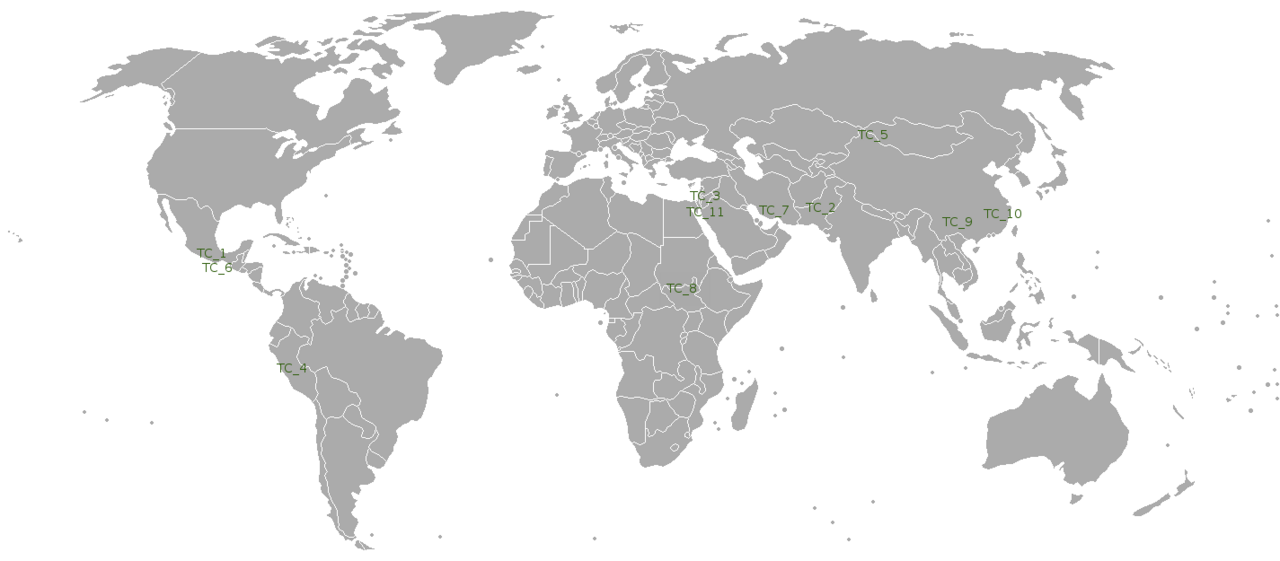
Usual sowing and harvest windows across 5 jurisdictions, covering jute.
Tools for this
Each tool shows its formula, constants and sources, and starts empty — nothing is filled in from this page.
- Seed-rate calculator
Convert a target plant stand into a seed rate, allowing for germination and establishment.
- Row spacing calculator
Work out in-row spacing and plants per metre of row for a target density.
- Production, area and yield calculator
Relate a harvested area and a yield to a production total, in either direction.
- Growing degree-days calculator
Accumulate heat units against a base temperature.
Relationships
Evidence-backed connections in the knowledge graph.
Susceptible to
Nutrients required
Suitable soils
Irrigation methods
Farming systems
Related topics
Harvested commodities
The traded commodities harvested from this crop. A commodity is the harvested lot, described by its own quality, grading, and storage evidence — not by the agronomy of the plant.
Scope & limitations
Geographic scope: Global overview of production concentrated in the monsoon-fed floodplains of South Asia.
Climate context: Warm, humid monsoon-season crop requiring abundant rainfall during rapid vegetative growth.
- Retting method and water access requirements are highly local and are not detailed here.
- Production statistics change annually and should be taken from primary datasets such as FAOSTAT.
Sources
This article draws on the following authoritative sources. See our sources & methodology for how they are selected.
- [1]FAO — Food and Agriculture Organization (opens in a new tab)Authoritative
Food and Agriculture Organization of the United Nations (FAO)
Cited for: Global jute production and trade context
- Type:
- Intergovernmental organization
- Jurisdiction:
- Global
- Accessed:
- 2026-07-12
- [2]FAOSTAT — FAO statistical database (opens in a new tab)Authoritative
Food and Agriculture Organization of the United Nations (FAO)
Cited for: Production and area statistics
- Type:
- Intergovernmental organization
- Jurisdiction:
- Global
- Accessed:
- 2026-07-12
- [3]CABI Digital Library — Crop Protection Compendium (opens in a new tab)High
CABI (Centre for Agriculture and Bioscience International)
Cited for: Jute disease and pest compendium data
- Type:
- Reference database
- Jurisdiction:
- Global
- Accessed:
- 2026-07-12
- Authoritative
Cited for: Classification and nomenclature
- Type:
- Reference database
- Jurisdiction:
- United States
- Accessed:
- 2026-07-12