Crop · Oilseed crop
Safflower
Carthamus tinctorius
Also known as: False saffron
Safflower is a spiny, deep-rooted annual oilseed grown for its seeds, valued for drought tolerance and its ability to use residual soil moisture in semi-arid cropping systems.
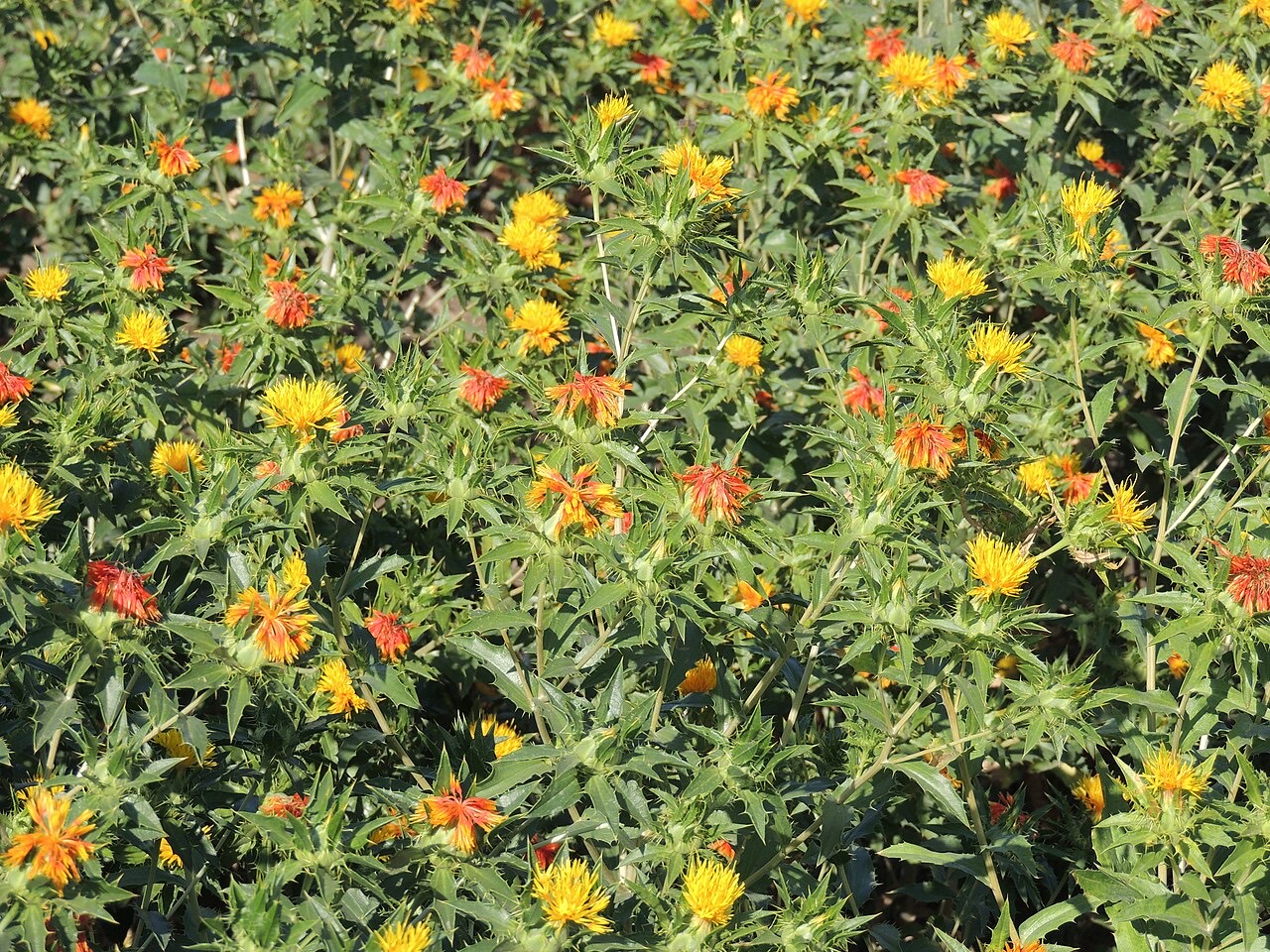
Safflower is grown mainly for its oilseed, pressed for cooking oil and, historically, for dyes extracted from its flower petals. Its deep taproot allows it to draw on subsoil moisture, making it a useful crop in dryland and residual-moisture rotations.
Modern cultivars are bred primarily for oil content and fatty-acid composition, with spineless types developed to ease handling, since the wild-type spiny bracts around the flower heads can complicate harvest and crop scouting.
Overview
Safflower is grown as a rotation crop in semi-arid grain-growing regions, valued for its deep root system, which can access soil moisture stored below the reach of shallower-rooted cereals.
Production is concentrated in regions with distinct dry seasons where the crop can mature on stored soil moisture with limited additional rainfall, though it is also grown under irrigation in some areas.
Botanical classification
- Family
- Asteraceae (daisy family)
- Genus
- Carthamus
- Principal species
- Carthamus tinctorius (cultivated safflower)
- Growth habit
- Erect, branching annual with a deep taproot, producing thistle-like flower heads and oil-rich achenes
Origin and distribution
Safflower has a long history of cultivation across the Middle East, South Asia, and North Africa, originally valued for the dye extracted from its flowers before being developed as a modern oilseed crop.
It is grown today in semi-arid regions across several continents.
Climate requirements
Safflower is adapted to semi-arid and temperate climates with cool, moist conditions during early vegetative growth followed by warmer, drier conditions during flowering and seed fill.
Its deep root system supports notable drought tolerance once established, though the crop is sensitive to prolonged waterlogging.
Soil requirements
Safflower performs best on deep, well-drained loam and clay loam soils that allow its taproot to access subsoil moisture reserves. Shallow or compacted soils restrict rooting and reduce the crop’s characteristic drought tolerance.
Establishment and crop management
Safflower is typically sown into a firm, moist seedbed early in the growing season to allow root development before the onset of drier conditions.
- Cultivar selection for oil profile, spinelessness, and regional adaptation
- Sowing timed to establish the crop ahead of seasonal drought and heat
- Weed control during early growth, before the canopy closes
- Rotation with cereals or other crops to manage disease pressure and utilize the deep root system
Nutrient considerations
Nitrogen supports vegetative growth and head number, while overall fertility requirements are moderate relative to some other oilseed crops, particularly in dryland systems where yield potential is set largely by available moisture.
Water and irrigation
Safflower is often grown on stored soil moisture in dryland rotations, though it is also produced under irrigation in some regions, with water demand concentrated around flowering and seed fill.
Because the crop is intolerant of waterlogging, irrigation scheduling and drainage are managed to avoid saturated root-zone conditions.
Common diseases and pests
Fusarium wilt can cause vascular wilting and stand loss in susceptible cultivars, and root rot is a significant risk in poorly drained or waterlogged soils. Aphids are common sap-feeding pests, and thrips can affect flower heads and developing seed.
Management relies on resistant or tolerant cultivars, crop rotation, monitoring, and — where justified — locally authorized control products applied according to their labels.
Harvest
Safflower is harvested by combine once the flower heads and seed have dried down in the field, similar in timing approach to other dryland oilseed and cereal crops, though the spiny bracts of some cultivars require attention to header settings.
Uses
- Edible oil extraction for cooking and food processing
- Birdseed and other specialty seed markets
- Historical and niche use of flower petals as a dye and colorant
- Oilseed meal used as animal feed after oil extraction
Botanical identity
Species- Accepted name
- Carthamus tinctorius
- Family
- Asteraceae
- Genus
- Carthamus
- Harvested part
- oilseed, flower
- Agricultural use
- oilseed, industrial raw material
- Crop group
- Oilseeds
What the authorities say
- World Flora Online — Taxonomic Backbone
- Carthamus tinctorius
- Plants of the World Online
- Carthamus tinctorius
Botanical identity here is what the consulted taxonomic authorities publish, on the date they were read. Where authorities disagree, both readings are shown rather than one being chosen silently.
Traded as
This crop is traded as one commodity in this corpus.
What AgricultureID holds for this crop
- 39 crop calendar records
- 2 soil references
- 1 climate references
- 133 market price series
Not held
- No published cultivars — not researched
- No official variety registrations — source exists not mapped
- No verified extension resources — source exists not ingested
- No pests and diseases naming this crop as a host — source exists not ingested
- No farm economics observations — source exists not mapped
- No related crops — not applicable
An absence here means this corpus holds no such record, not that none exists.
How to read figures on this page
Production, area and trade figures for any crop change from season to season and are compiled by FAO and by national agricultural statistics agencies. Take current numbers from those primary sources, dated to the period you mean, rather than from a secondary summary — including this one.
Crop water requirements are estimated from reference evapotranspiration and local climate data, following methods published by FAO and national agricultural agencies. A requirement quoted without the reference method and the local climate behind it is not a number that can be applied to a field.
Part of
Planting and harvest calendar
Usual sowing and harvest windows across 39 jurisdictions, covering safflower and safflower — season 1 and safflower — season 2.
Tools for this
Each tool shows its formula, constants and sources, and starts empty — nothing is filled in from this page.
- Seed-rate calculator
Convert a target plant stand into a seed rate, allowing for germination and establishment.
- Row spacing calculator
Work out in-row spacing and plants per metre of row for a target density.
- Production, area and yield calculator
Relate a harvested area and a yield to a production total, in either direction.
- Growing degree-days calculator
Accumulate heat units against a base temperature.
Relationships
Evidence-backed connections in the knowledge graph.
Susceptible to
Nutrients required
Climate sensitivity
Machinery
Farming systems
Related topics
Harvested commodities
The traded commodities harvested from this crop. A commodity is the harvested lot, described by its own quality, grading, and storage evidence — not by the agronomy of the plant.
Scope & limitations
Geographic scope: Global overview of production in semi-arid and temperate dryland cropping regions.
Climate context: Deep-rooted, drought-tolerant annual suited to semi-arid climates; intolerant of waterlogged soils.
- Cultivar selection (spineless vs. spiny types, oil profile) and rotation position are region-specific decisions not covered by universal values here.
- Production statistics change annually and should be taken from primary datasets such as FAOSTAT.
Sources
This article draws on the following authoritative sources. See our sources & methodology for how they are selected.
- [1]FAO — Food and Agriculture Organization (opens in a new tab)Authoritative
Food and Agriculture Organization of the United Nations (FAO)
Cited for: Global safflower production and trade context
- Type:
- Intergovernmental organization
- Jurisdiction:
- Global
- Accessed:
- 2026-07-12
- [2]FAOSTAT — FAO statistical database (opens in a new tab)Authoritative
Food and Agriculture Organization of the United Nations (FAO)
Cited for: Production and area statistics
- Type:
- Intergovernmental organization
- Jurisdiction:
- Global
- Accessed:
- 2026-07-12
- Authoritative
Cited for: Classification and nomenclature
- Type:
- Reference database
- Jurisdiction:
- United States
- Accessed:
- 2026-07-12
- [4]CABI Digital Library — Crop Protection Compendium (opens in a new tab)High
CABI (Centre for Agriculture and Bioscience International)
Cited for: Safflower disease and pest compendium data
- Type:
- Reference database
- Jurisdiction:
- Global
- Accessed:
- 2026-07-12