Soil · Soil texture
Clay Soil
Also known as: Heavy soil, Fine-textured soil
Clay soil is a fine-textured mineral soil dominated by clay-sized particles. It holds water and nutrients well but drains slowly and can be difficult to work when wet or dry.
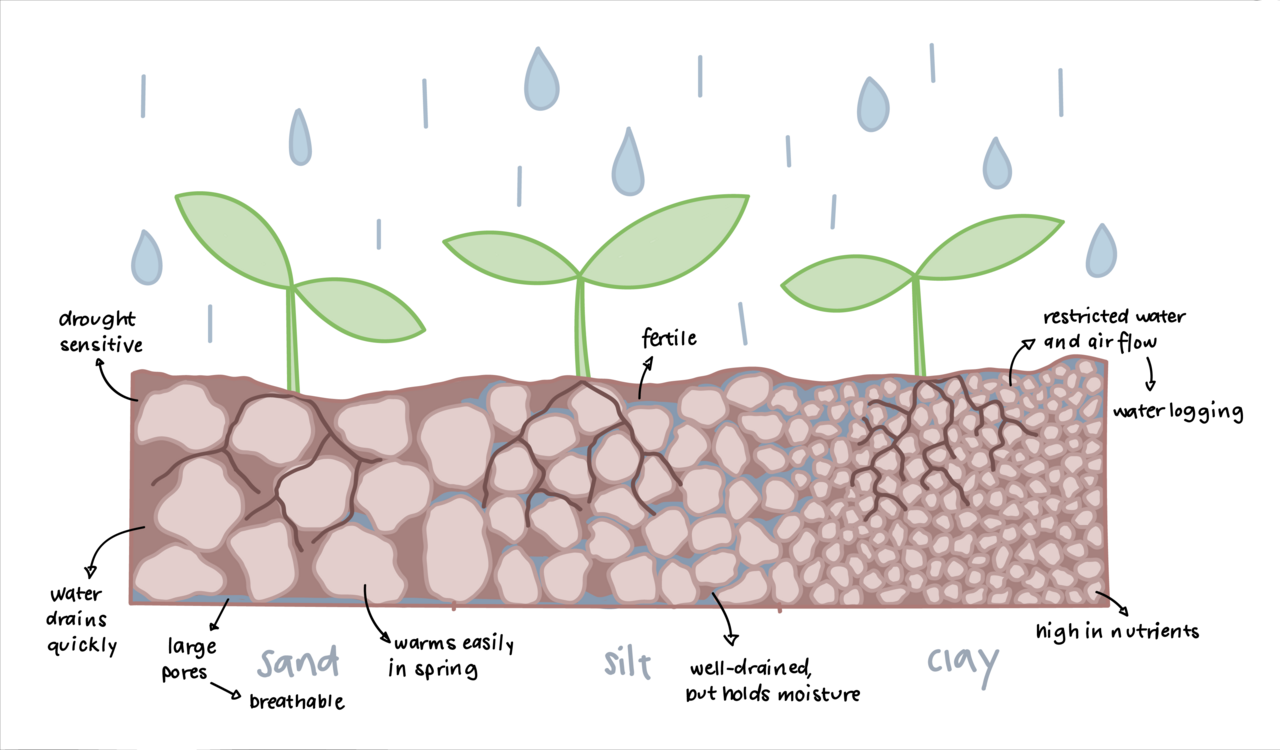
Clay soil is defined by a high proportion of clay-sized particles, the smallest of the mineral fractions. This fine texture gives clay soils a large surface area, which allows them to retain water and nutrients effectively but also makes them prone to slow drainage, compaction, and a narrow window of good workability.
In practice, few soils are pure clay; most are clay loams or silty clays in which clay is the dominant influence. Understanding how clay behaves helps explain management challenges and opportunities across many agricultural soils.
Overview
Soil texture describes the relative proportions of sand, silt, and clay particles. Clay soils are those in which clay-sized particles dominate the physical behaviour of the soil. Because clay particles are chemically active and hold water strongly, clay soils behave very differently from coarse, sandy soils.
Physical and chemical properties
- Water retention
- High total storage, but a significant fraction is held so tightly it is not readily available to plants.
- Aeration
- Small pore spaces limit air movement; roots can suffer when soils are saturated.
- Nutrient holding
- A high cation exchange capacity means clay soils retain nutrient cations such as potassium, calcium, and magnesium well.
- Structure
- Well-aggregated clay soils can be productive; poorly structured or compacted clays restrict rooting and drainage.
Management considerations
Managing clay soils centres on protecting and improving structure so that water can drain and roots can grow. Working clay soils at the wrong moisture content — too wet in particular — causes compaction and smearing that can take years to remedy.
- Time tillage and traffic to soil moisture to avoid compaction and smearing
- Add organic matter to improve aggregation and drainage over time
- Maintain cover and rooting to stabilise structure and reduce surface sealing
- Address drainage where waterlogging is persistent, following local guidance
Crop suitability
Well-structured clay and clay-loam soils suit crops that benefit from good moisture and nutrient retention, including many cereals such as wheat. Their slow drainage makes them less suited to crops that require light, free-draining soils, such as many root vegetables, unless drainage and structure are actively managed.
Assessing a clay soil
Texture can be estimated in the field by feel — clay soils feel sticky and can be moulded into a ribbon when moist — and confirmed by laboratory particle-size analysis. Soil survey information and local testing provide the most reliable basis for management decisions.
Relationships
Evidence-backed connections in the knowledge graph.
Scope & limitations
Geographic scope: General soil-science overview applicable worldwide; local soils vary and should be assessed directly.
Climate context: Clay behaviour interacts strongly with climate — wetting and drying cycles affect structure and workability.
- Individual fields vary; texture classes are general descriptions, not substitutes for local soil survey or testing.
- Management timing depends on local weather and soil moisture and cannot be generalised to fixed dates.
Sources
This article draws on the following authoritative sources. See our sources & methodology for how they are selected.
- [1]USDA NRCS — Natural Resources Conservation Service (opens in a new tab)Authoritative
USDA Natural Resources Conservation Service (NRCS)
Cited for: Soil texture, drainage, and management
- Type:
- Government agency
- Jurisdiction:
- United States
- Accessed:
- 2026-07-12
- Authoritative
Cited for: Soil function and classification context
- Type:
- Intergovernmental organization
- Jurisdiction:
- Global
- Accessed:
- 2026-07-12
- High
Cited for: Global soil properties and information
- Type:
- Research institute
- Jurisdiction:
- Global
- Accessed:
- 2026-07-12
- Authoritative
Cited for: Crop–soil suitability context
- Type:
- Reference database
- Jurisdiction:
- United States
- Accessed:
- 2026-07-12