Crop · Industrial crop
Sugarcane
Saccharum officinarum and interspecific Saccharum hybrids (Saccharum spp.)
Sugarcane is a tall, perennial tropical grass grown for its sucrose-rich stalks, used to produce sugar, ethanol, and molasses. A single planting is harvested over several successive ratoon cycles before replanting.
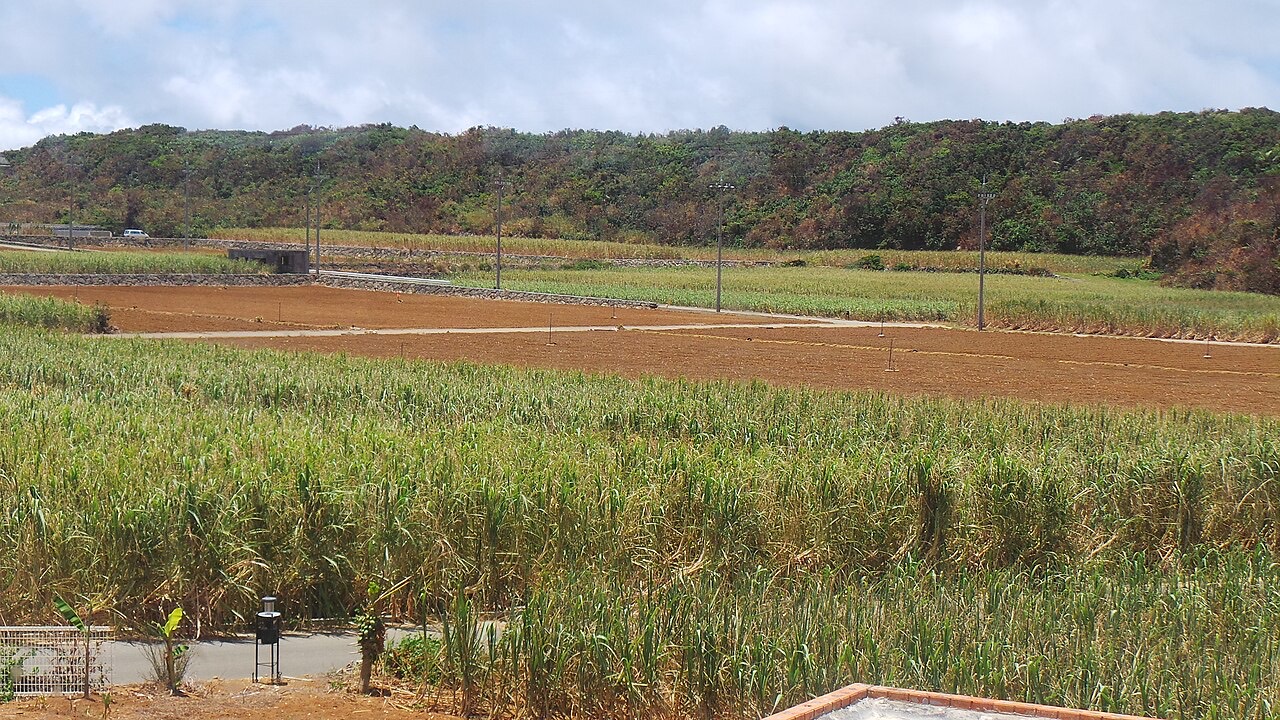
Sugarcane is a large perennial grass cultivated primarily in tropical and subtropical regions for the sucrose stored in its stalks. Modern commercial canes are complex interspecific hybrids bred from Saccharum officinarum, prized for its high sugar content, crossed with wild relatives such as Saccharum spontaneum to introduce vigor and disease resistance.
The crop is propagated vegetatively from stem cuttings ("setts") rather than seed, and after the first harvest the stubble regrows into subsequent "ratoon" crops, allowing several harvests from a single planting before yield decline makes replanting worthwhile.
Overview
Sugarcane is among the world's most important industrial crops, grown across tropical and subtropical regions to supply raw sugar, ethanol, and by-products such as molasses and bagasse. Its long growth cycle and ratoon cropping system distinguish it from most annual field crops.
The total time from planting to first harvest, and between successive ratoons, varies considerably by region and climate, generally spanning roughly ten months to two years depending on local growing conditions.
Botanical classification
- Family
- Poaceae (grass family)
- Genus
- Saccharum
- Principal species/hybrids
- Saccharum officinarum and complex interspecific Saccharum hybrids used commercially
- Growth habit
- Tall perennial grass propagated vegetatively from stem cuttings, regrowing from stubble as a ratoon crop
Origin and distribution
Sugarcane is believed to have originated in New Guinea and neighboring parts of Southeast Asia, where Saccharum officinarum was domesticated, before spreading across South and Southeast Asia and, through later trade and colonization, to Africa and the Americas.
Today, sugarcane is grown across a broad tropical and subtropical belt, with major production concentrated in parts of the Americas and South and Southeast Asia.
Climate requirements
Sugarcane requires substantial warmth and sunlight over its long growing cycle to accumulate sucrose, and it is grown across tropical and subtropical zones with adequate heat accumulation. It has little tolerance for frost, which can damage or kill standing cane.
A period of cooler, drier conditions before harvest is sometimes associated with improved sucrose concentration in some production regions, in contrast to the warm, moist conditions favored during the main vegetative growth phase.
Soil requirements
Sugarcane tolerates a wide range of soil types, from loams to heavier clay loams, provided soils are deep and reasonably fertile to support its extensive root system and large biomass.
Planting and ratoon management
New sugarcane fields are established from disease-screened stem cuttings containing viable buds. After the first harvest, the stubble is managed to regrow as a ratoon crop, and fields are typically ratooned for several cycles before declining vigor makes replanting worthwhile.
- Use of certified, disease-free planting material (setts)
- Ratoon management practices to sustain yield across successive harvests
- Weed control, particularly important during the slower-growing early stages
- Decisions on replanting interval based on ratoon yield decline and disease buildup
Nutrient considerations
Sugarcane has substantial nitrogen and potassium requirements given its large biomass, with potassium particularly linked to sucrose accumulation and overall stalk quality.
Water and irrigation
Sugarcane has a high water requirement over its long growing cycle. Furrow and flood irrigation have historically been common in many production regions, while drip irrigation is increasingly adopted where water efficiency is a priority.
Water stress during key growth phases can reduce both cane yield and sucrose accumulation, making irrigation scheduling an important management consideration in drier production areas.
Common diseases and pests
Fusarium-associated stalk and shoot diseases affect sugarcane in various production regions, and root rots caused by soil-borne pathogens can reduce stand vigor, particularly under poorly drained conditions. Aphids and fall armyworm, a broad-host-range pest, are among the insects that can damage foliage and reduce yield potential.
Management combines disease-free planting material, resistant varieties where available, monitoring, and — where justified — locally authorized control products applied according to their labels.
Harvest
Sugarcane is harvested when sucrose concentration in the stalk peaks, either by hand or mechanically, with green (unburned) harvesting, which retains crop residue as ground cover, increasingly favored over pre-harvest burning in many regions. Because sucrose degrades relatively quickly after cutting, cane is milled soon after harvest.
Uses
- Raw and refined sugar production
- Ethanol and other biofuel production
- Molasses for animal feed and industrial fermentation
- Bagasse (fibrous residue) used for energy cogeneration and paper products
Botanical identity
Species- Accepted name
- Saccharum officinarum
- Family
- Poaceae
- Genus
- Saccharum
- Harvested part
- stalk
- Agricultural use
- sugar, bioenergy, animal feed
- Crop group
- Sugar crops
What the authorities say
- World Flora Online — Taxonomic Backbone
- Saccharum officinarum
- Plants of the World Online
- Saccharum officinarum
Botanical identity here is what the consulted taxonomic authorities publish, on the date they were read. Where authorities disagree, both readings are shown rather than one being chosen silently.
Traded as
This crop is traded as one commodity in this corpus.
What AgricultureID holds for this crop
- 94 crop calendar records
- 2 pests and diseases naming this crop as a host
- 2 soil references
- 2 climate references
- 206 market price series
Not held
- No published cultivars — not researched
- No official variety registrations — source exists not mapped
- No verified extension resources — source exists not ingested
- No farm economics observations — source exists not mapped
- No related crops — not applicable
An absence here means this corpus holds no such record, not that none exists.
How to read figures on this page
Production, area and trade figures for any crop change from season to season and are compiled by FAO and by national agricultural statistics agencies. Take current numbers from those primary sources, dated to the period you mean, rather than from a secondary summary — including this one.
Crop water requirements are estimated from reference evapotranspiration and local climate data, following methods published by FAO and national agricultural agencies. A requirement quoted without the reference method and the local climate behind it is not a number that can be applied to a field.
Part of
Planting and harvest calendar
Usual sowing and harvest windows across 94 jurisdictions, covering sugarcane and sugarcane — season 1 and sugarcane — season 2 and sugarcane — season 3.
Authorised inputs (France)
The French register records 18 currently authorised products whose authorised use names this crop, held by 13 authorisation holders. This is a count of what exists on the register, not a recommendation and not a shortlist.
By function
- Herbicide 18
Targets named on the register
Use scope is recorded as the register writes it. Collective terms cover several crops at once and are left unmapped rather than expanded, because expanding one entry into several would invent authorisations that were never granted.
Authorisation is specific to one jurisdiction, one legal object and one moment. It is not a recommendation, and it says nothing about how a product may be used: always read the current official label at the source before acting.
Tools for this
Each tool shows its formula, constants and sources, and starts empty — nothing is filled in from this page.
- Seed-rate calculator
Convert a target plant stand into a seed rate, allowing for germination and establishment.
- Row spacing calculator
Work out in-row spacing and plants per metre of row for a target density.
- Production, area and yield calculator
Relate a harvested area and a yield to a production total, in either direction.
- Growing degree-days calculator
Accumulate heat units against a base temperature.
Relationships
Evidence-backed connections in the knowledge graph.
Susceptible to
Climate sensitivity
Irrigation methods
Managed with
Farming systems
Harvested commodities
The traded commodities harvested from this crop. A commodity is the harvested lot, described by its own quality, grading, and storage evidence — not by the agronomy of the plant.
Scope & limitations
Geographic scope: Global overview of tropical and subtropical production. Ratoon cycle length and harvest practice vary by region.
Climate context: Tropical to subtropical perennial grass with a long growth cycle and high heat and water demand.
- Ratoon-cycle length, replanting interval, and harvest method (green versus burned) vary regionally and are not resolved here.
- Production statistics change annually and should be taken from primary datasets such as FAOSTAT.
Sources
This article draws on the following authoritative sources. See our sources & methodology for how they are selected.
- [1]FAO — Food and Agriculture Organization (opens in a new tab)Authoritative
Food and Agriculture Organization of the United Nations (FAO)
Cited for: Global sugarcane production and trade context
- Type:
- Intergovernmental organization
- Jurisdiction:
- Global
- Accessed:
- 2026-07-12
- [2]FAOSTAT — FAO statistical database (opens in a new tab)Authoritative
Food and Agriculture Organization of the United Nations (FAO)
Cited for: Production and area statistics
- Type:
- Intergovernmental organization
- Jurisdiction:
- Global
- Accessed:
- 2026-07-12
- [3]USDA ARS — Agricultural Research Service (opens in a new tab)Authoritative
USDA Agricultural Research Service (ARS)
Cited for: Sugarcane research and disease information
- Type:
- Government agency
- Jurisdiction:
- United States
- Accessed:
- 2026-07-12
- Authoritative
Cited for: Classification and nomenclature
- Type:
- Reference database
- Jurisdiction:
- United States
- Accessed:
- 2026-07-12
- [5]CABI Digital Library — Crop Protection Compendium (opens in a new tab)High
CABI (Centre for Agriculture and Bioscience International)
Cited for: Sugarcane disease and pest compendium data
- Type:
- Reference database
- Jurisdiction:
- Global
- Accessed:
- 2026-07-12