Crop · Tree nut crop
Cashew
Anacardium occidentale
Also known as: Cashew nut tree
Cashew is a tropical evergreen tree grown for its true fruit — the kidney-shaped nut — which develops externally on a fleshy, edible stalk known as the cashew apple. It is notably drought- and heat-tolerant and widely grown on marginal soils in smallholder and agroforestry systems.
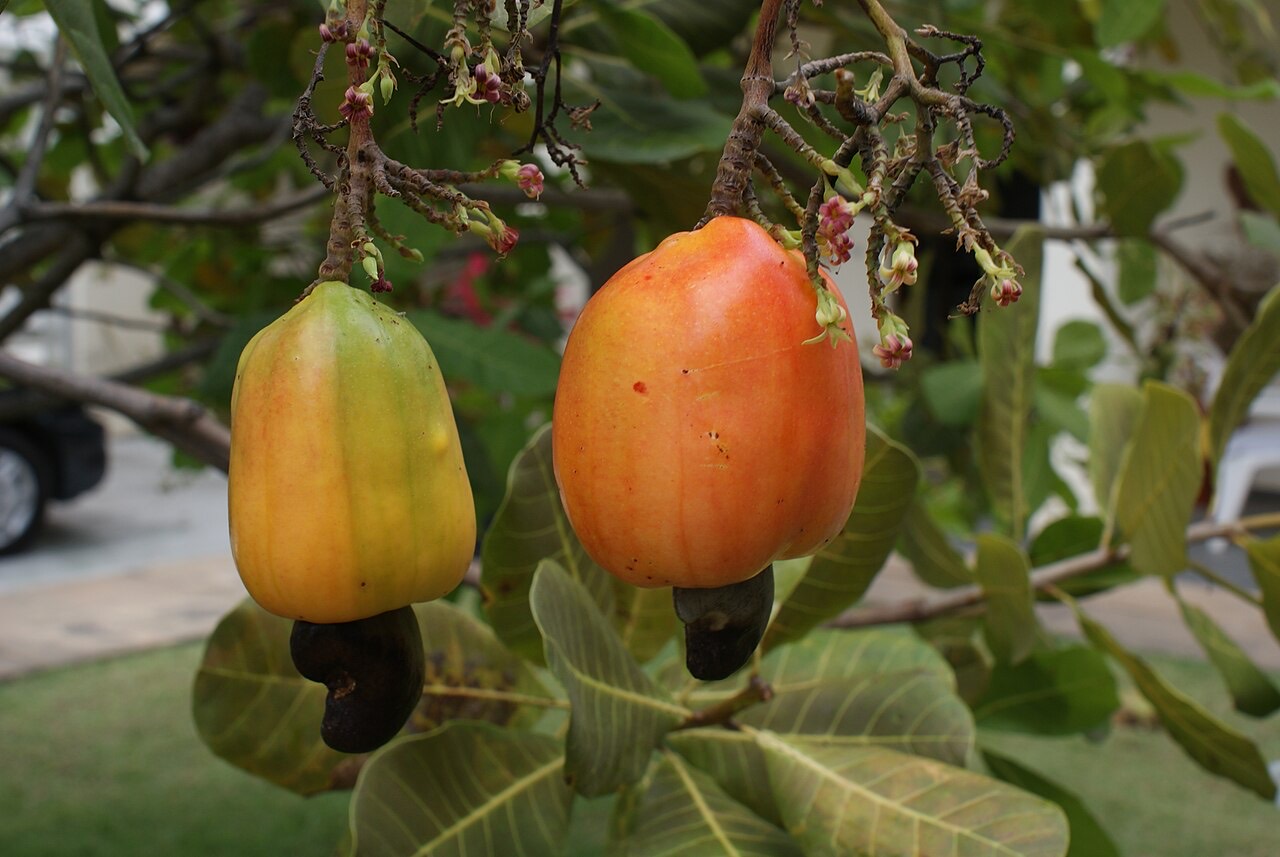
Cashew is a tropical evergreen tree grown primarily for its nut, though the plant produces an unusual fruit structure in which two distinct edible parts develop together. It is well adapted to hot, dry tropical climates and is widely cultivated by smallholders as well as in larger commercial plantings.
Cashew is notably drought- and heat-tolerant relative to many other tree nut crops and is often grown on marginal tropical soils where few other cash crops perform well, making it an important component of smallholder and agroforestry systems in many producing regions.
Overview
Cashew is grown as a long-lived tropical evergreen tree, established from seedlings or grafted planting material depending on region and production system. Its tolerance of heat, drought, and marginal soils has made it an important crop in areas less suited to many other tree crops.
Production spans smallholder plantings, often intercropped with other species, as well as larger commercial operations, with cultivar choice and management practices varying widely by producing region.
Botanical classification
- Family
- Anacardiaceae (sumac/cashew family)
- Genus
- Anacardium
- Principal species
- Anacardium occidentale (cashew)
- Fruit structure
- The true botanical fruit is the kidney-shaped nut that forms at the end of the "cashew apple," a fleshy, edible structure that is actually a swollen pedicel (stalk), not a true fruit
- Growth habit
- Evergreen tree, grown from seedlings or grafted material depending on region and production system
Origin and distribution
Cashew is native to tropical parts of South America, particularly Brazil, and was subsequently introduced to other tropical regions, including parts of Africa and Asia, where it has since become established as a significant smallholder and commercial crop.
Climate requirements
Cashew is adapted to hot, tropical climates and shows notable tolerance of both drought and heat once trees are established, making it suitable for regions where rainfall is seasonal or limited. It generally requires a distinct dry period for good flowering and nut development.
Cashew is sensitive to cold and frost and is not suited to temperate climates, restricting its cultivation to tropical and near-tropical zones.
Soil requirements
Cashew is notably adaptable to marginal soils, including sandy and light-textured soils of relatively low fertility, where it often outperforms many alternative crops. Deep, well-drained soils are still preferred, as the species has limited tolerance for waterlogging.
Orchard establishment and management
Establishing a cashew planting involves selecting seedling or grafted material suited to local conditions and spacing trees to allow for their eventual mature canopy size. Because of its tolerance for marginal land, cashew is frequently established in agroforestry arrangements alongside other crops or in reforestation and land-rehabilitation contexts.
- Planting material selection: seedling versus grafted, depending on region and desired uniformity
- Spacing to accommodate mature canopy spread
- Integration into agroforestry or intercropping systems where appropriate
- Long-term canopy and orchard floor management across many productive years
Nutrient considerations
Nitrogen supports vegetative growth, while potassium contributes to nut development and overall tree vigor. Zinc is a micronutrient of relevance to cashew, since deficiency can affect shoot growth and flowering.
Water and irrigation
Cashew is grown predominantly rain-fed in many traditional production regions, reflecting its drought tolerance once established, though irrigation, including drip irrigation, is used in some commercial plantings to support establishment and improve nut yield and quality.
Because a dry period supports flowering, irrigation scheduling in irrigated systems is managed carefully to avoid disrupting the natural flowering response to seasonal dryness.
Common diseases and pests
Anthracnose can affect flowers, young shoots, and developing fruit, particularly during humid periods. Root rot, often linked to poorly drained sites, can weaken or kill trees over time. Insect pests include aphids, mealybugs, and scale insects, which can affect shoots, flowers, and developing nuts and may also promote sooty mold through honeydew production.
Management combines resistant or tolerant planting material where available, sanitation, monitoring, and — where justified — locally authorized control products applied according to their labels.
Harvest
Cashew nuts are typically harvested after the cashew apple and attached nut fall to the ground, at which point the nut is detached from the apple and collected. The nut is subsequently dried before further processing to extract the kernel.
Uses
The cashew nut shell contains caustic phenolic compounds, known collectively as cashew nut shell liquid, which is why raw kernels require careful processing, including roasting or steaming steps, before the shell is removed and the kernel is safe to eat.
- Roasted and processed kernels for direct consumption
- Cashew apple used fresh, or processed into juice and other beverages in some producing regions
- Cashew nut shell liquid, a by-product with industrial applications
- Kernel-based ingredients used in confectionery and snack products
Botanical identity
Species- Accepted name
- Anacardium occidentale
- Family
- Anacardiaceae
- Genus
- Anacardium
- Harvested part
- seed, fruit
- Agricultural use
- human food
- Crop group
- Nuts
What the authorities say
- World Flora Online — Taxonomic Backbone
- Anacardium occidentale
- Plants of the World Online
- Anacardium occidentale
Botanical identity here is what the consulted taxonomic authorities publish, on the date they were read. Where authorities disagree, both readings are shown rather than one being chosen silently.
Traded as
This crop is traded as one commodity in this corpus.
What AgricultureID holds for this crop
- 5 crop calendar records
- 2 soil references
- 2 climate references
- 173 market price series
Not held
- No published cultivars — not researched
- No official variety registrations — source exists not mapped
- No verified extension resources — source exists not ingested
- No pests and diseases naming this crop as a host — source exists not ingested
- No farm economics observations — source exists not mapped
- No related crops — not applicable
An absence here means this corpus holds no such record, not that none exists.
How to read figures on this page
Production, area and trade figures for any crop change from season to season and are compiled by FAO and by national agricultural statistics agencies. Take current numbers from those primary sources, dated to the period you mean, rather than from a secondary summary — including this one.
Crop water requirements are estimated from reference evapotranspiration and local climate data, following methods published by FAO and national agricultural agencies. A requirement quoted without the reference method and the local climate behind it is not a number that can be applied to a field.
Planting and harvest calendar
Usual sowing and harvest windows across 5 jurisdictions, covering cashew and cashewnut.
Tools for this
Each tool shows its formula, constants and sources, and starts empty — nothing is filled in from this page.
- Seed-rate calculator
Convert a target plant stand into a seed rate, allowing for germination and establishment.
- Row spacing calculator
Work out in-row spacing and plants per metre of row for a target density.
- Production, area and yield calculator
Relate a harvested area and a yield to a production total, in either direction.
- Growing degree-days calculator
Accumulate heat units against a base temperature.
Relationships
Evidence-backed connections in the knowledge graph.
Susceptible to
Suitable soils
Climate sensitivity
Irrigation methods
Machinery
Farming systems
Related topics
Harvested commodities
The traded commodities harvested from this crop. A commodity is the harvested lot, described by its own quality, grading, and storage evidence — not by the agronomy of the plant.
Scope & limitations
Geographic scope: Global overview, focused on tropical and near-tropical production zones. Practices vary widely between smallholder and commercial systems.
Climate context: Tropical evergreen tree crop; notably drought- and heat-tolerant once established, but sensitive to cold and frost.
- Planting material choice, spacing, and management intensity differ substantially between smallholder and commercial cashew systems and are not covered by universal values here.
- Production statistics change over time and should be taken from primary datasets such as FAOSTAT.
Sources
This article draws on the following authoritative sources. See our sources & methodology for how they are selected.
- [1]FAO — Food and Agriculture Organization (opens in a new tab)Authoritative
Food and Agriculture Organization of the United Nations (FAO)
Cited for: Global cashew production and trade context
- Type:
- Intergovernmental organization
- Jurisdiction:
- Global
- Accessed:
- 2026-07-12
- [2]FAOSTAT — FAO statistical database (opens in a new tab)Authoritative
Food and Agriculture Organization of the United Nations (FAO)
Cited for: Production and area statistics
- Type:
- Intergovernmental organization
- Jurisdiction:
- Global
- Accessed:
- 2026-07-12
- [3]CABI Digital Library — Crop Protection Compendium (opens in a new tab)High
CABI (Centre for Agriculture and Bioscience International)
Cited for: Cashew pest and disease compendium data
- Type:
- Reference database
- Jurisdiction:
- Global
- Accessed:
- 2026-07-12
- [4]UC Statewide Integrated Pest Management Program (UC IPM) (opens in a new tab)High
University of California Agriculture and Natural Resources (UC ANR)
Cited for: Integrated pest management principles applicable to cashew
- Type:
- University extension service
- Jurisdiction:
- United States (California)
- Accessed:
- 2026-07-12
- Authoritative
Cited for: Classification and nomenclature
- Type:
- Reference database
- Jurisdiction:
- United States
- Accessed:
- 2026-07-12