Crop · Fruit crop
Mango
Mangifera indica
Mango is a tropical and subtropical evergreen tree grown widely for its fresh fruit. Orchards are established from grafted trees, which take several years to reach significant bearing.
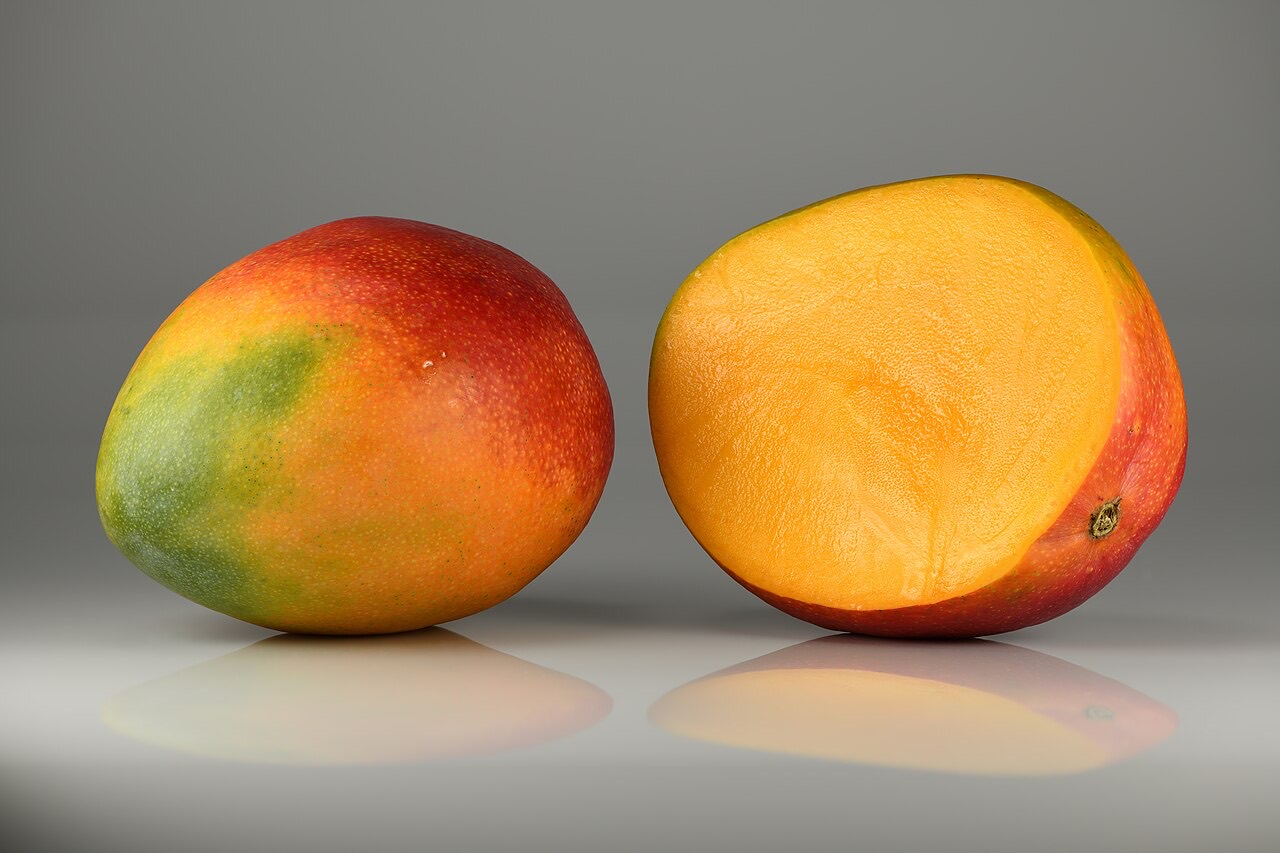
Mango is a large evergreen tree cultivated throughout the tropics and warmer subtropics, prized for its fragrant, sweet fruit. Commercial orchards are established from trees grafted onto seedling rootstocks, since grafting preserves the characteristics of a chosen cultivar and shortens the time to bearing compared with seedling trees.
Flowering in mango is influenced by a period of relatively cool or dry conditions that helps trigger flower induction, and orchard management in many regions is built around encouraging or, where needed, chemically supporting this transition from vegetative to reproductive growth.
Overview
Mango is one of the most important tropical tree fruits, grown across a wide belt of tropical and subtropical regions for both domestic consumption and export. Trees can become large and long-lived, with orchard spacing and pruning shaped by the eventual canopy size.
Flowering, and therefore yield, in mango can be strongly influenced by weather patterns preceding the flowering season, making year-to-year production more variable in some regions than for crops with less climate-dependent flowering.
Botanical classification
- Family
- Anacardiaceae (cashew family)
- Genus
- Mangifera
- Principal species
- Mangifera indica
- Growth habit
- Large evergreen tree, commercially propagated by grafting onto seedling rootstocks
Origin and distribution
Mango originated in the region spanning South Asia and Myanmar, where it has been cultivated for thousands of years, and later spread throughout Southeast Asia, Africa, and, following European exploration and colonization, to the Americas and other tropical regions worldwide.
Mango is now grown across the tropics and warm subtropics, with major production concentrated in South and Southeast Asia, alongside significant production in Africa and the Americas.
Climate requirements
Mango is adapted to tropical and warm subtropical climates and has essentially no frost tolerance; young growth and flowers are particularly vulnerable to cold damage.
A distinct dry or cool period is often important for triggering flower induction, and unusually wet or mild conditions during this window can reduce or delay flowering and, in turn, yield.
Soil requirements
Mango tolerates a wide range of soil types and pH levels provided drainage is good, with deep, well-drained soils generally preferred to support its extensive root system.
Orchard establishment and management
Mango orchards are established from grafted trees on seedling rootstocks, with spacing set to accommodate the eventual size of the canopy, which can be substantial in older, ungrafted-style plantings.
- Cultivar and rootstock selection matched to climate and market
- Wide spacing or planned canopy management for large mature trees
- Pruning to manage tree size and light penetration in modern high-density systems
- Management practices timed around the flower-induction period
Nutrient considerations
Nitrogen supports vegetative growth, but excessive nitrogen close to the flowering period can favor continued vegetative growth at the expense of flowering in some cultivars and climates. Potassium is important for fruit size and quality.
Water and irrigation
Mango is grown both rain-fed in regions with a suitable dry-then-wet seasonal pattern and under irrigation elsewhere. In some production systems, irrigation is deliberately withheld or reduced ahead of the flowering period to help encourage flower induction, before being resumed to support fruit development.
Drip irrigation is used in many commercial orchards to apply water efficiently to the root zone while supporting this staged approach to water management.
Common diseases and pests
Anthracnose is one of the most economically important diseases of mango, affecting flowers, young fruit, and ripening or stored fruit. Powdery mildew can also affect flowering panicles and young fruit, reducing fruit set in affected seasons. Thrips and aphids are among the insect pests that can damage flowers, foliage, or developing fruit.
Management combines resistant or tolerant cultivars where available, orchard sanitation, monitoring, and — where justified — locally authorized control products applied according to their labels.
Harvest
Mango is typically harvested at a mature-green stage assessed by indicators such as fruit shape, shoulder fill, and days after flowering, then allowed to ripen off the tree. Fruit is handled carefully during harvest, since the sap released at the stem end can cause skin irritation and blemishes.
Uses
- Fresh-market fruit consumption
- Juice, pulp, and nectar processing
- Dried mango and other processed snack products
- Pickles and chutneys made from unripe (green) fruit
Botanical identity
Species- Accepted name
- Mangifera indica
- Family
- Anacardiaceae
- Genus
- Mangifera
- Harvested part
- fruit
- Agricultural use
- human food
- Crop group
- Fruit
What the authorities say
- World Flora Online — Taxonomic Backbone
- Mangifera indica
- Plants of the World Online
- Mangifera indica
Botanical identity here is what the consulted taxonomic authorities publish, on the date they were read. Where authorities disagree, both readings are shown rather than one being chosen silently.
Traded as
This crop is traded as one commodity in this corpus.
No ingested price series for these commodities yet.
What AgricultureID holds for this crop
- 11 crop calendar records
- 5 pests and diseases naming this crop as a host
- 2 soil references
- 2 climate references
- 1 related crops
Not held
- No published cultivars — not researched
- No official variety registrations — source exists not mapped
- No verified extension resources — source exists not ingested
- No farm economics observations — source exists not mapped
- No market price series — source exists not mapped
An absence here means this corpus holds no such record, not that none exists.
How to read figures on this page
Production, area and trade figures for any crop change from season to season and are compiled by FAO and by national agricultural statistics agencies. Take current numbers from those primary sources, dated to the period you mean, rather than from a secondary summary — including this one.
Crop water requirements are estimated from reference evapotranspiration and local climate data, following methods published by FAO and national agricultural agencies. A requirement quoted without the reference method and the local climate behind it is not a number that can be applied to a field.
Part of
Related crops
- Shared pest and disease pressure
- Orange
Planting and harvest calendar
Usual sowing and harvest windows across 11 jurisdictions, covering mango.
Authorised inputs (France)
The French register records 10 currently authorised products whose authorised use names this crop, held by 6 authorisation holders. This is a count of what exists on the register, not a recommendation and not a shortlist.
By function
- Fongicide 9
- Acaricide 1
Targets named on the register
- Oïdium(s) 10
- Anthracnose(s) 1
Use scope is recorded as the register writes it. Collective terms cover several crops at once and are left unmapped rather than expanded, because expanding one entry into several would invent authorisations that were never granted.
Authorisation is specific to one jurisdiction, one legal object and one moment. It is not a recommendation, and it says nothing about how a product may be used: always read the current official label at the source before acting.
Tools for this
Each tool shows its formula, constants and sources, and starts empty — nothing is filled in from this page.
- Seed-rate calculator
Convert a target plant stand into a seed rate, allowing for germination and establishment.
- Row spacing calculator
Work out in-row spacing and plants per metre of row for a target density.
- Production, area and yield calculator
Relate a harvested area and a yield to a production total, in either direction.
- Growing degree-days calculator
Accumulate heat units against a base temperature.
Relationships
Evidence-backed connections in the knowledge graph.
Susceptible to
Suitable soils
Irrigation methods
Managed with
Farming systems
Harvested commodities
The traded commodities harvested from this crop. A commodity is the harvested lot, described by its own quality, grading, and storage evidence — not by the agronomy of the plant.
Scope & limitations
Geographic scope: Global overview of tropical and subtropical production. Flower-induction behavior and cultivar choice vary by region.
Climate context: Tropical to warm-subtropical evergreen tree with no meaningful frost tolerance.
- Flower-induction management and cultivar choice are climate- and region-specific and not exhaustively covered here.
- Production statistics change annually and should be taken from primary datasets such as FAOSTAT.
Sources
This article draws on the following authoritative sources. See our sources & methodology for how they are selected.
- [1]FAO — Food and Agriculture Organization (opens in a new tab)Authoritative
Food and Agriculture Organization of the United Nations (FAO)
Cited for: Global mango production and trade context
- Type:
- Intergovernmental organization
- Jurisdiction:
- Global
- Accessed:
- 2026-07-12
- [2]FAOSTAT — FAO statistical database (opens in a new tab)Authoritative
Food and Agriculture Organization of the United Nations (FAO)
Cited for: Production and area statistics
- Type:
- Intergovernmental organization
- Jurisdiction:
- Global
- Accessed:
- 2026-07-12
- Authoritative
Cited for: Classification and nomenclature
- Type:
- Reference database
- Jurisdiction:
- United States
- Accessed:
- 2026-07-12
- [4]CABI Digital Library — Crop Protection Compendium (opens in a new tab)High
CABI (Centre for Agriculture and Bioscience International)
Cited for: Mango disease and pest compendium data
- Type:
- Reference database
- Jurisdiction:
- Global
- Accessed:
- 2026-07-12
Cited for: Mango genetic resources and production research
- Type:
- Research institute
- Jurisdiction:
- Global
- Accessed:
- 2026-07-12