Crop · Culinary herb crop
Oregano
Origanum vulgare
Oregano is a perennial Mediterranean herb grown for its aromatic leaves, used fresh and dried as a culinary herb and as a source of essential oil.
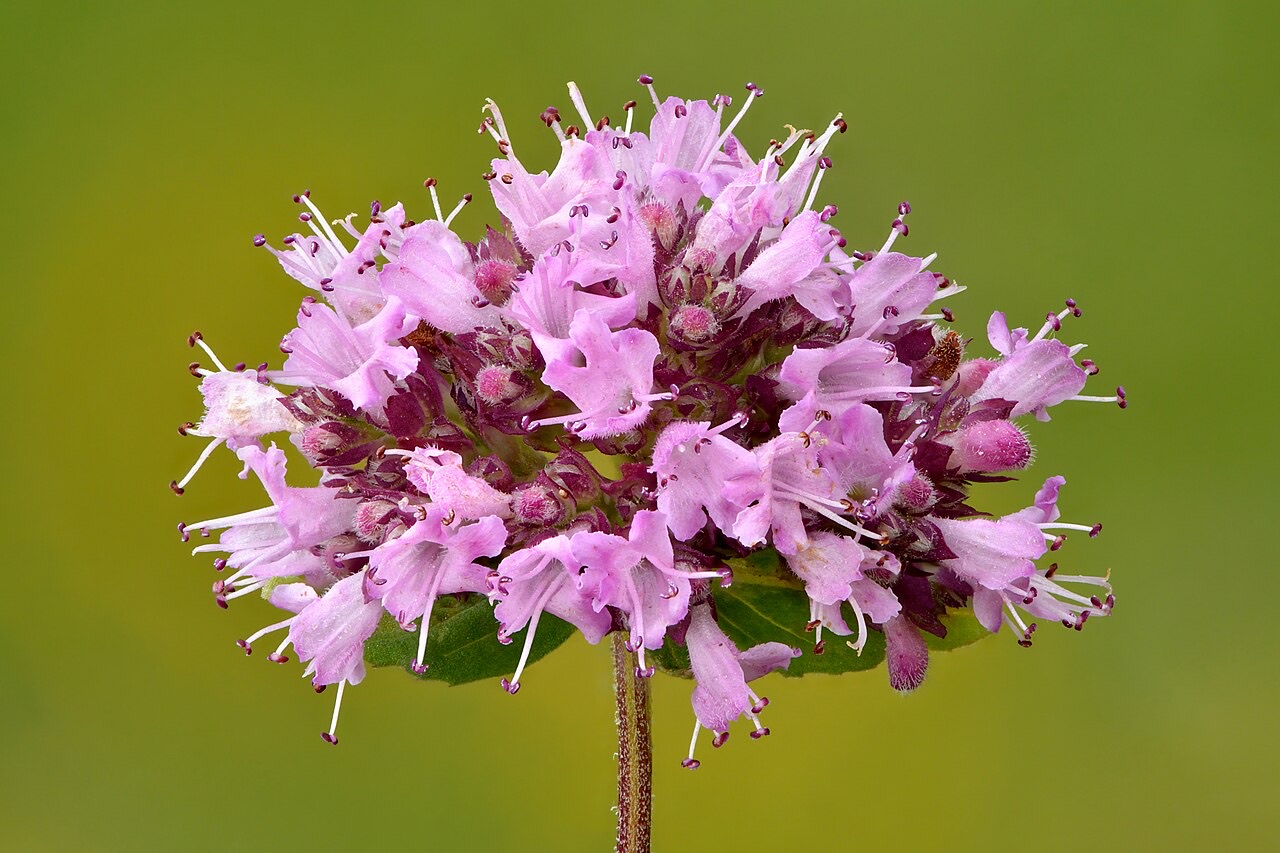
Oregano is a woody-based perennial herb adapted to warm, dry, sunny conditions typical of its Mediterranean origin. It is grown both as a compact garden herb and, in some regions, at field scale for dried herb and essential oil markets.
Flavor intensity and essential oil composition vary considerably between species and cultivars sold under the common name oregano, including related Origanum and Lippia species used regionally.
Overview
Oregano is grown in garden, field, and, less commonly, protected-cropping systems, supplying fresh-cut, dried, and processed herb markets as well as essential oil production in some regions.
Once established, oregano forms a spreading, woody-based clump that can be divided or propagated by cuttings to maintain particular flavor and aroma characteristics.
Botanical classification
- Family
- Lamiaceae (mint family)
- Genus
- Origanum
- Principal species
- Origanum vulgare
- Growth habit
- Low, spreading perennial subshrub with square stems, opposite aromatic leaves, and small clustered flowers
Origin and distribution
Oregano is native to the Mediterranean basin and parts of Western Asia, where it has long grown wild on dry, rocky hillsides and has been cultivated as a culinary herb for centuries.
Today it is grown across Mediterranean Europe, the Middle East, and other regions with suitable climates, alongside wider smaller-scale cultivation for local and garden herb markets.
Climate and soil requirements
Oregano is well adapted to hot, dry summers and mild winters typical of Mediterranean climates, tolerating drought well once established. It generally prefers full sun and can be sensitive to prolonged cold and waterlogged conditions.
Well-drained loams and sandy loams of moderate to low fertility are preferred; overly rich or consistently moist soils can promote lush but less aromatic growth and increase disease risk.
Cultivation and management
- Propagation commonly by division or cuttings to maintain specific flavor and aroma traits
- Wide spacing and good airflow to reduce humidity around foliage and limit disease
- Periodic cutting back to encourage compact, productive growth and delay woodiness
- Renewal of older plantings as productivity and leaf quality can decline over time
Nutrient considerations
Oregano generally requires modest fertility, and excessive nitrogen can favor leafy growth at the expense of the essential oil concentration that gives the herb its characteristic flavor and aroma.
Water and irrigation
Oregano tolerates drought well once established and is often grown with minimal supplemental irrigation in its native climate range, though young plantings benefit from consistent moisture during establishment.
Where irrigation is used, drip systems are common, helping avoid the prolonged leaf wetness that can encourage fungal disease.
Common diseases and pests
Root rot is a key risk on poorly drained sites, since oregano is sensitive to waterlogged soil, and powdery mildew can affect foliage under humid conditions. Aphids and spider mites are common pests affecting foliage.
| Problem | Type | Notes |
|---|---|---|
| Root rot | Disease | Linked to poor drainage and waterlogging |
| Powdery mildew | Disease | Favored by humid conditions |
| Aphids | Pest | Sap-feeding insects on foliage |
| Spider mites | Pest | Favored by hot, dry conditions |
Harvest
Leafy stems are cut, typically just before or during early flowering when essential oil concentration is often highest, then used fresh or dried and stripped from stems for storage.
Uses
- Fresh and dried leaves used widely as a culinary herb, particularly in Mediterranean cuisines
- Essential oil extracted for the flavor and fragrance industries
- Dried herb blends and seasoning products
- Ornamental and pollinator-friendly groundcover use in some garden settings
Botanical identity
Species- Accepted name
- Origanum vulgare
- Family
- Lamiaceae
- Genus
- Origanum
- Harvested part
- leaf
- Agricultural use
- spice, human food
- Crop group
- Spices and herbs
What the authorities say
- World Flora Online — Taxonomic Backbone
- Origanum vulgare
- Plants of the World Online
- Origanum vulgare
Botanical identity here is what the consulted taxonomic authorities publish, on the date they were read. Where authorities disagree, both readings are shown rather than one being chosen silently.
What AgricultureID holds for this crop
- 2 soil references
- 2 climate references
Not held
- No crop calendar records — source exists not mapped
- No published cultivars — not researched
- No official variety registrations — source exists not mapped
- No verified extension resources — source exists not ingested
- No pests and diseases naming this crop as a host — source exists not ingested
- No farm economics observations — source exists not mapped
- No market price series — source exists not mapped
- No related crops — not applicable
An absence here means this corpus holds no such record, not that none exists.
How to read figures on this page
Production, area and trade figures for any crop change from season to season and are compiled by FAO and by national agricultural statistics agencies. Take current numbers from those primary sources, dated to the period you mean, rather than from a secondary summary — including this one.
Crop water requirements are estimated from reference evapotranspiration and local climate data, following methods published by FAO and national agricultural agencies. A requirement quoted without the reference method and the local climate behind it is not a number that can be applied to a field.
Tools for this
Each tool shows its formula, constants and sources, and starts empty — nothing is filled in from this page.
- Seed-rate calculator
Convert a target plant stand into a seed rate, allowing for germination and establishment.
- Row spacing calculator
Work out in-row spacing and plants per metre of row for a target density.
- Production, area and yield calculator
Relate a harvested area and a yield to a production total, in either direction.
- Growing degree-days calculator
Accumulate heat units against a base temperature.
Relationships
Evidence-backed connections in the knowledge graph.
Susceptible to
Nutrients required
Suitable soils
Climate sensitivity
Irrigation methods
Managed with
Farming systems
Scope & limitations
Geographic scope: Global overview; traditionally grown across Mediterranean Europe and the Middle East, with wider cultivation elsewhere for herb and oil markets.
Climate context: Mediterranean-adapted perennial subshrub tolerant of heat and drought once established; sensitive to waterlogging and prolonged cold.
- Flavor and essential oil composition vary considerably between species and cultivars sold as oregano, which is not detailed exhaustively here.
- Oregano is discussed here only as a culinary and agricultural crop; medicinal or health-efficacy claims are outside the scope of this reference.
Sources
This article draws on the following authoritative sources. See our sources & methodology for how they are selected.
- [1]FAO — Food and Agriculture Organization (opens in a new tab)Authoritative
Food and Agriculture Organization of the United Nations (FAO)
Cited for: Global herb crop production context
- Type:
- Intergovernmental organization
- Jurisdiction:
- Global
- Accessed:
- 2026-07-12
- [2]CABI Digital Library — Crop Protection Compendium (opens in a new tab)High
CABI (Centre for Agriculture and Bioscience International)
Cited for: Oregano disease and pest compendium data
- Type:
- Reference database
- Jurisdiction:
- Global
- Accessed:
- 2026-07-12
- Moderate
Cited for: Cultivation guidance
- Type:
- Reference database
- Jurisdiction:
- United Kingdom
- Accessed:
- 2026-07-12
- Authoritative
Cited for: Classification and nomenclature
- Type:
- Reference database
- Jurisdiction:
- United States
- Accessed:
- 2026-07-12