Crop · Culinary herb crop
Parsley
Petroselinum crispum
Parsley is a biennial herb grown for its fresh leaves, used widely as a culinary garnish and flavoring, typically harvested in its first year before the plant flowers and sets seed in its second.
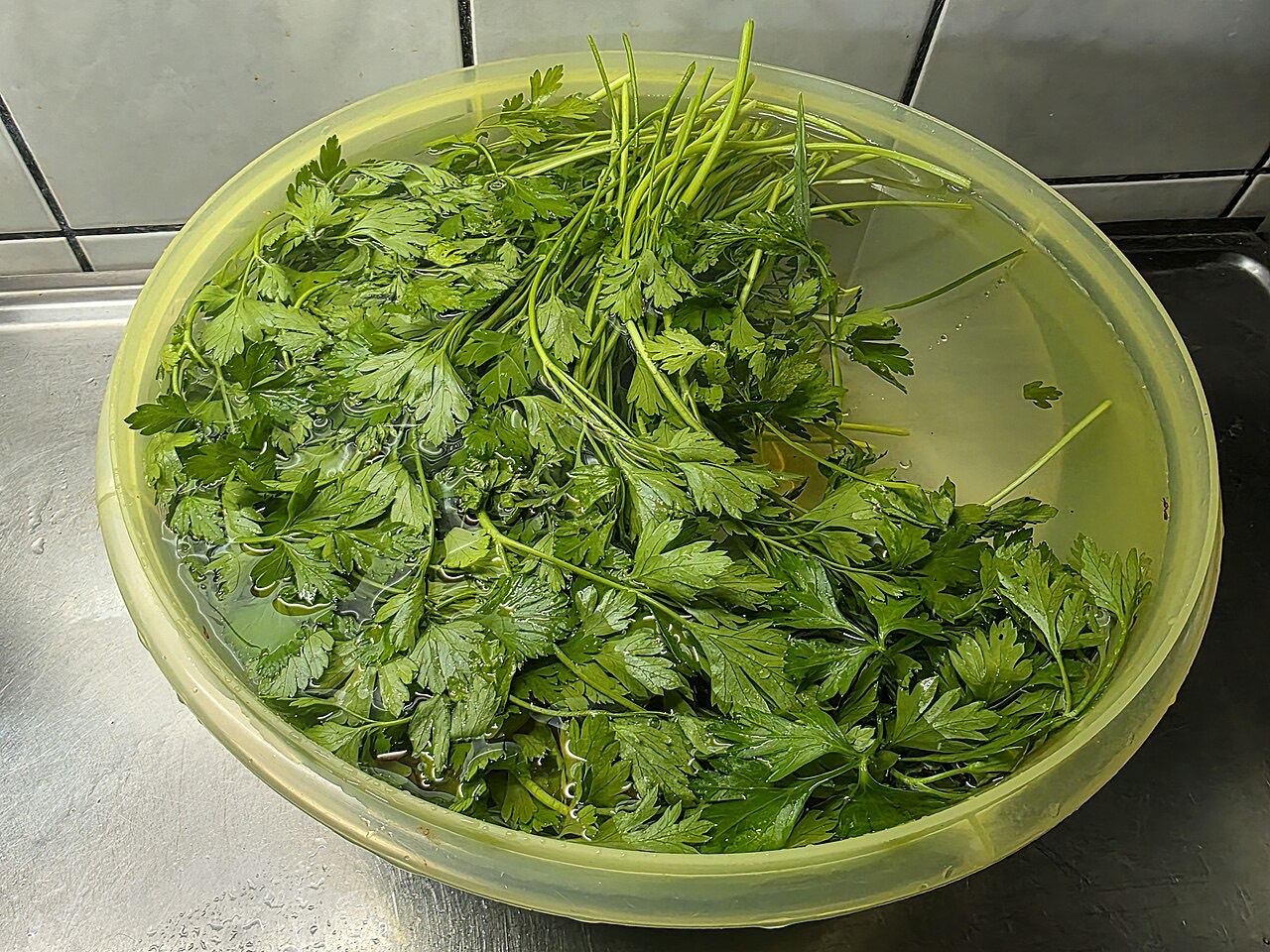
Parsley is a true biennial: in its first year it produces a rosette of leafy growth, the stage at which it is harvested for culinary use, and in its second year it bolts, flowers, and sets seed before dying. Most commercial and garden production focuses entirely on the first-year leaf stage.
Two main cultivar groups are grown: curly-leaved parsley, valued partly for its garnish appearance, and flat-leaved (Italian) parsley, generally preferred for its stronger flavor in cooking.
Overview
Parsley is grown widely in home gardens and commercial horticulture for fresh-cut, potted, and dried herb markets. Its cool-season tolerance and moderate frost hardiness allow production across a broad range of temperate climates.
Because parsley is grown almost exclusively for leaf, not seed, in commercial production, most crops are harvested and terminated well before the plant reaches its second, flowering year.
Botanical classification
- Family
- Apiaceae (carrot family)
- Genus
- Petroselinum
- Principal species
- Petroselinum crispum
- Growth habit
- Biennial herb forming a basal rosette of divided leaves in its first year, followed by a flowering stem in its second
Origin and distribution
Parsley is native to the central Mediterranean region and has been cultivated since antiquity, valued both as a culinary herb and, historically, as a garnish and garden ornamental.
It is now grown throughout temperate regions worldwide, supplying fresh, dried, and processed herb markets. Production statistics are compiled at national and regional levels rather than through a single global dataset.
Climate and soil requirements
Parsley grows best in cool to mild conditions and tolerates light frost, allowing production to extend into cooler shoulder seasons in many climates. Prolonged heat can reduce leaf quality and hasten bolting.
Fertile, moisture-retentive loams and sandy loams support strong leafy growth. The crop performs poorly on shallow, compacted, or poorly drained soils.
Cultivation and management
- Direct seeding or transplanting, with attention to the crop’s characteristically slow germination
- Repeated cutting of outer leaves to encourage continued regrowth through the harvest period
- Crop rotation with unrelated species to manage soil-borne disease and pest pressure
- Timely removal of plants that begin to bolt, to maintain leaf quality in continued plantings
Nutrient considerations
Nitrogen strongly influences leafy growth and is central to parsley’s value as a fresh herb, while potassium supports overall plant vigor across repeated cuttings.
Water and irrigation
Consistent soil moisture supports even leaf growth and helps maintain quality across repeated harvests; drought stress can toughen leaves and hasten bolting.
Drip irrigation is commonly used in commercial parsley production to maintain steady moisture while limiting prolonged leaf wetness.
Common diseases and pests
Powdery mildew can affect parsley foliage later in the season, and bacterial leaf spot can cause water-soaked lesions under humid, wet conditions. Aphids are common sap-feeding pests, and leaf miners can tunnel within leaves, reducing marketable quality.
| Problem | Type | Notes |
|---|---|---|
| Powdery mildew | Disease | Common foliar disease later in the season |
| Bacterial leaf spot | Disease | Favored by humid, wet conditions |
| Aphids | Pest | Sap-feeding insects on foliage |
| Leaf miners | Pest | Larvae tunnel within leaf tissue |
Harvest
Outer leaves and stems are cut by hand or machine once plants reach sufficient size, allowing repeated harvests from the same planting as new growth emerges from the center of the rosette.
Uses
- Fresh leaves used widely as a culinary garnish and flavoring herb
- Dried and freeze-dried parsley used in packaged seasoning blends
- Fresh-cut and potted herb products for retail markets
- Root parsley, a related cultivar group grown for its edible root, used as a vegetable in some cuisines
Botanical identity
Species- Accepted name
- Petroselinum crispum
- Family
- Apiaceae
- Genus
- Petroselinum
- Harvested part
- leaf
- Agricultural use
- human food, spice
- Crop group
- Spices and herbs, Vegetables
What the authorities say
- World Flora Online — Taxonomic Backbone
- Petroselinum crispum
- Plants of the World Online
- Petroselinum crispum
Botanical identity here is what the consulted taxonomic authorities publish, on the date they were read. Where authorities disagree, both readings are shown rather than one being chosen silently.
What AgricultureID holds for this crop
- 13 crop calendar records
- 2 soil references
- 2 climate references
Not held
- No published cultivars — not researched
- No official variety registrations — source exists not mapped
- No verified extension resources — source exists not ingested
- No pests and diseases naming this crop as a host — source exists not ingested
- No farm economics observations — source exists not mapped
- No market price series — source exists not mapped
- No related crops — not applicable
An absence here means this corpus holds no such record, not that none exists.
How to read figures on this page
Production, area and trade figures for any crop change from season to season and are compiled by FAO and by national agricultural statistics agencies. Take current numbers from those primary sources, dated to the period you mean, rather than from a secondary summary — including this one.
Crop water requirements are estimated from reference evapotranspiration and local climate data, following methods published by FAO and national agricultural agencies. A requirement quoted without the reference method and the local climate behind it is not a number that can be applied to a field.
Part of
Planting and harvest calendar
Usual sowing and harvest windows across 13 jurisdictions, covering parsley.
Tools for this
Each tool shows its formula, constants and sources, and starts empty — nothing is filled in from this page.
- Seed-rate calculator
Convert a target plant stand into a seed rate, allowing for germination and establishment.
- Row spacing calculator
Work out in-row spacing and plants per metre of row for a target density.
- Production, area and yield calculator
Relate a harvested area and a yield to a production total, in either direction.
- Growing degree-days calculator
Accumulate heat units against a base temperature.
Relationships
Evidence-backed connections in the knowledge graph.
Susceptible to
Suitable soils
Climate sensitivity
Irrigation methods
Managed with
Scope & limitations
Geographic scope: Global overview; grown throughout temperate regions worldwide for fresh, dried, and processed herb markets.
Climate context: Cool-season biennial herb, moderately frost-tolerant, grown almost exclusively as a first-year leaf crop before flowering.
- Curly- and flat-leaved cultivar groups differ in flavor intensity and use, which is not detailed exhaustively here.
- Production statistics for parsley are reported inconsistently across countries and should be taken from primary national or FAO datasets.
Sources
This article draws on the following authoritative sources. See our sources & methodology for how they are selected.
- Moderate
Cited for: Cultivation and site guidance
- Type:
- Reference database
- Jurisdiction:
- United Kingdom
- Accessed:
- 2026-07-12
- Authoritative
Cited for: Classification and nomenclature
- Type:
- Reference database
- Jurisdiction:
- United States
- Accessed:
- 2026-07-12
- [3]CABI Digital Library — Crop Protection Compendium (opens in a new tab)High
CABI (Centre for Agriculture and Bioscience International)
Cited for: Parsley disease and pest compendium data
- Type:
- Reference database
- Jurisdiction:
- Global
- Accessed:
- 2026-07-12
- [4]FAO — Food and Agriculture Organization (opens in a new tab)Authoritative
Food and Agriculture Organization of the United Nations (FAO)
Cited for: Global herb crop production context
- Type:
- Intergovernmental organization
- Jurisdiction:
- Global
- Accessed:
- 2026-07-12