Crop · Vegetable crop
Pumpkin
Cucurbita pepo, Cucurbita maxima, and Cucurbita moschata (species cultivated as pumpkin vary by region and type)
Also known as: Winter squash
Pumpkin is a warm-season vining crop grown for its large, hard-rinded fruit, harvested mature and valued for both food use and long storage life compared with summer squash types.
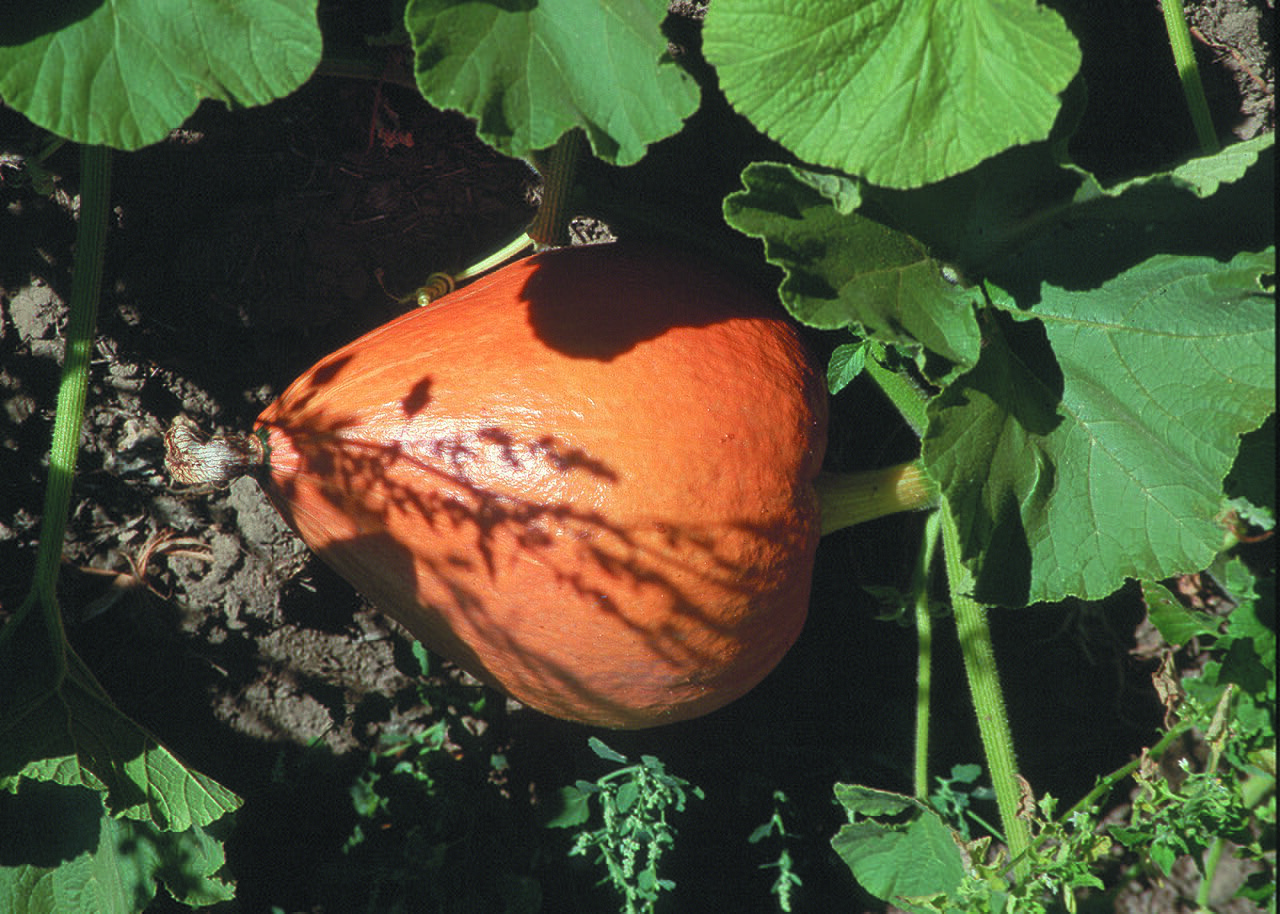
"Pumpkin" is a common name applied to certain cultivated types within several species of Cucurbita, harvested at full maturity when the rind has hardened, distinguishing them from summer squash types of the same genus that are picked immature.
The hardened rind and mature seed of pumpkin support substantially longer storage than summer squash, and the crop is grown both for direct food use and, in many markets, for seasonal decorative and cultural uses.
Overview
Pumpkin is grown as a warm-season annual on typically sprawling vines, though some bush-type cultivars exist, producing large fruit that are harvested once fully mature and the rind has hardened sufficiently for storage and handling.
Because several distinct Cucurbita species are marketed as "pumpkin" depending on region and fruit type, cultivar and species selection is an important early decision matched to local climate and intended use.
Botanical classification
- Family
- Cucurbitaceae (gourd family)
- Principal species
- Cucurbita pepo, Cucurbita maxima, and Cucurbita moschata, depending on regional pumpkin type
- Growth habit
- Vining or, in some cultivars, bush-type annual bearing large fruit with a hard mature rind
Origin and distribution
The Cucurbita species grown as pumpkin were domesticated in the Americas, among the earliest crops cultivated there, with different species domesticated in different regions before spreading globally following European contact.
Pumpkin is now grown widely across temperate and warm regions worldwide.
Climate requirements
Pumpkin requires warm soil and air temperatures for germination and growth and is sensitive to frost, with a comparatively long period from sowing to full fruit maturity relative to summer squash types.
Field planting is timed to allow the crop to reach maturity before the first autumn frost in temperate regions, since immature fruit generally does not store as well.
Soil requirements
Pumpkin performs best on fertile, well-drained loams with good moisture-holding capacity, supporting the extensive vine growth and large fruit size characteristic of the crop.
Establishment and crop management
Pumpkin is typically direct-seeded after soil has warmed and frost risk has passed, at wide spacing to accommodate the sprawling vine growth of most cultivars, though transplants are used in some systems for an earlier start.
- Species and cultivar selection matched to fruit size, use (food or decorative), and local season length
- Multi-year rotation away from cucurbits, which a long-season storage crop can afford and a double-cropped summer squash often cannot
- Adequate pollinator activity, since fruit set depends on pollen transfer between separate male and female flowers
- Fruit thinning in some systems to concentrate plant resources on fewer, larger fruit
Nutrient considerations
Nitrogen supports the extensive vegetative growth needed before fruiting, while potassium contributes to fruit size, rind quality, and storage life.
Water and irrigation
Pumpkin has substantial water demand during vine growth and fruit development, given the size of the mature fruit, and both furrow and drip irrigation are used depending on scale and region, alongside rain-fed production in areas with adequate seasonal rainfall.
Common diseases and pests
Powdery mildew and downy mildew are common foliar diseases of pumpkin, capable of reducing leaf area and, in turn, fruit size and quality if unmanaged. Aphids and whiteflies are notable insect pests, both directly and as virus vectors.
Management combines resistant cultivars, crop rotation, monitoring, and — where justified — locally authorized control products applied according to their labels.
Harvest
Pumpkin is harvested once the fruit has reached full color and the rind has hardened enough to resist puncture, generally cut from the vine with a portion of stem attached, since fruit with a broken or missing stem tends to store poorly.
Uses
- Fresh and processed food, including canned puree, soups, and baked goods
- Seed roasted as a snack or pressed for oil
- Livestock feed in some production regions
- Decorative and seasonal cultural uses in some markets
What this page covers
genus conceptThis page covers pumpkins and winter squashes, which are grown from several Cucurbita species that differ in rind, keeping quality and stem form. No single species is "the" pumpkin.
The page covers several cultivated species of one genus. Each is a real, separately verifiable taxon; the page exists because the trade name covers all of them.
| Taxon | In this corpus | Role |
|---|---|---|
| Cucurbita pepoField pumpkin | held only as a cultivar group | Carries the Halloween pumpkins, acorn squash, and — as the Zucchini Group the corpus does hold — courgettes. |
| Cucurbita maximaWinter squash | held as a verified taxon — listed in the taxa register, no page of its own | The largest fruits and the best keepers; soft round stem. |
| Cucurbita moschataButternut squash | held as a verified taxon — listed in the taxa register, no page of its own | The most heat- and disease-tolerant of the four; hard flared stem. |
| Cucurbita argyrospermaCushaw squash | held as a verified taxon — listed in the taxa register, no page of its own | Grown mainly in Mexico and Central America, often for seed. |
| Cucurbita ficifoliaFig-leaf gourd | held as a verified taxon — listed in the taxa register, no page of its own | A highland species used for preserves and as cucurbit rootstock. Omitted from the original scope note. |
When a taxon here earns its own page: A species earns a page when its rind, storage behaviour and disease susceptibility make genus-level advice misleading. Cucurbita pepo would additionally require the species identity the corpus does not currently hold.
Botanical identity
Genus-level crop concept- Accepted name
- CucurbitaL.
- Family
- Cucurbitaceae
- Genus
- Cucurbita
- Harvested part
- fruit
- Agricultural use
- human food, animal feed
- Crop group
- Vegetables
What the authorities say
- Plants of the World Online
- Cucurbita
"Pumpkin" is not one species. Commercial pumpkins and winter squashes are grown from at least four cultivated Cucurbita species — C. pepo, C. maxima, C. moschata and C. argyrosperma — which differ in rind, keeping quality, stem form and disease susceptibility. All four are held separately with verified identities. Naming a single species as "pumpkin" would pick one arbitrarily and be wrong about the rest.
- "Pumpkin", "squash" and "winter squash" are culinary and market terms that cut across four cultivated Cucurbita species. Which species a given pumpkin is matters agronomically and is not recoverable from the common name.
Botanical identity here is what the consulted taxonomic authorities publish, on the date they were read. Where authorities disagree, both readings are shown rather than one being chosen silently.
What AgricultureID holds for this crop
- 168 crop calendar records
- 2 soil references
- 2 climate references
- 1 related crops
Not held
- No published cultivars — not researched
- No official variety registrations — source exists not mapped
- No verified extension resources — source exists not ingested
- No pests and diseases naming this crop as a host — source exists not ingested
- No farm economics observations — source exists not mapped
- No market price series — source exists not mapped
An absence here means this corpus holds no such record, not that none exists.
How to read figures on this page
Production, area and trade figures for any crop change from season to season and are compiled by FAO and by national agricultural statistics agencies. Take current numbers from those primary sources, dated to the period you mean, rather than from a secondary summary — including this one.
Crop water requirements are estimated from reference evapotranspiration and local climate data, following methods published by FAO and national agricultural agencies. A requirement quoted without the reference method and the local climate behind it is not a number that can be applied to a field.
Part of
Related crops
- Same crop concept
- Zucchini
Planting and harvest calendar
Usual sowing and harvest windows across 168 jurisdictions, covering pumpkin and pumpkin — season 1 and pumpkin — season 2.
Tools for this
Each tool shows its formula, constants and sources, and starts empty — nothing is filled in from this page.
- Seed-rate calculator
Convert a target plant stand into a seed rate, allowing for germination and establishment.
- Row spacing calculator
Work out in-row spacing and plants per metre of row for a target density.
- Production, area and yield calculator
Relate a harvested area and a yield to a production total, in either direction.
- Growing degree-days calculator
Accumulate heat units against a base temperature.
Relationships
Evidence-backed connections in the knowledge graph.
Susceptible to
Suitable soils
Climate sensitivity
Irrigation methods
Scope & limitations
Geographic scope: Global overview. Agronomic details (timing, rates, varieties) are region-specific and vary widely.
Climate context: Warm-season crop with a relatively long maturity period; frost-sensitive and timed to mature before autumn frost in temperate regions.
- The term "pumpkin" spans several Cucurbita species with different sizes, uses, and agronomy; this entry is a general overview rather than species-specific detail.
- Production statistics change annually and should be taken from primary datasets such as FAOSTAT.
Sources
This article draws on the following authoritative sources. See our sources & methodology for how they are selected.
- [1]FAO — Food and Agriculture Organization (opens in a new tab)Authoritative
Food and Agriculture Organization of the United Nations (FAO)
Cited for: Role of pumpkin and winter squash in vegetable production
- Type:
- Intergovernmental organization
- Jurisdiction:
- Global
- Accessed:
- 2026-07-12
- [2]FAOSTAT — FAO statistical database (opens in a new tab)Authoritative
Food and Agriculture Organization of the United Nations (FAO)
Cited for: Production, area, and trade statistics
- Type:
- Intergovernmental organization
- Jurisdiction:
- Global
- Accessed:
- 2026-07-12
- Authoritative
Cited for: Classification and nomenclature
- Type:
- Reference database
- Jurisdiction:
- United States
- Accessed:
- 2026-07-12
- [4]CABI Digital Library — Crop Protection Compendium (opens in a new tab)High
CABI (Centre for Agriculture and Bioscience International)
Cited for: Cucurbit disease and pest compendium data
- Type:
- Reference database
- Jurisdiction:
- Global
- Accessed:
- 2026-07-12
- [5]UC Statewide Integrated Pest Management Program (UC IPM) (opens in a new tab)High
University of California Agriculture and Natural Resources (UC ANR)
Cited for: Integrated pest management guidelines for pumpkin
- Type:
- University extension service
- Jurisdiction:
- United States (California)
- Accessed:
- 2026-07-12