Pest · Insect pest
Whiteflies
Family Aleyrodidae (order Hemiptera)
Also known as: White flies, Aleyrodids
Whiteflies are small, moth-like sap-feeding insects found on the undersides of leaves. They weaken plants through feeding and honeydew production, and several species are important vectors of plant viruses.
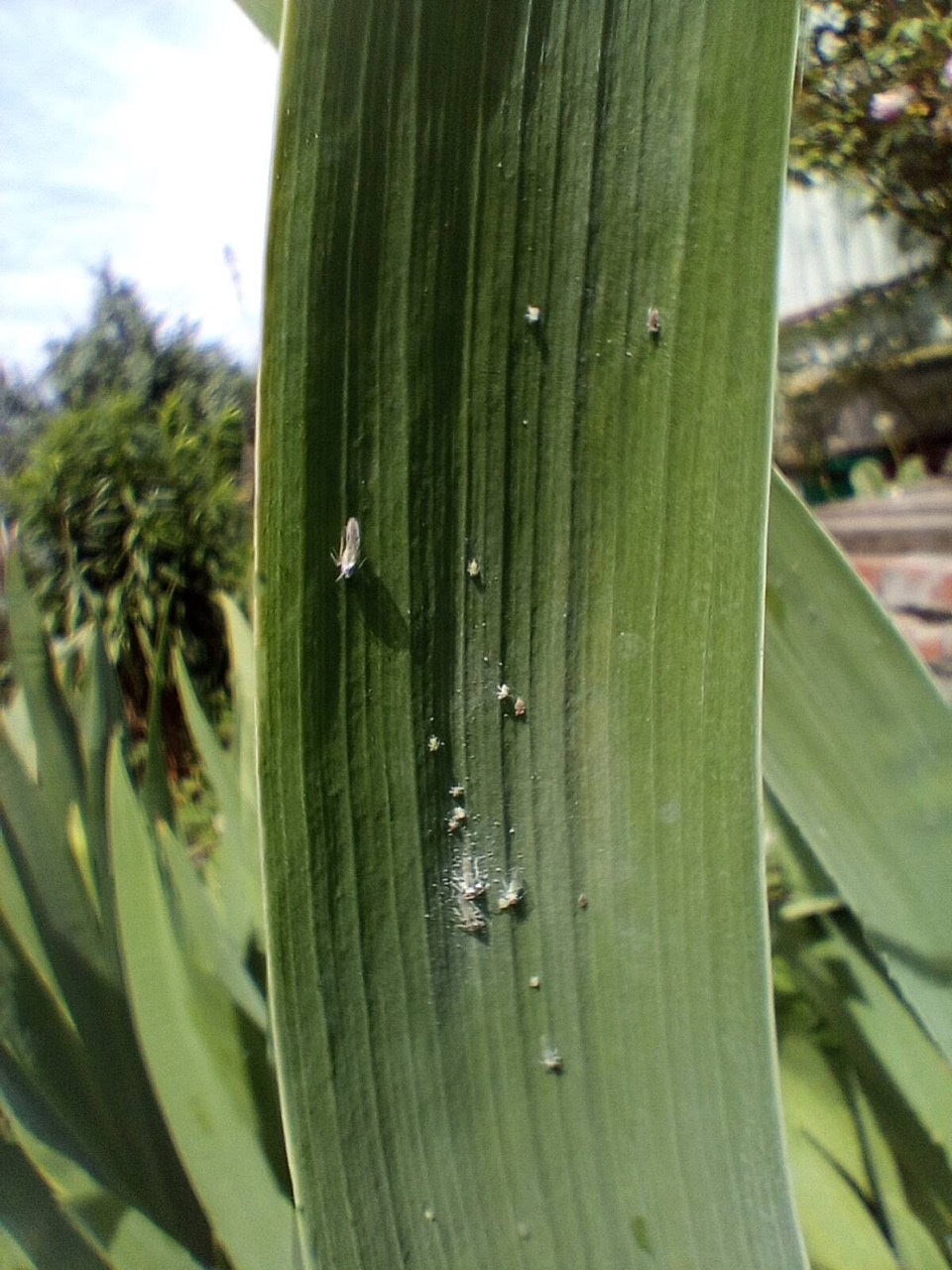
Whiteflies are small insects, typically only one to two millimetres long, with a powdery white wax coating that gives adults a moth-like appearance. They are true bugs in the order Hemiptera, related to aphids and scale insects, and are found worldwide on a very wide range of host plants, particularly in warm climates and protected growing environments such as greenhouses.
Like aphids, whiteflies feed by inserting piercing-sucking mouthparts into plant tissue to withdraw sap, and they excrete sugary honeydew as a byproduct. Certain whitefly species, most notably Bemisia tabaci, are also highly efficient vectors of plant viruses, including begomoviruses that can cause severe disease in tomato and other crops.
Identification
Adult whiteflies are tiny, winged insects covered in a fine white wax, usually resting on the undersides of leaves. Immature stages (nymphs) are flattened, oval, and scale-like, ranging from translucent to pale yellow, and remain fixed in place while feeding on the underside of leaves.
- Adults fly up in a small cloud when infested foliage is disturbed
- Sticky honeydew on leaves and surfaces below, often with black sooty mould growing on it
- Yellowing, wilting, or reduced vigour under heavy, sustained infestation
- Pale, flattened nymphs and cast skins visible on the undersides of leaves
Biology and life cycle
Eggs are laid on the undersides of leaves, often anchored by a short stalk and sometimes arranged in a circular or arc-shaped pattern. After hatching, a brief mobile "crawler" stage settles to begin feeding, after which the nymph passes through several flattened, immobile instars before a final non-feeding stage that precedes adult emergence.
| Stage | Description |
|---|---|
| Egg | Laid on the underside of leaves, often anchored by a short stalk. |
| Crawler (1st instar) | Brief mobile stage; settles to begin feeding. |
| Sessile nymphal instars | Flattened, scale-like, immobile stages that feed continuously. |
| Pupal (final) stage | Non-feeding stage preceding adult emergence. |
| Adult | Winged, mobile stage capable of dispersal and, in some species, virus transmission. |
In warm climates and protected environments such as greenhouses, generations overlap continuously, so all life stages may be present at once and populations can persist without a clear seasonal gap.
Damage and hosts
Direct feeding by large whitefly populations can weaken plants, cause yellowing, and reduce vigour. Honeydew excreted during feeding coats leaves and fruit, and the sooty mould that grows on it can further reduce photosynthesis and lower produce quality. For many crops, however, the greatest economic impact comes from the plant viruses that some whitefly species transmit while feeding.
Whiteflies attack a very broad range of host crops. Notable hosts include tomato, potato, and soybean, alongside many other vegetables and ornamentals, with the specific pest species and dominant biotype varying by region and cropping system.
Monitoring
Regular scouting for whiteflies focuses on the undersides of leaves and on field or greenhouse margins, where colonization often begins, so that trends can be tracked before populations become difficult to manage.
- Yellow sticky traps placed within the canopy to catch flying adults
- Inspection of leaf undersides for eggs, nymphs, and cast skins
- Gently disturbing foliage to observe adults flushing into flight
- Prioritizing field edges or greenhouse entry points where infestations often start
Management principles
Whitefly management, like that of other sap-feeding pests, relies on combining several tactics within an integrated pest management approach rather than a single control method.
- Conserve natural enemies such as parasitic wasps, predatory beetles, and lacewings
- Avoid excessive nitrogen fertilization, which can encourage lush growth attractive to whiteflies
- Use reflective mulches or fine screening in greenhouses to reduce colonization where practical
- Remove heavily infested crop residues and manage weeds that can host whiteflies between crops
- Monitor with traps and leaf inspection, and use local thresholds to guide any intervention
Relationships
Evidence-backed connections in the knowledge graph.
Scope & limitations
Geographic scope: Global overview of a large insect family; pest species, biotypes, virus relationships, and guidance vary by region and by production system (open field versus protected cultivation).
Climate context: Whitefly populations build fastest in warm conditions and can persist year-round in greenhouses and mild climates.
- This is a general overview of a large insect family, not species- or biotype-level guidance for a specific crop or region.
- Virus-vector relationships differ among whitefly species and biotypes and are not exhaustively covered here.
- Thresholds and control-product recommendations are jurisdiction-specific and are not provided here.
Sources
This article draws on the following authoritative sources. See our sources & methodology for how they are selected.
- [1]UC Statewide Integrated Pest Management Program (UC IPM) (opens in a new tab)High
University of California Agriculture and Natural Resources (UC ANR)
Cited for: Whitefly identification and IPM principles
- Type:
- University extension service
- Jurisdiction:
- United States (California)
- Accessed:
- 2026-07-12
- [2]CABI Digital Library — Crop Protection Compendium (opens in a new tab)High
CABI (Centre for Agriculture and Bioscience International)
Cited for: Whitefly biology, hosts, and importance
- Type:
- Reference database
- Jurisdiction:
- Global
- Accessed:
- 2026-07-12
- [3]EPPO Global Database (opens in a new tab)Authoritative
European and Mediterranean Plant Protection Organization (EPPO)
Cited for: Species nomenclature and distribution
- Type:
- Reference database
- Jurisdiction:
- Global
- Accessed:
- 2026-07-12
- [4]Iowa State University Extension and Outreach (opens in a new tab)High
Iowa State University Extension and Outreach
Cited for: Monitoring and management context in field crops
- Type:
- University extension service
- Jurisdiction:
- United States (Iowa)
- Accessed:
- 2026-07-12
- [5]USDA APHIS — Animal and Plant Health Inspection Service (opens in a new tab)Authoritative
USDA Animal and Plant Health Inspection Service (APHIS)
Cited for: Regulatory context for whitefly-vectored plant viruses
- Type:
- Government agency
- Jurisdiction:
- United States
- Accessed:
- 2026-07-12
Related topics
Crops
- Bitter Gourd
- Black Gram
- Bottle Gourd
- Cape Gooseberry
- Cassava
- Castor Bean
- Chayote
- Chia
- Cotton
- Cucumber
- Fenugreek
- Gboma Eggplant
- Guar
- Horse Gram
- Jack Bean
- Jatropha
- Jicama
- Kenaf
- Lablab
- Lima Bean
- Melon
- Moth Bean
- Mung Bean
- Papaya
- Perilla
- Potato
- Pumpkin
- Rice Bean
- Scarlet Eggplant
- Sesame
- Soybean
- Stevia
- Sweet Pepper
- Tomatillo
- Tomato
- Upland Cotton
- Velvet Bean
- Water Spinach
- Waterleaf
- Watermelon
- Winged Bean
- Yardlong Bean
- Zucchini