Crop · Vegetable crop
Artichoke
Cynara cardunculus var. scolymus
Also known as: Globe artichoke
Artichoke is a perennial thistle-like plant of the daisy family grown for its large, immature flower buds, harvested and eaten as a vegetable before the flower opens.
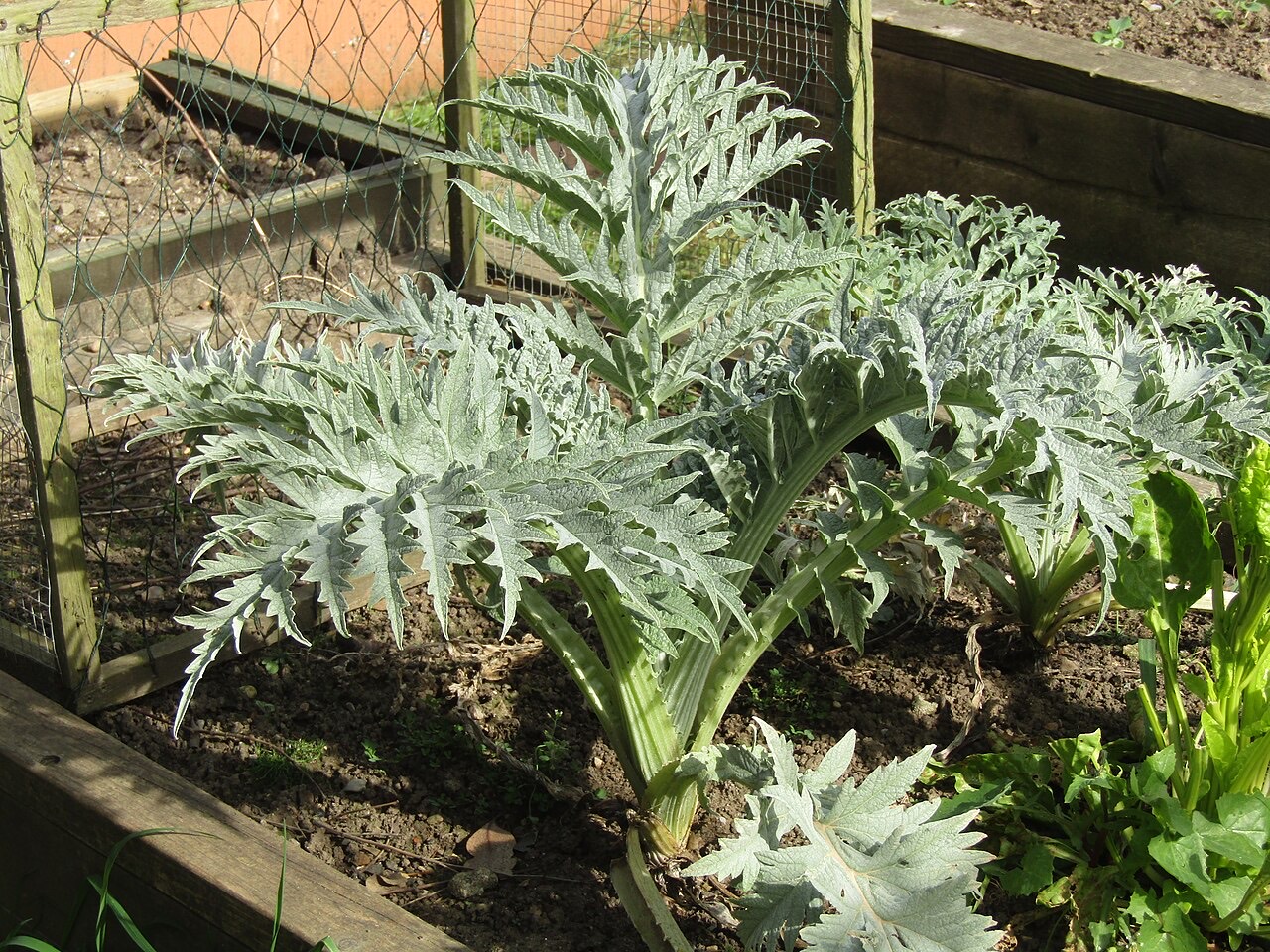
Globe artichoke is a cultivated variety of Cynara cardunculus, the same species that includes cardoon, grown instead for its edible leaf stalks. Artichoke plants form a rosette of large, deeply lobed leaves surrounding thick flowering stems that bear the harvested buds.
Although artichoke is a true perennial capable of producing for several years from the same root system, it is grown as an annual in some colder climates where winter conditions are too severe for the crown to survive.
Overview
Artichoke is grown commercially in regions with mild, relatively cool-summer coastal or Mediterranean climates, which favor extended bud production and high-quality heads.
Established plantings can remain productive for several years, with individual plants producing multiple buds per stem across a defined harvest season each year.
Botanical classification
- Family
- Asteraceae (daisy family)
- Genus
- Cynara
- Principal species
- Cynara cardunculus var. scolymus
- Growth habit
- Large perennial herb forming a rosette of lobed leaves and thick flowering stems bearing large, bracted flower heads (the harvested "buds")
Origin and distribution
Globe artichoke is believed to have been selected from wild Cynara cardunculus populations native to the Mediterranean region, where it has been cultivated since ancient times.
Italy, Spain, and Egypt are among the leading producers today, alongside significant production in the United States, particularly in coastal California.
Climate and soil requirements
Artichoke favors mild, relatively cool-summer climates with moderate winters; it has some tolerance of light frost once established but can be damaged or killed by hard freezes, particularly in young plantings.
Deep, fertile, well-drained loams and sandy loams support the large root system needed for a productive, long-lived planting. Poorly drained soils increase the risk of crown and root disease.
Cultivation and management
- Establishment from crown divisions, rooted suckers, or seed-grown transplants, depending on cultivar and region
- Wide spacing to accommodate the plant’s large mature size and multi-year growth
- Removal of spent flowering stems after harvest to encourage subsequent regrowth
- Winter crown management, including mulching or cutting back, in regions with cold winters
Nutrient considerations
Nitrogen supports the vigorous leafy growth needed to sustain bud production, while potassium contributes to overall plant vigor and bud quality across the harvest season.
Water and irrigation
Artichoke requires consistent moisture for good bud size and quality, and drought stress during bud development can lead to smaller, lower-quality heads.
Drip irrigation is widely used in commercial production to maintain steady soil moisture while limiting excess leaf wetness and associated disease risk.
Common diseases and pests
Gray mold can affect flower buds and bracts under cool, humid conditions, sometimes causing significant losses close to harvest, while root rot can weaken or kill plants on poorly drained sites. Aphids are common sap-feeding pests on foliage and buds, and slugs can damage young growth, particularly in cool, moist conditions.
| Problem | Type | Notes |
|---|---|---|
| Gray mold | Disease | Can affect buds and bracts under cool, humid conditions |
| Root rot | Disease | Risk increased on poorly drained sites |
| Aphids | Pest | Sap-feeding insects on foliage and buds |
| Slugs | Pest | Damage young growth in cool, moist conditions |
Harvest
Flower buds are hand-cut while still tightly closed and before the bracts begin to open, typically starting with the large terminal bud on each stem, followed by smaller lateral buds as the season progresses.
Uses
- Fresh immature flower buds eaten steamed, boiled, grilled, or roasted as a vegetable
- Artichoke hearts canned, jarred, or frozen for retail and food-service markets
- Ingredient in prepared foods, dips, and salads
- Related cardoon variety of the same species grown for its edible leaf stalks in some regions
Botanical identity
Species- Accepted name
- Cynara cardunculus
- Family
- Asteraceae
- Genus
- Cynara
- Harvested part
- inflorescence
- Agricultural use
- human food
- Crop group
- Vegetables
What the authorities say
- World Flora Online — Taxonomic Backbone
- Cynara cardunculus
- Plants of the World Online
- Cynara cardunculus
Botanical identity here is what the consulted taxonomic authorities publish, on the date they were read. Where authorities disagree, both readings are shown rather than one being chosen silently.
What AgricultureID holds for this crop
- 26 crop calendar records
- 2 soil references
- 2 climate references
Not held
- No published cultivars — not researched
- No official variety registrations — source exists not mapped
- No verified extension resources — source exists not ingested
- No pests and diseases naming this crop as a host — source exists not ingested
- No farm economics observations — source exists not mapped
- No market price series — source exists not mapped
- No related crops — not applicable
An absence here means this corpus holds no such record, not that none exists.
How to read figures on this page
Production, area and trade figures for any crop change from season to season and are compiled by FAO and by national agricultural statistics agencies. Take current numbers from those primary sources, dated to the period you mean, rather than from a secondary summary — including this one.
Crop water requirements are estimated from reference evapotranspiration and local climate data, following methods published by FAO and national agricultural agencies. A requirement quoted without the reference method and the local climate behind it is not a number that can be applied to a field.
Part of
Planting and harvest calendar
Usual sowing and harvest windows across 26 jurisdictions, covering artichoke and artichoke — season 1 and artichoke — season 2 and cardoon.
Authorised inputs (France)
The French register records 59 currently authorised products whose authorised use names this crop, held by 34 authorisation holders. This is a count of what exists on the register, not a recommendation and not a shortlist.
By function
- Fongicide 31
- Insecticide 19
- Herbicide 6
- Régulateur de croissance 2
- Acaricide 1
Targets named on the register
- Oïdium(s) 18
- Chenilles phytophages 15
- Mildiou(s) 12
- Bactériose(s) 6
- Pucerons 4
- Coléoptères phytophages 3
Use scope is recorded as the register writes it. Collective terms cover several crops at once and are left unmapped rather than expanded, because expanding one entry into several would invent authorisations that were never granted.
Authorisation is specific to one jurisdiction, one legal object and one moment. It is not a recommendation, and it says nothing about how a product may be used: always read the current official label at the source before acting.
Tools for this
Each tool shows its formula, constants and sources, and starts empty — nothing is filled in from this page.
- Seed-rate calculator
Convert a target plant stand into a seed rate, allowing for germination and establishment.
- Row spacing calculator
Work out in-row spacing and plants per metre of row for a target density.
- Production, area and yield calculator
Relate a harvested area and a yield to a production total, in either direction.
- Growing degree-days calculator
Accumulate heat units against a base temperature.
Relationships
Evidence-backed connections in the knowledge graph.
Suitable soils
Climate sensitivity
Irrigation methods
Managed with
Farming systems
Scope & limitations
Geographic scope: Global overview; major production in Italy, Spain, and Egypt, with significant production also in coastal California in the United States.
Climate context: Mild, relatively cool-summer Mediterranean-type perennial crop with moderate frost sensitivity; sometimes grown as an annual in colder climates.
- Cultivar hardiness and typical management as a perennial versus annual crop vary considerably by region and are not detailed exhaustively here.
- Production statistics change annually and should be taken from primary datasets such as FAOSTAT.
Sources
This article draws on the following authoritative sources. See our sources & methodology for how they are selected.
- [1]FAO — Food and Agriculture Organization (opens in a new tab)Authoritative
Food and Agriculture Organization of the United Nations (FAO)
Cited for: Global artichoke production context
- Type:
- Intergovernmental organization
- Jurisdiction:
- Global
- Accessed:
- 2026-07-12
- [2]FAOSTAT — FAO statistical database (opens in a new tab)Authoritative
Food and Agriculture Organization of the United Nations (FAO)
Cited for: Production and area statistics
- Type:
- Intergovernmental organization
- Jurisdiction:
- Global
- Accessed:
- 2026-07-12
- Authoritative
Cited for: Classification and nomenclature
- Type:
- Reference database
- Jurisdiction:
- United States
- Accessed:
- 2026-07-12
- [4]CABI Digital Library — Crop Protection Compendium (opens in a new tab)High
CABI (Centre for Agriculture and Bioscience International)
Cited for: Artichoke disease and pest compendium data
- Type:
- Reference database
- Jurisdiction:
- Global
- Accessed:
- 2026-07-12
- Moderate
Cited for: Cultivation guidance
- Type:
- Reference database
- Jurisdiction:
- United Kingdom
- Accessed:
- 2026-07-12