Crop · Tree nut crop
Chestnut
Castanea sativa (European chestnut); other cultivated species include Castanea dentata (American chestnut) and Castanea mollissima (Chinese chestnut)
Also known as: Sweet chestnut
Chestnut is a deciduous nut tree of the beech family grown for its starchy, relatively low-oil nut, eaten roasted or boiled and processed into flour and other products.
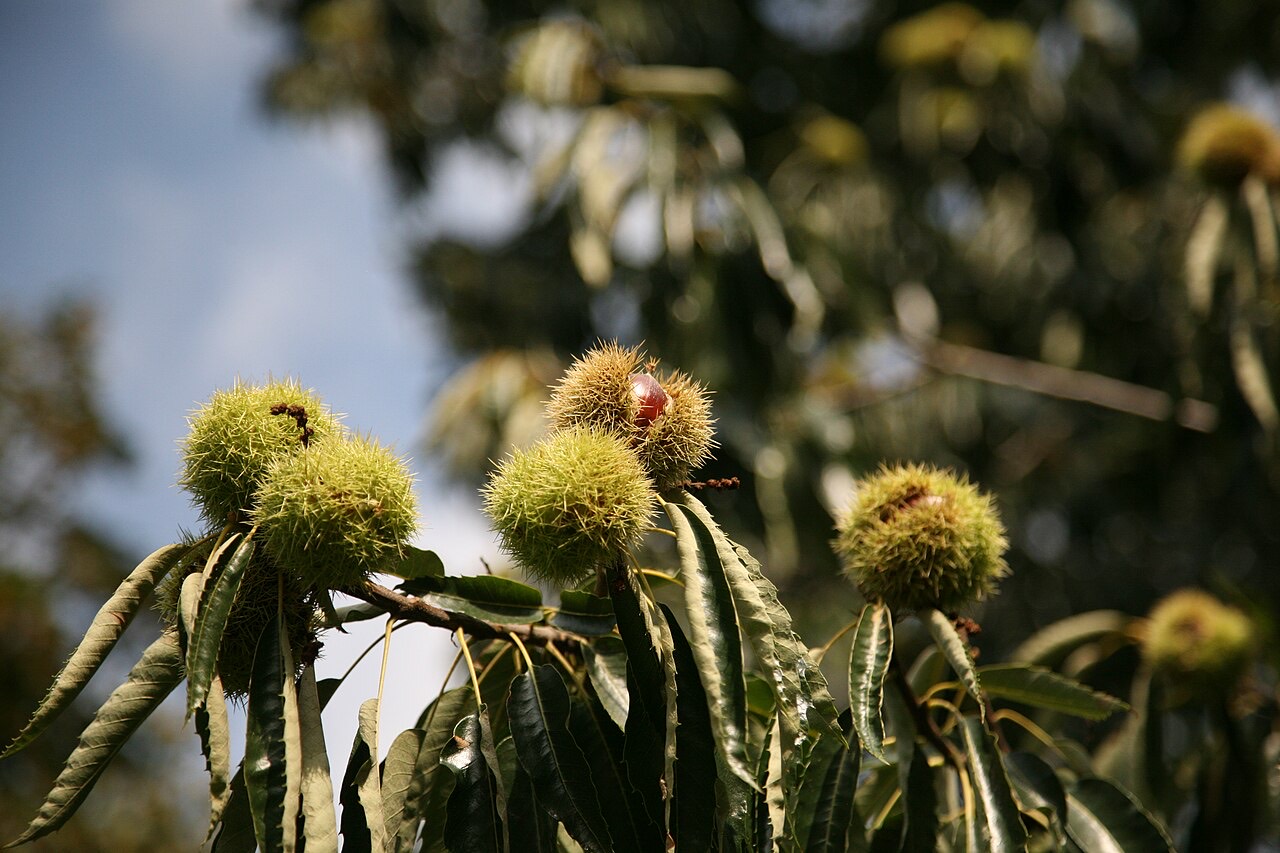
Chestnut trees produce spiny burrs that split open at maturity to release one or more nuts. Unlike most tree nuts, the chestnut kernel is high in starch and low in oil, giving it a texture and culinary role closer to a starchy staple than an oilseed nut.
Several Castanea species and their hybrids are cultivated worldwide, selected in part for resistance to chestnut blight, a disease that historically devastated American chestnut populations and continues to shape breeding and orchard siting decisions.
Overview
Chestnut is grown both as a traditional orchard crop in parts of Europe and Asia and, increasingly, as an alternative tree crop elsewhere. Trees can be very long-lived, and in some regions old chestnut groves have been managed for nut production for centuries.
Production combines dedicated orchards of grafted cultivars with, in some traditional areas, semi-wild or coppiced stands managed for both timber and nuts.
Botanical classification
- Family
- Fagaceae (beech family)
- Genus
- Castanea
- Principal species
- Castanea sativa, Castanea mollissima, Castanea crenata, Castanea dentata, and interspecific hybrids
- Growth habit
- Deciduous tree bearing nuts enclosed in a spiny burr that splits at maturity
Origin and distribution
European chestnut is native to southern Europe, western Asia, and North Africa, where it has long been cultivated as a staple food tree in some regions. Chinese and Japanese chestnuts are native to East Asia, and American chestnut was historically dominant across the eastern forests of North America before the introduction of chestnut blight in the early twentieth century.
Today, leading producers include China, Turkey, South Korea, and countries in southern Europe.
Climate and soil requirements
Chestnut requires a period of winter chilling and is generally adapted to cool to warm temperate climates with moderate, well-distributed rainfall. Prolonged heat and drought during summer can stress trees and affect nut fill.
Trees prefer well-drained, moderately acidic sandy loams and generally perform poorly on shallow, waterlogged, or strongly calcareous soils, which restrict root development and increase disease susceptibility.
Cultivation and management
- Grafted cultivars, often chosen for blight tolerance and nut quality, established on suitable rootstocks
- Spacing and pruning managed to develop a productive canopy and ease of harvest
- Cross-pollination between compatible cultivars generally needed for good nut set
- Long-term orchard planning given the extended productive life of chestnut trees
Nutrient considerations
Nitrogen and potassium support vegetative growth and nut development, and boron has been associated with fruit set and quality in some chestnut-growing regions.
Water and irrigation
Chestnut is grown both rain-fed, in regions with reliably moist summers, and under supplemental irrigation where summers are drier. Water stress during nut development can reduce yield and kernel quality.
Where irrigation is used, scheduling follows local evapotranspiration estimates and soil moisture monitoring appropriate to the orchard system.
Common diseases and pests
Chestnut blight, a bark canker disease, historically devastated American chestnut populations and remains a major consideration in breeding and site selection in affected regions. Among the diseases tracked here, anthracnose can affect leaves and nuts, while root rot, particularly ink disease caused by Phytophthora species, can kill trees on poorly drained sites. The chestnut weevil is a significant nut-infesting pest, and aphids are a common foliage pest.
| Problem | Type | Notes |
|---|---|---|
| Anthracnose | Disease | Affects leaves and developing nuts |
| Root rot | Disease | Includes ink disease on poorly drained sites |
| Weevils | Pest | Larvae develop inside nuts, reducing quality |
| Aphids | Pest | Sap-feeding insects affecting foliage |
Harvest
Nuts drop from the tree as burrs split open in autumn and are collected from the ground, either by hand or with mechanical sweepers and harvesters, then cleaned and cured before storage or sale.
Uses
- Roasted or boiled whole nuts eaten as a starchy food
- Chestnut flour used in baking and regional dishes
- Processed products such as candied chestnuts (marrons glacés) and purées
- Timber and coppice wood from chestnut trees used in some traditional production systems
Botanical identity
Species- Accepted name
- Castanea sativa
- Family
- Fagaceae
- Genus
- Castanea
- Harvested part
- seed
- Agricultural use
- human food
- Crop group
- Nuts
What the authorities say
- World Flora Online — Taxonomic Backbone
- Castanea sativa
- Plants of the World Online
- Castanea sativa
Botanical identity here is what the consulted taxonomic authorities publish, on the date they were read. Where authorities disagree, both readings are shown rather than one being chosen silently.
What AgricultureID holds for this crop
- 2 soil references
- 2 climate references
Not held
- No crop calendar records — source exists not mapped
- No published cultivars — not researched
- No official variety registrations — source exists not mapped
- No verified extension resources — source exists not ingested
- No pests and diseases naming this crop as a host — source exists not ingested
- No farm economics observations — source exists not mapped
- No market price series — source exists not mapped
- No related crops — not applicable
An absence here means this corpus holds no such record, not that none exists.
How to read figures on this page
Production, area and trade figures for any crop change from season to season and are compiled by FAO and by national agricultural statistics agencies. Take current numbers from those primary sources, dated to the period you mean, rather than from a secondary summary — including this one.
Crop water requirements are estimated from reference evapotranspiration and local climate data, following methods published by FAO and national agricultural agencies. A requirement quoted without the reference method and the local climate behind it is not a number that can be applied to a field.
Authorised inputs (France)
The French register records 11 currently authorised products whose authorised use names this crop, held by 9 authorisation holders. This is a count of what exists on the register, not a recommendation and not a shortlist.
By function
- Fongicide 4
- Insecticide 3
- Acaricide 2
- Attractif phéromone (confusion sexuelle) 2
Targets named on the register
- Septoriose(s) 4
- Désinsectisation 4
- Chenilles foreuses des fruits 3
- Pourriture des fruits 1
- Chancres à champignons 1
Use scope is recorded as the register writes it. Collective terms cover several crops at once and are left unmapped rather than expanded, because expanding one entry into several would invent authorisations that were never granted.
Authorisation is specific to one jurisdiction, one legal object and one moment. It is not a recommendation, and it says nothing about how a product may be used: always read the current official label at the source before acting.
Tools for this
Each tool shows its formula, constants and sources, and starts empty — nothing is filled in from this page.
- Seed-rate calculator
Convert a target plant stand into a seed rate, allowing for germination and establishment.
- Row spacing calculator
Work out in-row spacing and plants per metre of row for a target density.
- Production, area and yield calculator
Relate a harvested area and a yield to a production total, in either direction.
- Growing degree-days calculator
Accumulate heat units against a base temperature.
Relationships
Evidence-backed connections in the knowledge graph.
Susceptible to
Suitable soils
Climate sensitivity
Irrigation methods
Managed with
Farming systems
Scope & limitations
Geographic scope: Global overview; major production in China, with significant production also in Turkey, South Korea, and southern Europe.
Climate context: Cool to warm temperate deciduous tree crop with a winter chilling requirement; generally intolerant of prolonged heat, drought, or waterlogging.
- Chestnut blight and regional disease pressure vary considerably and are not detailed exhaustively here.
- Production statistics change annually and should be taken from primary datasets such as FAOSTAT.
Sources
This article draws on the following authoritative sources. See our sources & methodology for how they are selected.
- [1]FAO — Food and Agriculture Organization (opens in a new tab)Authoritative
Food and Agriculture Organization of the United Nations (FAO)
Cited for: Global chestnut production context
- Type:
- Intergovernmental organization
- Jurisdiction:
- Global
- Accessed:
- 2026-07-12
- [2]FAOSTAT — FAO statistical database (opens in a new tab)Authoritative
Food and Agriculture Organization of the United Nations (FAO)
Cited for: Production and area statistics
- Type:
- Intergovernmental organization
- Jurisdiction:
- Global
- Accessed:
- 2026-07-12
- [3]CABI Digital Library — Crop Protection Compendium (opens in a new tab)High
CABI (Centre for Agriculture and Bioscience International)
Cited for: Chestnut disease and pest compendium data
- Type:
- Reference database
- Jurisdiction:
- Global
- Accessed:
- 2026-07-12
- Authoritative
Cited for: Classification and nomenclature
- Type:
- Reference database
- Jurisdiction:
- United States
- Accessed:
- 2026-07-12
- Moderate
Cited for: Cultivation and site-selection guidance
- Type:
- Reference database
- Jurisdiction:
- United Kingdom
- Accessed:
- 2026-07-12