Crop · Tree fruit crop
Fig
Ficus carica
Also known as: Common fig
Fig is a subtropical deciduous tree fruit grown for fresh and dried fruit, notable for its unusual enclosed inflorescence and for tolerating heat and drought better than many other tree fruits.
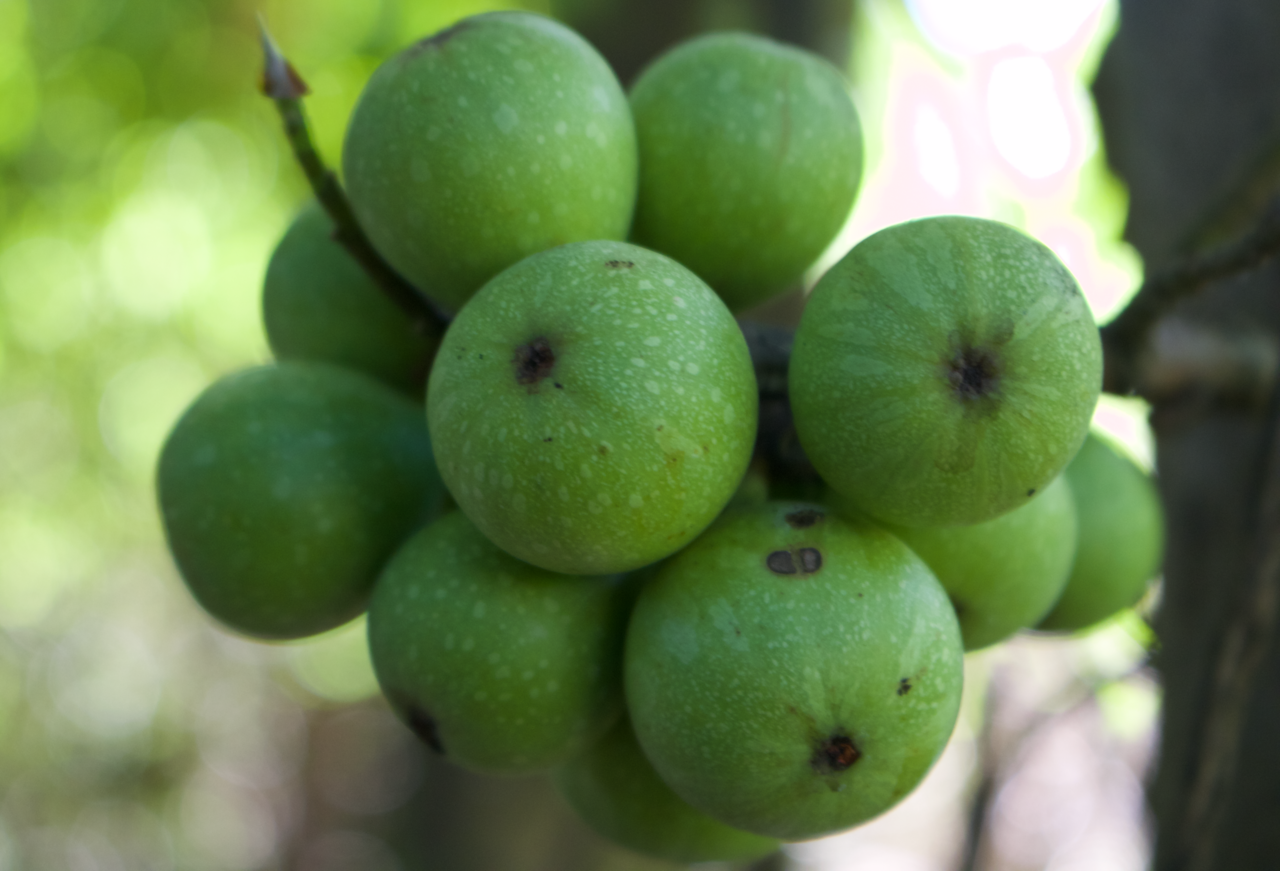
Fig is a long-cultivated tree fruit adapted to warm, dry summers and mild winters, though it is grown in a range of subtropical and warm-temperate climates worldwide. Commercial plantings are established almost exclusively from cuttings rather than seed, since fig roots readily from hardwood cuttings and this preserves the characteristics of a chosen cultivar.
The crop is valued for both fresh consumption and drying, and its fruiting structure is botanically distinctive: what is eaten as the "fruit" is technically a syconium, a fleshy, inverted receptacle enclosing many tiny flowers, making the true fruits (small drupelets) hidden inside rather than visible on the surface.
Overview
Fig is grown as a long-lived perennial tree or large shrub, propagated clonally by cuttings rather than replanted annually. Production ranges from smallholder and dooryard plantings to commercial orchards managed for fresh-market or drying fruit.
Because fig is propagated vegetatively and can crop for many years from a single planting, cultivar choice, training, and site selection made at establishment shape management for the life of the planting, similar to other perennial tree fruit crops.
Botanical classification
- Family
- Moraceae (mulberry family)
- Genus
- Ficus
- Principal species
- Ficus carica (common fig)
- Growth habit
- Deciduous or semi-evergreen tree or large shrub, commercially propagated from hardwood cuttings
- Fruiting structure
- The edible "fruit" is a syconium — an inverted, fleshy receptacle enclosing numerous tiny flowers, with the true fruits forming as small drupelets inside it
Fig reproduction involves a genuinely unusual pollination system in some cultivar groups: Smyrna-type figs require pollination by a specific fig wasp (a process called caprification) to develop normally, while common-type fig cultivars set fruit without pollination. The pollination requirement therefore depends on the cultivar type grown, and growers select cultivars appropriate to whether a pollinator wasp and compatible caprifig source are available in their region.
Origin and distribution
Fig is native to the Mediterranean basin and western Asia and has been cultivated since antiquity, spreading with human settlement across the Mediterranean and later to other warm, dry-summer regions of the world with suitable climates.
It is now grown commercially in Mediterranean-climate and other warm subtropical regions on multiple continents.
Climate requirements
Fig is well adapted to hot, dry summer conditions and tolerates drought and heat stress better than many other tree fruit crops once trees are established. This makes it a common choice in Mediterranean-type and semi-arid climates.
Fig is intolerant of waterlogged soils and prolonged excess moisture, which increases the risk of root rot, so climate suitability is closely tied to soil drainage as much as rainfall or temperature alone.
Soil requirements
Fig grows well on a range of soils, including loams and sandy soils, and is often noted for tolerating relatively poor or shallow soils better than many other fruit trees, provided drainage is adequate. Good drainage is the single most important soil requirement, since the crop is intolerant of waterlogging and prone to root rot in saturated conditions.
Orchard establishment and management
Fig orchards are established from rooted hardwood cuttings of the desired cultivar rather than from seed, since propagation by cuttings preserves fruit type, pollination behavior, and other cultivar traits.
- Cultivar selection matched to common-type or Smyrna-type fruiting habit and local pollinator availability
- Propagation from hardwood cuttings to maintain true-to-type trees
- Training and pruning to manage tree size and encourage fruiting wood
- Site selection emphasizing drainage given the crop's sensitivity to waterlogging
Nutrient considerations
Potassium supports fruit development and quality in fig, as in many tree fruit crops, while boron plays a role in fruit set and development. Excessive nitrogen can favor vegetative growth at the expense of fruiting and fruit quality.
Water and irrigation
Fig tolerates drought well once established, and deficit irrigation strategies are sometimes used deliberately to manage vigor and fruit quality. Drip irrigation is commonly used in commercial plantings to apply water efficiently to the root zone while avoiding prolonged soil saturation.
Irregular water supply, such as a dry period followed by heavy irrigation or rain, is a recognized cause of fruit splitting and souring in fig. Consistent moisture management during fruit development helps reduce this quality risk, while still avoiding the waterlogging the crop tolerates poorly.
Common diseases and pests
Anthracnose can affect fig leaves and fruit, particularly under humid conditions, while root rot is a significant risk in poorly drained or overwatered soils given the crop's general intolerance of waterlogging. Insect pests include scale insects and mealybugs, which can affect vigor and fruit quality, and fruit flies, which can infest ripening fruit.
Management combines site drainage, sanitation, monitoring, and — where justified — locally authorized control products applied according to their labels.
Harvest
Fig fruit does not continue to ripen appreciably after picking, so fruit intended for fresh sale is typically harvested at or near full ripeness, identified by softening, color change, and sometimes a drooping stalk. Fruit for drying may be allowed to partially dry on the tree before harvest. Because ripe fruit is soft and perishable, harvest is generally done by hand and often requires multiple passes through the season.
Uses
| Product form | Typical use |
|---|---|
| Fresh fig | Fresh eating; short shelf life due to fruit softness |
| Dried fig | Long-storage product for direct consumption or processing |
| Processed fig | Preserves, pastes, and ingredients in baked goods |
- Fresh-market eating figs
- Dried figs for extended storage and export
- Preserves, jams, and confectionery ingredients
- Processed pastes and fillings for baked goods
Botanical identity
Species- Accepted name
- Ficus carica
- Family
- Moraceae
- Genus
- Ficus
- Harvested part
- fruit
- Agricultural use
- human food
- Crop group
- Fruit
What the authorities say
- World Flora Online — Taxonomic Backbone
- Ficus carica
- Plants of the World Online
- Ficus carica
Botanical identity here is what the consulted taxonomic authorities publish, on the date they were read. Where authorities disagree, both readings are shown rather than one being chosen silently.
What AgricultureID holds for this crop
- 7 crop calendar records
- 1 pests and diseases naming this crop as a host
- 2 soil references
- 2 climate references
Not held
- No published cultivars — not researched
- No official variety registrations — source exists not mapped
- No verified extension resources — source exists not ingested
- No farm economics observations — source exists not mapped
- No market price series — source exists not mapped
- No related crops — not applicable
An absence here means this corpus holds no such record, not that none exists.
How to read figures on this page
Production, area and trade figures for any crop change from season to season and are compiled by FAO and by national agricultural statistics agencies. Take current numbers from those primary sources, dated to the period you mean, rather than from a secondary summary — including this one.
Crop water requirements are estimated from reference evapotranspiration and local climate data, following methods published by FAO and national agricultural agencies. A requirement quoted without the reference method and the local climate behind it is not a number that can be applied to a field.
Part of
Planting and harvest calendar
Usual sowing and harvest windows across 7 jurisdictions, covering fig.
Authorised inputs (France)
The French register records 12 currently authorised products whose authorised use names this crop, held by 10 authorisation holders. This is a count of what exists on the register, not a recommendation and not a shortlist.
By function
- Insecticide 9
- Herbicide 2
- Nématicide 1
Targets named on the register
- Mouches des fruits 4
- Cult. Installées 2
- Chenilles phytophages 2
- Cochenilles 2
- Insectes xylophages 1
- Nématodes 1
Use scope is recorded as the register writes it. Collective terms cover several crops at once and are left unmapped rather than expanded, because expanding one entry into several would invent authorisations that were never granted.
Authorisation is specific to one jurisdiction, one legal object and one moment. It is not a recommendation, and it says nothing about how a product may be used: always read the current official label at the source before acting.
Tools for this
Each tool shows its formula, constants and sources, and starts empty — nothing is filled in from this page.
- Seed-rate calculator
Convert a target plant stand into a seed rate, allowing for germination and establishment.
- Row spacing calculator
Work out in-row spacing and plants per metre of row for a target density.
- Production, area and yield calculator
Relate a harvested area and a yield to a production total, in either direction.
- Growing degree-days calculator
Accumulate heat units against a base temperature.
Relationships
Evidence-backed connections in the knowledge graph.
Susceptible to
Suitable soils
Climate sensitivity
Irrigation methods
Machinery
Managed with
Related topics
Scope & limitations
Geographic scope: Global overview. Cultivar choice, pollination requirements, and site suitability are region-specific.
Climate context: Subtropical to warm-temperate tree fruit, notably tolerant of heat and drought once established; intolerant of waterlogging.
- Cultivar pollination requirements (common-type versus Smyrna-type) and regional pollinator availability are site-specific and not covered by universal guidance here.
- Production statistics change over time and should be taken from primary datasets such as FAOSTAT.
Sources
This article draws on the following authoritative sources. See our sources & methodology for how they are selected.
- [1]FAO — Food and Agriculture Organization (opens in a new tab)Authoritative
Food and Agriculture Organization of the United Nations (FAO)
Cited for: Global fig production and cultivation context
- Type:
- Intergovernmental organization
- Jurisdiction:
- Global
- Accessed:
- 2026-07-12
- [2]FAOSTAT — FAO statistical database (opens in a new tab)Authoritative
Food and Agriculture Organization of the United Nations (FAO)
Cited for: Production and area statistics
- Type:
- Intergovernmental organization
- Jurisdiction:
- Global
- Accessed:
- 2026-07-12
- [3]CABI Digital Library — Crop Protection Compendium (opens in a new tab)High
CABI (Centre for Agriculture and Bioscience International)
Cited for: Fig pest and disease compendium data
- Type:
- Reference database
- Jurisdiction:
- Global
- Accessed:
- 2026-07-12
- [4]UC Statewide Integrated Pest Management Program (UC IPM) (opens in a new tab)High
University of California Agriculture and Natural Resources (UC ANR)
Cited for: Integrated pest management guidelines for fig
- Type:
- University extension service
- Jurisdiction:
- United States (California)
- Accessed:
- 2026-07-12
- Authoritative
Cited for: Classification and nomenclature
- Type:
- Reference database
- Jurisdiction:
- United States
- Accessed:
- 2026-07-12