Crop · Vine fruit crop
Kiwifruit
Actinidia deliciosa (fuzzy/green kiwifruit); Actinidia chinensis (gold kiwifruit)
Also known as: Kiwi, Chinese gooseberry
Kiwifruit is a deciduous woody vine trained on a trellis or pergola system and grown for its fuzzy or smooth-skinned fruit. Vines are typically dioecious, requiring separate male and female plants for fruit set.
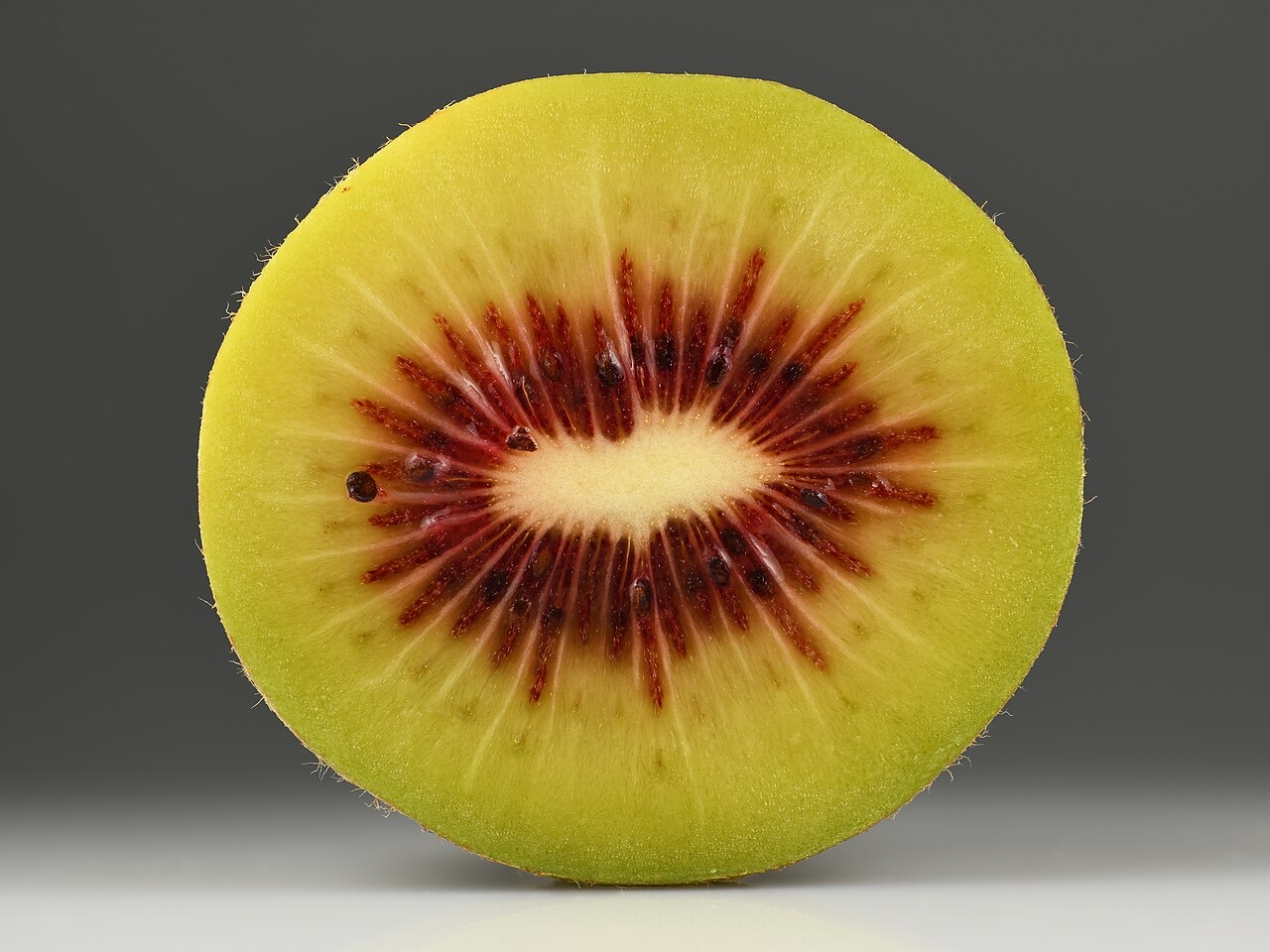
Kiwifruit is grown commercially as a vigorous, deciduous woody vine (a liana) rather than as a freestanding tree or shrub. Because the vine climbs and needs physical support to fruit productively, plantings are built around a permanent trellis or pergola structure rather than an open orchard canopy.
Most commercially grown kiwifruit cultivars are dioecious, meaning individual vines are either male or female. Female vines produce the fruit, but they require pollen from nearby male vines to set a commercial crop, so plantings interplant a proportion of male pollinizer vines among the female fruiting vines.
Overview
Kiwifruit is grown as a long-lived, deciduous vine supported on a permanent trellis or pergola structure. Once established, a planting can remain productive for many years, making trellis design, cultivar choice, and pollinizer arrangement long-term decisions made largely at establishment.
Green kiwifruit (Actinidia deliciosa) and gold kiwifruit (Actinidia chinensis) are the two principal commercial types, differing in skin texture, flesh color, and flavor, with cultivar-specific management practices in each case.
Botanical classification
- Family
- Actinidiaceae
- Genus
- Actinidia
- Principal species
- Actinidia deliciosa (fuzzy/green kiwifruit) and Actinidia chinensis (gold kiwifruit)
- Growth habit
- Vigorous, climbing, deciduous woody vine (liana), not a freestanding tree
- Reproductive habit
- Predominantly dioecious, with separate male and female vines; female flowers require pollination from a male vine to set fruit
Origin and distribution
Kiwifruit originates from wild Actinidia species native to central and eastern China. Selection and breeding, followed by international spread and commercialization during the twentieth century, established it as a globally traded fruit grown in a number of temperate and mild-winter regions outside its native range.
Climate requirements
Kiwifruit vines require a period of winter chilling to break dormancy and flower normally, similar to other temperate deciduous fruit crops, with the specific chilling need varying by species and cultivar.
Spring frost is a significant risk, since new growth and flowers emerging after bud break are frost-sensitive and can be damaged or destroyed by a late cold event, potentially reducing or eliminating that season’s crop.
Soil requirements
Kiwifruit performs best on deep, well-drained loam and sandy soils with good moisture-holding capacity. The vine’s vigorous root system benefits from soil depth and structure, and it has poor tolerance of waterlogging.
Planting and training
Because kiwifruit is a climbing vine rather than a self-supporting tree, establishing a planting centers on building a permanent trellis or pergola structure strong enough to support the vine’s weight and vigorous growth over many years, alongside selecting compatible male and female vines.
- Trellis or pergola structure selection and construction as a permanent, load-bearing framework
- Selection of compatible male pollinizer and female fruiting vines, interplanted so pollinators are within reach of flowering female vines
- Training young vines onto the support structure and establishing a permanent framework of cordons or canes
- Ongoing pruning to manage vine vigor, light exposure, and fruiting wood renewal across many productive years
Nutrient considerations
Nitrogen supports vine vigor and canopy development, which must be balanced against excessive shading of fruiting wood. Potassium influences fruit size and quality, while calcium is associated with fruit firmness and storage quality, as in many other tree and vine fruits.
Water and irrigation
Kiwifruit vines have a relatively high water demand due to their large leaf area and vigorous growth habit. Drip irrigation is widely used in commercial plantings to supply water efficiently to the root zone while managing canopy humidity.
Irrigation scheduling aims to avoid water stress during flowering and fruit development while preventing waterlogging, to which the vine’s root system is sensitive.
Common diseases and pests
Bacterial canker of kiwifruit, caused by Pseudomonas syringae pv. actinidiae (commonly referred to as Psa), is a serious bacterial disease of the vine and wood that causes cankers, dieback, and, in severe cases, vine death, rather than merely superficial leaf spotting. It has caused serious documented disruption to kiwifruit industries in several major growing regions historically and remains a significant ongoing risk factor requiring careful biosecurity and orchard hygiene practices. Gray mold can affect flowers, fruit, and stored fruit, particularly under cool, humid conditions.
Leaf rollers, scale insects, and thrips are common insect pests that can affect foliage and fruit finish.
Management combines disease-tolerant cultivars and rootstocks where available, strict sanitation and biosecurity practices, monitoring, and — where justified — locally authorized control products applied according to their labels.
Harvest
Kiwifruit is harvested by hand once fruit reaches a maturity standard, commonly assessed through internal indicators such as soluble solids content, since the fruit continues to ripen and soften significantly after picking during storage and handling.
Uses
| Type | Species | Typical characteristics |
|---|---|---|
| Green (fuzzy) kiwifruit | Actinidia deliciosa | Fuzzy brown skin, green flesh, tart-sweet flavor |
| Gold kiwifruit | Actinidia chinensis | Smoother, often bronze skin, yellow flesh, generally sweeter flavor |
- Fresh-market eating fruit
- Juice, purée, and processed fruit products
- Use in baked goods and prepared foods
Botanical identity
Variety- Accepted name
- Actinidia chinensis var. deliciosa
- Family
- Actinidiaceae
- Genus
- Actinidia
- Harvested part
- fruit
- Agricultural use
- human food
- Crop group
- Fruit
What the authorities say
- World Flora Online — Taxonomic Backbone
- Actinidia chinensis deliciosa
- Plants of the World Online
- Actinidia chinensis var. deliciosa
Botanical identity here is what the consulted taxonomic authorities publish, on the date they were read. Where authorities disagree, both readings are shown rather than one being chosen silently.
What AgricultureID holds for this crop
- 2 soil references
- 2 climate references
Not held
- No crop calendar records — source exists not mapped
- No published cultivars — not researched
- No official variety registrations — source exists not mapped
- No verified extension resources — source exists not ingested
- No pests and diseases naming this crop as a host — source exists not ingested
- No farm economics observations — source exists not mapped
- No market price series — source exists not mapped
- No related crops — not applicable
An absence here means this corpus holds no such record, not that none exists.
How to read figures on this page
Production, area and trade figures for any crop change from season to season and are compiled by FAO and by national agricultural statistics agencies. Take current numbers from those primary sources, dated to the period you mean, rather than from a secondary summary — including this one.
Crop water requirements are estimated from reference evapotranspiration and local climate data, following methods published by FAO and national agricultural agencies. A requirement quoted without the reference method and the local climate behind it is not a number that can be applied to a field.
Part of
Authorised inputs (France)
The French register records 33 currently authorised products whose authorised use names this crop, held by 21 authorisation holders. This is a count of what exists on the register, not a recommendation and not a shortlist.
By function
- Fongicide 12
- Insecticide 10
- Régulateur de croissance 5
- Herbicide 3
- Stimulateur des défenses naturelles 2
- Not stated 1
Targets named on the register
- Bactériose(s) 12
- Act. Qual. Fruits 6
- Chenilles phytophages 4
- Cult. Installées 2
- Mouches des fruits 2
- Cicadelles, cercopides et psylles 2
Use scope is recorded as the register writes it. Collective terms cover several crops at once and are left unmapped rather than expanded, because expanding one entry into several would invent authorisations that were never granted.
Authorisation is specific to one jurisdiction, one legal object and one moment. It is not a recommendation, and it says nothing about how a product may be used: always read the current official label at the source before acting.
Tools for this
Each tool shows its formula, constants and sources, and starts empty — nothing is filled in from this page.
- Seed-rate calculator
Convert a target plant stand into a seed rate, allowing for germination and establishment.
- Row spacing calculator
Work out in-row spacing and plants per metre of row for a target density.
- Production, area and yield calculator
Relate a harvested area and a yield to a production total, in either direction.
- Growing degree-days calculator
Accumulate heat units against a base temperature.
Relationships
Evidence-backed connections in the knowledge graph.
Suitable soils
Climate sensitivity
Irrigation methods
Machinery
Farming systems
Scope & limitations
Geographic scope: Global overview. Trellis design, cultivar choice, and pollinizer arrangement are region- and site-specific.
Climate context: Temperate deciduous vine requiring winter chill; frost-sensitive at bud break and susceptible to significant bacterial disease pressure (Psa) in some regions.
- Trellis system design, chilling-hour specifics, and male-to-female vine ratios are cultivar- and site-specific decisions not covered by universal values here.
- The regional presence and severity of bacterial canker (Psa) vary and should be confirmed against current local plant-health authority guidance.
- Production and cultivar-popularity statistics change over time and should be taken from primary datasets such as FAOSTAT.
Sources
This article draws on the following authoritative sources. See our sources & methodology for how they are selected.
- [1]FAO — Food and Agriculture Organization (opens in a new tab)Authoritative
Food and Agriculture Organization of the United Nations (FAO)
Cited for: Global kiwifruit production and trade context
- Type:
- Intergovernmental organization
- Jurisdiction:
- Global
- Accessed:
- 2026-07-12
- [2]FAOSTAT — FAO statistical database (opens in a new tab)Authoritative
Food and Agriculture Organization of the United Nations (FAO)
Cited for: Production and area statistics
- Type:
- Intergovernmental organization
- Jurisdiction:
- Global
- Accessed:
- 2026-07-12
- [3]CABI Digital Library — Crop Protection Compendium (opens in a new tab)High
CABI (Centre for Agriculture and Bioscience International)
Cited for: Bacterial canker (Psa) and kiwifruit pest compendium data
- Type:
- Reference database
- Jurisdiction:
- Global
- Accessed:
- 2026-07-12
- [4]UC Statewide Integrated Pest Management Program (UC IPM) (opens in a new tab)High
University of California Agriculture and Natural Resources (UC ANR)
Cited for: Integrated pest management guidance relevant to kiwifruit pests
- Type:
- University extension service
- Jurisdiction:
- United States (California)
- Accessed:
- 2026-07-12
- Authoritative
Cited for: Classification and nomenclature
- Type:
- Reference database
- Jurisdiction:
- United States
- Accessed:
- 2026-07-12