Pest · Insect pest
Fruit Flies
Family Tephritidae (order Diptera), including Bactrocera, Ceratitis, and related genera
Also known as: True fruit flies, Tephritid fruit flies
Fruit flies (family Tephritidae) are flies whose larvae develop inside ripening fruit, causing internal damage, rot, and premature drop in mango, orange, cucumber, and olive, and are subject to strict quarantine controls in many regions.
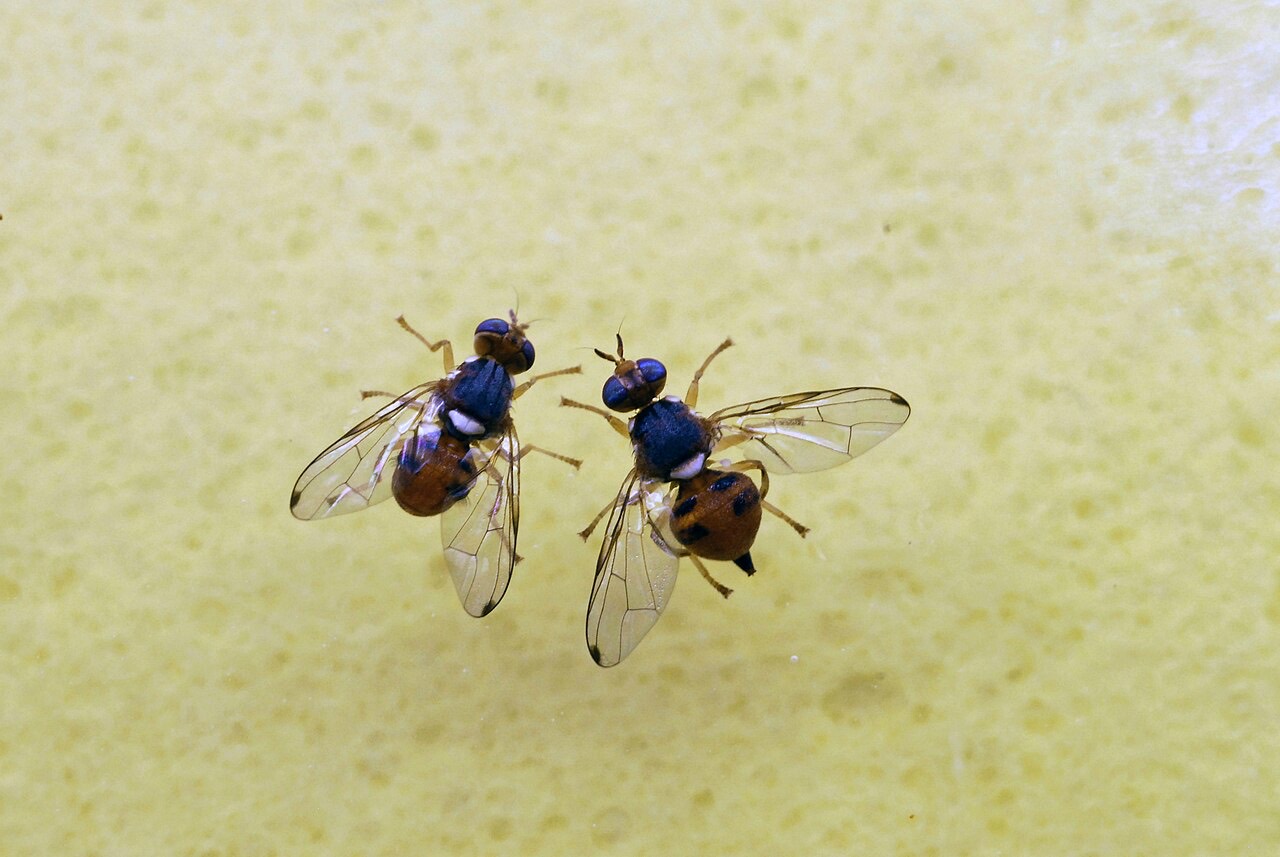
True fruit flies (Tephritidae) are a large family of flies whose larvae, rather than the adults, cause the economic damage. Females puncture the skin of ripening or ripe fruit to lay eggs, and the maggots that hatch feed inside the flesh, often unnoticed until the fruit softens, discolours, or drops.
Several genera, including Bactrocera and Ceratitis, are major quarantine pests because larvae can be transported inside apparently sound fruit, so international and domestic trade in host fruit is often restricted or regulated where these species occur.
Identification
Adult tephritid flies are typically patterned with dark markings on clear or banded wings and are smaller than house flies. Larvae are legless, creamy-white maggots found feeding inside fruit, and are usually detected by cutting open suspect fruit rather than by seeing adults directly.
Early external signs include small, discoloured puncture marks (oviposition stings) on the fruit surface, sometimes followed by resin or fluid oozing from the site.
Biology and life cycle
Females insert eggs just beneath the fruit skin; larvae hatch and feed within the fruit through several instars, then drop to the soil to pupate. Adults emerge from the soil to mate and seek new host fruit, and multiple generations can occur across a fruiting season in warm climates.
Damage and hosts
Larval feeding breaks down fruit tissue, often allowing secondary decay organisms to enter, and heavily infested fruit softens, discolours, and drops prematurely. Damage frequently is not visible from the outside until infestation is advanced.
Host crops include mango, orange, cucumber, and olive, along with many other fruiting and cucurbit crops, with the specific species and host range varying by region.
Monitoring
Traps baited with food or pheromone lures are widely used to detect adult flies and track population trends ahead of and during fruit ripening, supporting decisions on timing and area-wide programmes.
Management principles
Fruit fly management typically combines several tactics, often coordinated at an area-wide scale because adults are mobile between orchards and host plants.
- Use trapping and lures to monitor and, where appropriate, mass-trap adult flies
- Collect and destroy fallen and infested fruit to break the larval-to-pupal cycle
- Conserve parasitoid wasps and other natural enemies
- Follow quarantine and phytosanitary requirements for fruit movement where these pests are regulated
Relationships
Evidence-backed connections in the knowledge graph.
Risk increases under
Related topics
Scope & limitations
Geographic scope: Found across tropical and subtropical fruit- and vegetable-growing regions worldwide; species present, host range, and quarantine status vary considerably by country.
Climate context: Warm, humid conditions generally support faster development and more generations per year, and seasonal rainfall patterns can influence fruiting and infestation timing.
- This is a general overview of a large family spanning many pest species, not species-level guidance for a specific crop, region, or quarantine status.
- Trapping thresholds, bait formulations, and quarantine rules are jurisdiction-specific and are not provided here.
Sources
This article draws on the following authoritative sources. See our sources & methodology for how they are selected.
- [1]CABI Digital Library — Crop Protection Compendium (opens in a new tab)High
CABI (Centre for Agriculture and Bioscience International)
Cited for: Biology, hosts, and distribution
- Type:
- Reference database
- Jurisdiction:
- Global
- Accessed:
- 2026-07-12
- [2]EPPO Global Database (opens in a new tab)Authoritative
European and Mediterranean Plant Protection Organization (EPPO)
Cited for: Species nomenclature, distribution, and quarantine status
- Type:
- Reference database
- Jurisdiction:
- Global
- Accessed:
- 2026-07-12
- [3]USDA APHIS — Animal and Plant Health Inspection Service (opens in a new tab)Authoritative
USDA Animal and Plant Health Inspection Service (APHIS)
Cited for: Quarantine and regulatory context
- Type:
- Government agency
- Jurisdiction:
- United States
- Accessed:
- 2026-07-12
- [4]FAO — Food and Agriculture Organization (opens in a new tab)Authoritative
Food and Agriculture Organization of the United Nations (FAO)
Cited for: Fruit fly management and trade context
- Type:
- Intergovernmental organization
- Jurisdiction:
- Global
- Accessed:
- 2026-07-12