Crop · Tree fruit crop
Olive
Olea europaea
Also known as: Common olive
Olive is a long-lived evergreen tree grown across Mediterranean-type climates for oil and table fruit, tolerant of drought, heat, and poor soils once established.
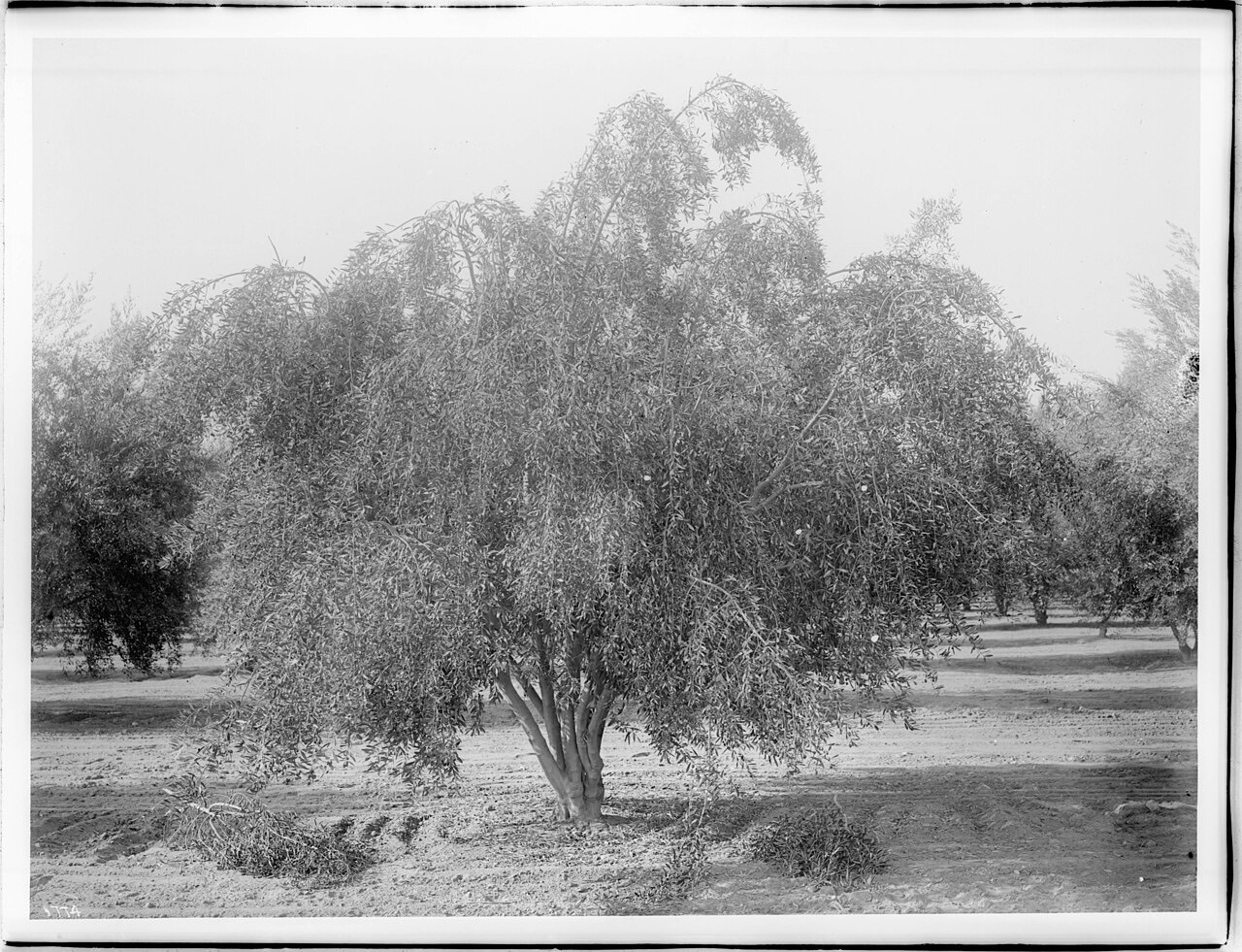
Olive is one of the defining perennial crops of Mediterranean-type climates, grown for its fruit, which is pressed for oil or cured for table consumption. Trees can remain productive for many decades, and some traditional groves are far older, making orchard-level decisions long-term commitments.
Cultivars are selected according to end use — oil, table, or dual-purpose — and orchard systems range from widely spaced traditional groves to modern high-density hedgerow plantings designed for mechanical harvest.
Overview
Olive is grown across Mediterranean-climate regions worldwide, from long-established groves around the Mediterranean basin to newer plantings in similar climates elsewhere, spanning traditional low-density orchards and intensive mechanized systems.
The crop’s tolerance of heat, drought, and marginal soils has supported its cultivation on land less suited to many other tree crops, though yield and oil quality still respond strongly to management and climate.
Botanical classification
- Family
- Oleaceae (olive family)
- Genus
- Olea
- Principal species
- Olea europaea (cultivated olive)
- Growth habit
- Long-lived evergreen tree, commercially propagated from cuttings and grown in traditional or hedgerow orchard systems
Origin and distribution
Olive cultivation traces back thousands of years around the eastern Mediterranean basin, spreading across southern Europe, North Africa, and the Near East before later introduction to other Mediterranean-type climates, including parts of the Americas, southern Africa, and Australia.
Production remains concentrated around the Mediterranean basin.
Climate requirements
Olive is adapted to Mediterranean-type climates with hot, dry summers and mild, wet winters, and it requires a period of winter chilling for normal flowering, though its chilling requirement is modest compared with many temperate fruit trees.
The crop tolerates high summer temperatures and drought well once established, but young trees and blossom are more vulnerable to frost, which can damage or kill tissue in unusually cold winters.
Soil requirements
Olive tolerates a wide range of soils, including shallow, stony, and calcareous (chalky) soils where many other tree crops perform poorly, provided drainage is adequate. Well-structured loams support the best growth and yield.
Orchard establishment and management
New groves are established from cultivars selected for oil or table use, climate adaptation, and, increasingly, suitability for mechanical harvest, with spacing set according to the chosen training and harvest system.
- Cultivar selection for oil or table use and regional climate adaptation
- Training system choice, from traditional open-vase forms to modern hedgerow systems for mechanical harvest
- Pruning to maintain light penetration and manage the biennial (alternate) bearing tendency of many cultivars
- Long-term orchard floor and irrigation management across many productive decades
Nutrient considerations
Nitrogen supports vegetative growth and fruit set, while boron is closely linked to flower and fruit set in olive, with deficiency associated with poor fruiting. Potassium supports fruit growth and oil accumulation.
Water and irrigation
Traditional olive groves are often grown rain-fed, relying on the tree’s deep rooting and drought tolerance, while modern intensive orchards commonly use deficit irrigation, applying water strategically below full crop demand to manage vigor and support oil quality.
Water stress at critical stages such as flowering and fruit set can reduce yield, so irrigated systems schedule deficits carefully around these periods.
Common diseases and pests
Anthracnose affects fruit, causing rot that reduces oil quality, particularly under wet conditions near harvest, while Verticillium wilt is a soil-borne fungal disease that can cause serious dieback and tree loss, especially where susceptible crops preceded the grove. The olive fruit fly is a major insect pest affecting fruit quality, and scale insects can weaken trees and promote sooty mold.
Management combines resistant or tolerant cultivars where available, orchard sanitation, monitoring, and — where justified — locally authorized control products applied according to their labels.
Harvest
Olive is harvested by hand, with hand-held or mechanical shakers, or with continuous mechanical harvesters in hedgerow systems, with timing set by intended use and desired ripeness, since oil composition and table-olive processing both depend on fruit maturity at picking.
Uses
- Extraction of olive oil for culinary and food-industry use
- Curing and processing of table olives
- By-products such as pomace used for oil extraction residues, animal feed, or fuel
- Ornamental and landscape use in Mediterranean-climate regions
Botanical identity
Species- Accepted name
- Olea europaea
- Family
- Oleaceae
- Genus
- Olea
- Harvested part
- fruit
- Agricultural use
- human food, oilseed
- Crop group
- Fruit, Oilseeds
What the authorities say
- World Flora Online — Taxonomic Backbone
- Olea europaea
- Plants of the World Online
- Olea europaea
Botanical identity here is what the consulted taxonomic authorities publish, on the date they were read. Where authorities disagree, both readings are shown rather than one being chosen silently.
What AgricultureID holds for this crop
- 9 crop calendar records
- 3 pests and diseases naming this crop as a host
- 2 soil references
- 2 climate references
Not held
- No published cultivars — not researched
- No official variety registrations — source exists not mapped
- No verified extension resources — source exists not ingested
- No farm economics observations — source exists not mapped
- No market price series — source exists not mapped
- No related crops — not applicable
An absence here means this corpus holds no such record, not that none exists.
How to read figures on this page
Production, area and trade figures for any crop change from season to season and are compiled by FAO and by national agricultural statistics agencies. Take current numbers from those primary sources, dated to the period you mean, rather than from a secondary summary — including this one.
Crop water requirements are estimated from reference evapotranspiration and local climate data, following methods published by FAO and national agricultural agencies. A requirement quoted without the reference method and the local climate behind it is not a number that can be applied to a field.
Part of
Planting and harvest calendar
Usual sowing and harvest windows across 9 jurisdictions, covering olive.
Authorised inputs (France)
The French register records 65 currently authorised products whose authorised use names this crop, held by 35 authorisation holders. This is a count of what exists on the register, not a recommendation and not a shortlist.
By function
- Fongicide 29
- Insecticide 16
- Herbicide 12
- Attractif phéromone (confusion sexuelle) 3
- Bactéricide 2
- Acaricide 2
Targets named on the register
- Maladies du feuillage 28
- Bactériose(s) 19
- Chenilles phytophages 11
- Cult. Installées 11
- Mouche de l'olive 7
- Cochenilles 3
Use scope is recorded as the register writes it. Collective terms cover several crops at once and are left unmapped rather than expanded, because expanding one entry into several would invent authorisations that were never granted.
Authorisation is specific to one jurisdiction, one legal object and one moment. It is not a recommendation, and it says nothing about how a product may be used: always read the current official label at the source before acting.
Tools for this
Each tool shows its formula, constants and sources, and starts empty — nothing is filled in from this page.
- Seed-rate calculator
Convert a target plant stand into a seed rate, allowing for germination and establishment.
- Row spacing calculator
Work out in-row spacing and plants per metre of row for a target density.
- Production, area and yield calculator
Relate a harvested area and a yield to a production total, in either direction.
- Growing degree-days calculator
Accumulate heat units against a base temperature.
Relationships
Evidence-backed connections in the knowledge graph.
Susceptible to
Suitable soils
Irrigation methods
Machinery
Farming systems
Scope & limitations
Geographic scope: Global overview of Mediterranean-type climate production. Cultivar, training system, and irrigation strategy are region- and site-specific.
Climate context: Mediterranean-type climate tree crop tolerant of heat and drought; requires modest winter chilling and is frost-sensitive when young or in bloom.
- Cultivar choice, training system, and deficit-irrigation strategy are site- and market-specific decisions not covered by universal values here.
- Production and trade statistics change annually and should be taken from primary datasets such as FAOSTAT.
Sources
This article draws on the following authoritative sources. See our sources & methodology for how they are selected.
- [1]FAO — Food and Agriculture Organization (opens in a new tab)Authoritative
Food and Agriculture Organization of the United Nations (FAO)
Cited for: Global olive production and trade context
- Type:
- Intergovernmental organization
- Jurisdiction:
- Global
- Accessed:
- 2026-07-12
- [2]FAOSTAT — FAO statistical database (opens in a new tab)Authoritative
Food and Agriculture Organization of the United Nations (FAO)
Cited for: Production and area statistics
- Type:
- Intergovernmental organization
- Jurisdiction:
- Global
- Accessed:
- 2026-07-12
- [3]European Commission — Agriculture and rural development (opens in a new tab)Authoritative
European Commission, Directorate-General for Agriculture
Cited for: European Union olive sector agronomy and policy context
- Type:
- Government agency
- Jurisdiction:
- European Union
- Accessed:
- 2026-07-12
- [4]CABI Digital Library — Crop Protection Compendium (opens in a new tab)High
CABI (Centre for Agriculture and Bioscience International)
Cited for: Olive disease and pest compendium data
- Type:
- Reference database
- Jurisdiction:
- Global
- Accessed:
- 2026-07-12
- Authoritative
Cited for: Classification and nomenclature
- Type:
- Reference database
- Jurisdiction:
- United States
- Accessed:
- 2026-07-12