Crop · Fruit crop
Grape
Vitis vinifera (European grape); interspecific hybrids and American Vitis species such as Vitis labrusca are also cultivated
Also known as: Wine grape, Table grape
Grape is a woody perennial vine grown worldwide for wine, table fruit, raisins, and juice. Vineyards are established from grafted or own-rooted vines and cropped over many years on trellised training systems.
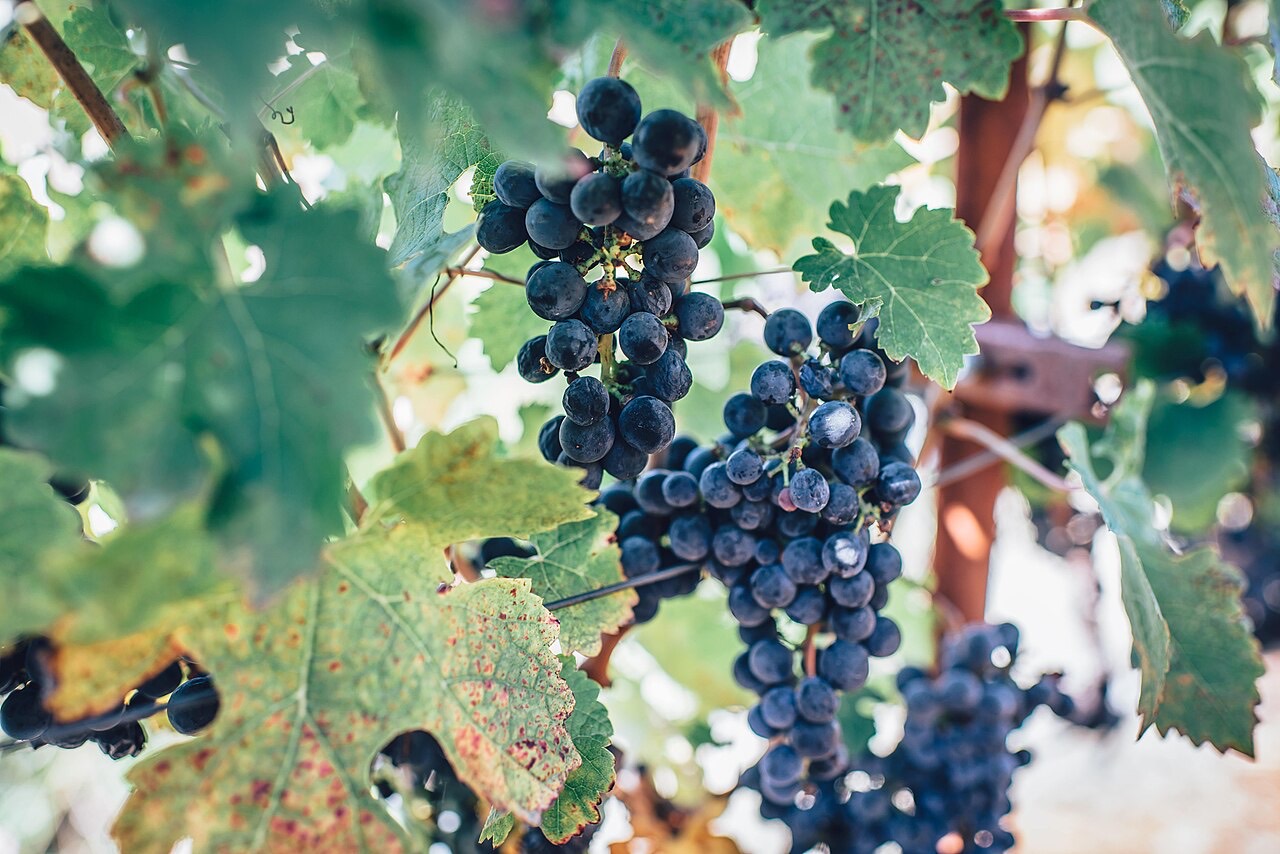
Grapevines are long-lived, climbing perennials trained onto trellis systems to support the canopy and simplify management. Vitis vinifera, the species behind most wine and much table-grape production, is grown across a wide range of temperate and Mediterranean-type climates, while other Vitis species and hybrids are used in regions with more challenging winters or disease pressure.
Because vines can remain productive for decades, decisions on rootstock, trellis system, and row orientation are made at planting and shape management for the life of the vineyard. End use — wine, fresh table fruit, drying, or juice — strongly influences cultivar choice and canopy management.
Overview
Grapevines are grown as trained, trellised perennials rather than replanted annually. Vineyard systems range from mechanized, high-volume production to smaller plantings managed for specific wine styles or fresh-market quality.
Because Vitis vinifera is susceptible to the root-feeding insect phylloxera in many regions, much of the world's vinifera production is grafted onto resistant rootstocks derived from American Vitis species, making rootstock choice a central establishment decision.
Botanical classification
- Family
- Vitaceae (grape family)
- Genus
- Vitis
- Principal species
- Vitis vinifera, together with hybrid and rootstock material derived from American Vitis species
- Growth habit
- Deciduous, climbing woody vine trained onto a trellis or support structure
Origin and distribution
Vitis vinifera originates from the region spanning the Caucasus, the Near East, and the eastern Mediterranean, where it was domesticated for wine production in antiquity before spreading throughout the Mediterranean basin and, later, worldwide.
Today grape is grown on every populated continent, from cool-climate wine regions to hot, irrigated table-grape production areas.
Climate requirements
Grape ripening is closely tied to accumulated heat over the growing season, and regions are often characterized by heat-summation indices used to match cultivars to climate. Adequate warmth during ripening supports sugar accumulation and flavor development.
Prolonged drought and extreme heat can stress vines and affect fruit composition, while excess rainfall near harvest raises the risk of fruit splitting and bunch rot.
Soil requirements
Grapevines are adaptable and often perform well on soils of only moderate fertility, since excessive vigor can reduce fruit quality. Well-drained sandy and loam soils are widely favored, and deep rooting allows vines to draw on subsoil moisture.
Vineyard establishment and management
Establishing a vineyard involves selecting a rootstock suited to local soil and pest pressure, a cultivar matched to the intended product and climate, and a trellis and training system suited to mechanization and canopy management goals.
- Rootstock selection for phylloxera resistance and soil adaptation
- Cultivar choice matched to wine style, table use, or drying
- Trellis system and row orientation set at planting
- Canopy management (shoot positioning, leaf removal) to balance yield and fruit quality
Nutrient considerations
Potassium supports fruit ripening and is taken up in significant amounts by the crop, while magnesium deficiency can contribute to premature bunch-stem necrosis in some regions. Nutrient status is generally monitored through petiole or leaf-blade analysis rather than soil testing alone.
Water and irrigation
Grape is grown both rain-fed, particularly in traditional Mediterranean-climate wine regions, and under irrigation in drier production areas. Drip irrigation is the dominant method in irrigated vineyards, allowing controlled deficit irrigation to manage vine vigor and fruit quality.
Mild, managed water stress is sometimes used deliberately in wine-grape production to influence berry size and composition, in contrast to the more consistent moisture typically favored for table grapes.
Common diseases and pests
Downy mildew and powdery mildew are two of the most significant fungal diseases of grape, both capable of damaging leaves and clusters under favorable conditions. Gray mold (Botrytis bunch rot) can affect ripening or ripe fruit, particularly in wet conditions near harvest. Spider mites and thrips are among the pests that can affect foliage and fruit quality.
Management combines canopy management for airflow, resistant or tolerant cultivars where available, monitoring, and — where justified — locally authorized control products applied according to their labels.
Harvest
Grape is harvested when sugar, acid, and flavor development reach the target profile for the intended product, whether fresh table fruit, wine, or raisins. Harvest may be by hand or machine, and timing balances fruit quality against weather risk.
Uses
- Wine production across still, sparkling, and fortified styles
- Fresh table-grape consumption
- Raisins and other dried products
- Juice, and by-products such as grape seed oil and pomace
Botanical identity
Species- Accepted name
- Vitis vinifera
- Family
- Vitaceae
- Genus
- Vitis
- Harvested part
- berry
- Agricultural use
- human food, beverage
- Crop group
- Fruit
What the authorities say
- World Flora Online — Taxonomic Backbone
- Vitis vinifera
- Plants of the World Online
- Vitis vinifera
Botanical identity here is what the consulted taxonomic authorities publish, on the date they were read. Where authorities disagree, both readings are shown rather than one being chosen silently.
Traded as
This crop is traded as 2 distinct commodities, which are graded and priced separately.
No ingested price series for these commodities yet.
What AgricultureID holds for this crop
- 10 crop calendar records
- 9 published cultivars
- 4 verified extension resources
- 9 pests and diseases naming this crop as a host
- 2 soil references
- 2 climate references
- 2 related crops
Not held
- No official variety registrations — source exists not mapped
- No farm economics observations — source exists not mapped
- No market price series — source exists not mapped
An absence here means this corpus holds no such record, not that none exists.
How to read figures on this page
Production, area and trade figures for any crop change from season to season and are compiled by FAO and by national agricultural statistics agencies. Take current numbers from those primary sources, dated to the period you mean, rather than from a secondary summary — including this one.
Crop water requirements are estimated from reference evapotranspiration and local climate data, following methods published by FAO and national agricultural agencies. A requirement quoted without the reference method and the local climate behind it is not a number that can be applied to a field.
Part of
Related crops
Planting and harvest calendar
Usual sowing and harvest windows across 10 jurisdictions, covering grape.
Official extension guidance
4 resources indexed from public extension publishers. Each was written for a particular place; read it at the source.
Assessing Grapevine Bud Damage
Factsheet published by University of Maryland Extension for Maryland. It addresses grape. The source is organised around “Assessing Grapevine Bud Damage”, “To see a VIDEO of how this is done, please check the following:” and “How to adjust pruning based on an assessment of low temperature damage to buds”.
University of Maryland Extension · Crop establishment · publisher states 2021-04-30
Factsheet published by Penn State Extension for Pennsylvania. It addresses grape. The source is organised around “Disease Cycle” and “Disease Management”.
Penn State Extension · Disease management · publisher states 2026-04-02
Phomopsis Cane and Leaf Spot of Grape
Factsheet published by Ohio State University Extension for Ohio. It addresses grape. The source is organised around “Causal Organism and Disease Cycle”, “Search form” and “PLPATH-FRU-47”.
Ohio State University Extension · Disease management · publisher states no date; reachable 2026-08-27
Round Two: Multi-Colored Asian Ladybeetle (MALB) Management For Grape Growers
Factsheet published by University of Maryland Extension for Maryland. It addresses grape. The source is organised around “Round Two: Multi-Colored Asian Ladybeetle (MALB) Management For Grape Growers”, “Management of the MALB” and “More on this topic in Timely Viticulture”.
University of Maryland Extension · Pest management · publisher states 2024-10-23
These are pointers to guidance published by others. Each was written for a particular place and season and is revised by its publisher; read it at the source, and check it applies where you farm.
Authorised inputs (France)
The French register records 384 currently authorised products whose authorised use names this crop, held by 116 authorisation holders. This is a count of what exists on the register, not a recommendation and not a shortlist.
By function
- Fongicide 254
- Insecticide 40
- Attractif phéromone (confusion sexuelle) 29
- Herbicide 28
- Acaricide 14
- Régulateur de croissance 6
Targets named on the register
- Mildiou(s) 114
- Oïdium(s) 101
- Tordeuses de la grappe 48
- Pourriture grise 46
- Black rot 34
- Cult. Installées 28
Use scope is recorded as the register writes it. Collective terms cover several crops at once and are left unmapped rather than expanded, because expanding one entry into several would invent authorisations that were never granted.
Authorisation is specific to one jurisdiction, one legal object and one moment. It is not a recommendation, and it says nothing about how a product may be used: always read the current official label at the source before acting.
Tools for this
Each tool shows its formula, constants and sources, and starts empty — nothing is filled in from this page.
- Seed-rate calculator
Convert a target plant stand into a seed rate, allowing for germination and establishment.
- Row spacing calculator
Work out in-row spacing and plants per metre of row for a target density.
- Production, area and yield calculator
Relate a harvested area and a yield to a production total, in either direction.
- Growing degree-days calculator
Accumulate heat units against a base temperature.
Relationships
Evidence-backed connections in the knowledge graph.
Susceptible to
Suitable soils
Climate sensitivity
Irrigation methods
Machinery
Managed with
Related topics
Notable cultivars
Documented varieties tied to this species, with registry status and sources on each page. Not an exhaustive list.
- Cabernet SauvignonCabernet Sauvignon is a red wine grape that arose in Bordeaux, France, and is now among the most widely planted wine grapes in the world. DNA analysis has shown it to be a natural cross of Cabernet Franc and Sauvignon Blanc.
- ChardonnayChardonnay is a white wine grape that originated in the Burgundy region of France. DNA analysis has identified it as a natural cross of Pinot and the old variety Gouais Blanc, and it is grown for still and sparkling wines worldwide.
- ConcordConcord is an American grape derived from the native species Vitis labrusca, selected in Concord, Massachusetts, in the mid-19th century. It is a cold-hardy, slip-skin grape widely used for juice, jelly, and table use rather than fine wine.
- MerlotMerlot is a red wine grape from Bordeaux, France, widely grown for soft, early-drinking red wines and as a blending partner for Cabernet Sauvignon. DNA analysis identifies Cabernet Franc as one of its parents.
- Pinot NoirPinot Noir is an ancient red wine grape from Burgundy, France, valued for elegant, aromatic red wines and as a principal grape of Champagne. It is regarded as difficult to grow and best suited to cool climates.
- RieslingRiesling is an aromatic white wine grape from the Rhine region of Germany, noted for high acidity, cold-hardiness, and a wide range of styles from bone-dry to intensely sweet. It is regarded as strongly expressive of site.
- Sauvignon BlancSauvignon Blanc is an aromatic white wine grape from the Loire Valley and Bordeaux in France, known for crisp, high-acid wines with herbaceous and citrus character. It is one of the two parents of Cabernet Sauvignon.
- TempranilloTempranillo is a red wine grape native to Spain and the principal variety of Rioja and Ribera del Duero. Its name reflects its relatively early ripening, and it is grown across Spain and Portugal under many regional synonyms.
- Thompson SeedlessThompson Seedless is a white, seedless grape of eastern Mediterranean origin, also known as Sultana or Sultanina. It is a leading grape for raisins as well as table use and juice, and is grown widely in hot, irrigated regions.
Harvested commodities
The traded commodities harvested from this crop. A commodity is the harvested lot, described by its own quality, grading, and storage evidence — not by the agronomy of the plant.
- Table GrapesTable grapes are bunches of fresh grape berries traded for eating. They are non-climacteric, so they never sweeten after cutting, and the bunch — berries plus its green stem framework — must arrive intact, which makes harvest timing and an unbroken cold chain the whole commercial game.
- Wine GrapesWine grapes are grapes harvested for fermentation rather than for eating. They are bought on composition — sugar, acidity, pH, and phenolic ripeness — not on appearance, and the lot has hours rather than weeks to reach the winery intact.
Scope & limitations
Geographic scope: Global overview. Cultivar, rootstock, and trellis choices are highly region- and end-use-specific.
Climate context: Perennial vine crop with ripening driven by cumulative seasonal heat; grown rain-fed or irrigated depending on region.
- Rootstock, trellis system, and irrigation strategy are site- and end-use-specific decisions not covered by universal values here.
- Production statistics change annually and should be taken from primary datasets such as FAOSTAT.
Sources
This article draws on the following authoritative sources. See our sources & methodology for how they are selected.
- [1]FAO — Food and Agriculture Organization (opens in a new tab)Authoritative
Food and Agriculture Organization of the United Nations (FAO)
Cited for: Global grape production and trade context
- Type:
- Intergovernmental organization
- Jurisdiction:
- Global
- Accessed:
- 2026-07-12
- [2]FAOSTAT — FAO statistical database (opens in a new tab)Authoritative
Food and Agriculture Organization of the United Nations (FAO)
Cited for: Production and area statistics
- Type:
- Intergovernmental organization
- Jurisdiction:
- Global
- Accessed:
- 2026-07-12
- Authoritative
Cited for: Classification and nomenclature
- Type:
- Reference database
- Jurisdiction:
- United States
- Accessed:
- 2026-07-12
- [4]CABI Digital Library — Crop Protection Compendium (opens in a new tab)High
CABI (Centre for Agriculture and Bioscience International)
Cited for: Grape disease and pest compendium data
- Type:
- Reference database
- Jurisdiction:
- Global
- Accessed:
- 2026-07-12
- [5]UC Statewide Integrated Pest Management Program (UC IPM) (opens in a new tab)High
University of California Agriculture and Natural Resources (UC ANR)
Cited for: Integrated pest management guidelines for grape
- Type:
- University extension service
- Jurisdiction:
- United States (California)
- Accessed:
- 2026-07-12