Crop · Fruit crop
Blackberry
Rubus fruticosus aggregate (cultivated blackberries are largely complex Rubus hybrids)
Also known as: Bramble, Thornless blackberry
Blackberry is a perennial cane fruit related to raspberry, grown for its dark aggregate fruit on a permanent root system, with modern thornless and primocane-fruiting cultivars widely used in commercial production.
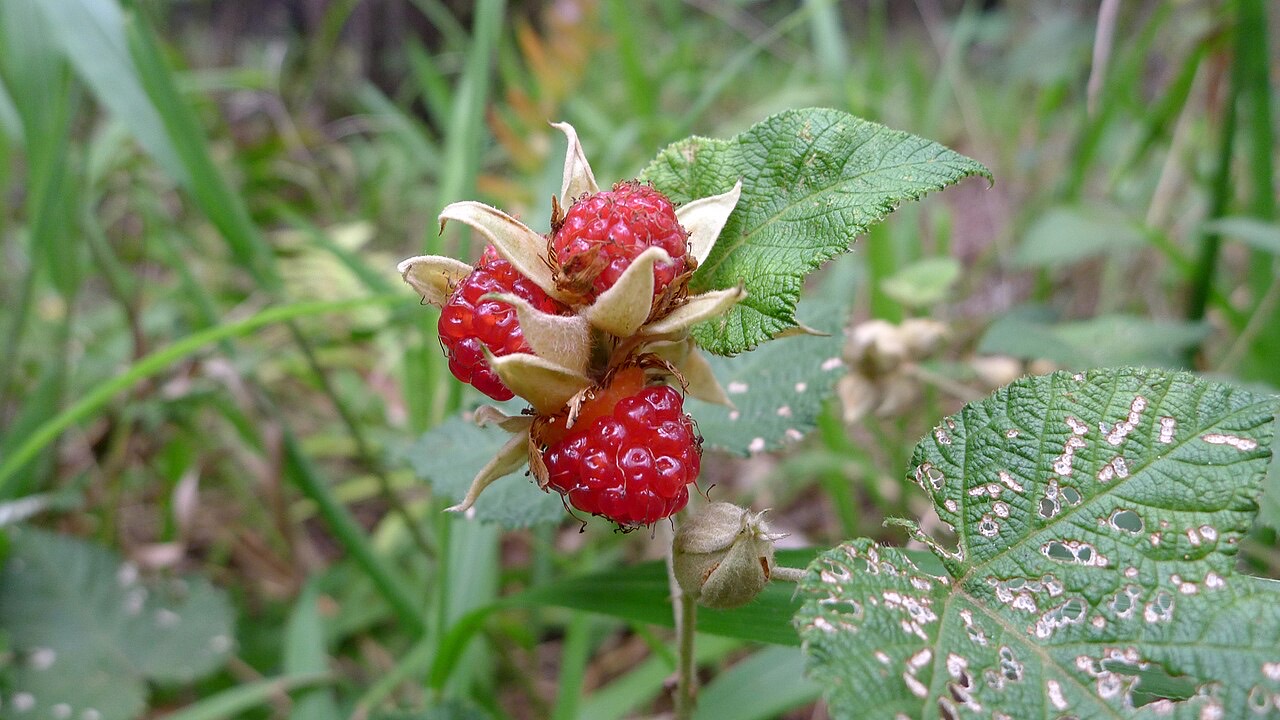
Blackberry is grown as a perennial bramble fruit, closely related to raspberry within the genus Rubus. Cultivated blackberries are typically complex hybrids selected for traits such as thornlessness, upright or semi-erect growth habit, and improved fruit size and firmness, rather than a single wild species grown unchanged.
As in raspberry, cultivars differ in fruiting habit: traditional floricane types fruit on second-year canes, while primocane types fruit on the current season's canes, extending the harvest season and simplifying pruning in many production systems.
Overview
Blackberry is cultivated as a perennial planting managed around the trailing, semi-erect, or erect growth habit and the floricane or primocane fruiting type of the chosen cultivar, with modern breeding having substantially reduced or eliminated thorns in many commercial cultivars.
Production spans open-field plantings and, increasingly, protected culture under tunnels, which extends the season and can improve fruit quality by reducing rain damage during harvest.
Botanical classification
- Family
- Rosaceae (rose family)
- Genus
- Rubus
- Principal taxa
- Rubus fruticosus aggregate (European blackberry) and numerous complex interspecific hybrid cultivars
- Growth habit
- Perennial shrub with trailing, semi-erect, or erect canes; floricane types fruit on second-year canes, primocane types on first-year canes
Origin and distribution
Wild blackberries occur natively across temperate regions of Europe, Asia, and the Americas, and modern cultivated types trace to breeding programs, particularly in North America, that combined multiple wild Rubus species to develop thornless, higher-yielding, and firmer-fruited cultivars.
Commercial production is now established across temperate and warm-temperate regions worldwide; production and trade statistics are compiled by national and international bodies and change over time.
Climate requirements
Blackberry generally tolerates warmer summer conditions better than raspberry, allowing production in a somewhat wider range of temperate and warm-temperate climates, though cultivars still vary in heat and cold tolerance.
Spring frost during flowering remains a risk to yield, and many floricane cultivars have a winter chilling requirement for normal flowering the following season.
Soil requirements
Blackberry performs best on deep, well-drained loams with good structure and moisture-holding capacity, and — as with raspberry — is intolerant of prolonged waterlogging, which increases the risk of root rot in the perennial root system.
Planting and establishment
Blackberry is established from certified nursery plants, generally trained onto a trellis or wire support system suited to the cultivar's growth habit — trailing types require more extensive training than erect types.
- Cultivar selection matched to growth habit (trailing, semi-erect, erect), thornlessness, fruiting type, and market window
- Trellis and training system suited to the chosen growth habit
- Pruning targeted differently for floricane versus primocane types
- Site drainage improvement where native soils are heavier or prone to waterlogging
Nutrient considerations
Nitrogen supports cane growth but is managed to avoid excessive vegetative vigor at the expense of fruiting, while potassium contributes to fruit size and quality across the harvest season.
Water and irrigation
Blackberry roots are shallow and fibrous, so the plant draws on a small volume of soil and shows stress quickly in dry weather. Trailing types on a trellis carry a larger evaporating canopy than erect types and are correspondingly less forgiving of an interrupted supply.
Common diseases and pests
Gray mold (Botrytis) can affect flowers and ripening fruit, particularly in humid conditions, and anthracnose can affect canes and fruit. Aphids and spider mites are among the key insect and mite pests, the former also of concern as virus vectors.
Management combines resistant cultivars, canopy management for airflow, monitoring, and — where justified — locally authorized control products applied according to their labels.
Harvest
Blackberry canes arise from the crown, so a planting stays where it is put and is trained on a trellis that separates the fruiting floricanes from the primocanes growing for next season. That separation is the central management task, and it is what makes trellis design a decision about labour rather than about support.
Uses
- Fresh-market fruit, picked with the receptacle inside it, which makes it firmer in the punnet than a raspberry
- Individually quick-frozen fruit, dominated by thornless erect cultivars bred for machine harvest
- Jam and pie filling, where the seed size that limits fresh sales matters less
- Juice and colour extract, drawing on the anthocyanin content
What this page covers
species complexThis page covers cultivated blackberries, which are complex hybrids drawn from many Rubus microspecies. Rubus is apomictic and its species boundaries are contested by the authorities themselves, so no accepted binomial can carry the page and the corpus holds none of the underlying taxa as a verified identity.
The species boundaries under this name are contested by the authorities themselves, so no single accepted binomial can carry the page.
| Taxon | In this corpus | Role |
|---|---|---|
| Rubus fruticosus agg.Blackberry aggregate | not held by this corpus | An aggregate name, not a species. Plants of the World Online resolves it; World Flora Online returns no placement. |
| Rubus ursinusCalifornian blackberry | not held by this corpus | One of the American parents behind the trailing cultivars. |
When a taxon here earns its own page: Nothing here can be split until the authorities agree on what the species are. This concept is waiting on taxonomy, not on editorial effort.
Botanical identity
Species complexsingle source- Accepted name
- RubusL.
- Family
- Rosaceae
- Genus
- Rubus
- Harvested part
- berry
- Agricultural use
- human food
- Crop group
- Fruit
What the authorities say
- Plants of the World Online
- Rubus fruticosus
"Rubus fruticosus" is an aggregate, not a species. Plants of the World Online resolves the name; World Flora Online returns no placement for it. Cultivated blackberries are complex hybrids drawn from many Rubus microspecies, and the genus is apomictic, so the species boundaries themselves are contested. Held as a complex rather than published under a species name the sources do not support.
- Rubus is apomictic and its microspecies are numerous and contested. Cultivated blackberries are complex hybrids; no single species name describes them.
Botanical identity here is what the consulted taxonomic authorities publish, on the date they were read. Where authorities disagree, both readings are shown rather than one being chosen silently.
What AgricultureID holds for this crop
- 1 pests and diseases naming this crop as a host
- 2 soil references
- 1 climate references
- 1 related crops
Not held
- No crop calendar records — source exists not mapped
- No published cultivars — not researched
- No official variety registrations — source exists not mapped
- No verified extension resources — source exists not ingested
- No farm economics observations — source exists not mapped
- No market price series — source exists not mapped
An absence here means this corpus holds no such record, not that none exists.
How to read figures on this page
Production, area and trade figures for any crop change from season to season and are compiled by FAO and by national agricultural statistics agencies. Take current numbers from those primary sources, dated to the period you mean, rather than from a secondary summary — including this one.
Crop water requirements are estimated from reference evapotranspiration and local climate data, following methods published by FAO and national agricultural agencies. A requirement quoted without the reference method and the local climate behind it is not a number that can be applied to a field.
Part of
Related crops
- Same genus
- Raspberry
Tools for this
Each tool shows its formula, constants and sources, and starts empty — nothing is filled in from this page.
- Seed-rate calculator
Convert a target plant stand into a seed rate, allowing for germination and establishment.
- Row spacing calculator
Work out in-row spacing and plants per metre of row for a target density.
- Production, area and yield calculator
Relate a harvested area and a yield to a production total, in either direction.
- Growing degree-days calculator
Accumulate heat units against a base temperature.
Relationships
Evidence-backed connections in the knowledge graph.
Susceptible to
Nutrients required
Suitable soils
Climate sensitivity
Irrigation methods
Machinery
Related topics
Scope & limitations
Geographic scope: Global overview. Cultivar, trellising, and chilling-requirement specifics are region- and site-specific.
Climate context: Temperate to warm-temperate cane fruit, generally more heat-tolerant than raspberry; still vulnerable to spring frost during bloom.
- Cultivated blackberries are largely complex interspecific hybrids, so growth habit and fruiting type vary substantially by cultivar and should be confirmed before planting.
- Production and cultivar-popularity statistics change over time and should be taken from primary datasets such as FAOSTAT.
Sources
This article draws on the following authoritative sources. See our sources & methodology for how they are selected.
- [1]FAO — Food and Agriculture Organization (opens in a new tab)Authoritative
Food and Agriculture Organization of the United Nations (FAO)
Cited for: Global blackberry production and trade context
- Type:
- Intergovernmental organization
- Jurisdiction:
- Global
- Accessed:
- 2026-07-12
- [2]FAOSTAT — FAO statistical database (opens in a new tab)Authoritative
Food and Agriculture Organization of the United Nations (FAO)
Cited for: Production and area statistics
- Type:
- Intergovernmental organization
- Jurisdiction:
- Global
- Accessed:
- 2026-07-12
- Authoritative
Cited for: Classification and nomenclature
- Type:
- Reference database
- Jurisdiction:
- United States
- Accessed:
- 2026-07-12
- [4]CABI Digital Library — Crop Protection Compendium (opens in a new tab)High
CABI (Centre for Agriculture and Bioscience International)
Cited for: Blackberry disease and pest compendium data
- Type:
- Reference database
- Jurisdiction:
- Global
- Accessed:
- 2026-07-12
- [5]Cornell CALS — Plant pathology and crop resources (opens in a new tab)High
Cornell University College of Agriculture and Life Sciences
Cited for: Cane fruit cultivar and production research
- Type:
- University extension service
- Jurisdiction:
- United States (New York)
- Accessed:
- 2026-07-12