Crop · Fruit crop
Raspberry
Rubus idaeus
Also known as: Red raspberry, European raspberry
Raspberry is a perennial cane fruit grown for its soft, aggregate fruit, cultivated on a permanent root system whose above-ground canes typically live for two seasons in traditional (floricane) types.
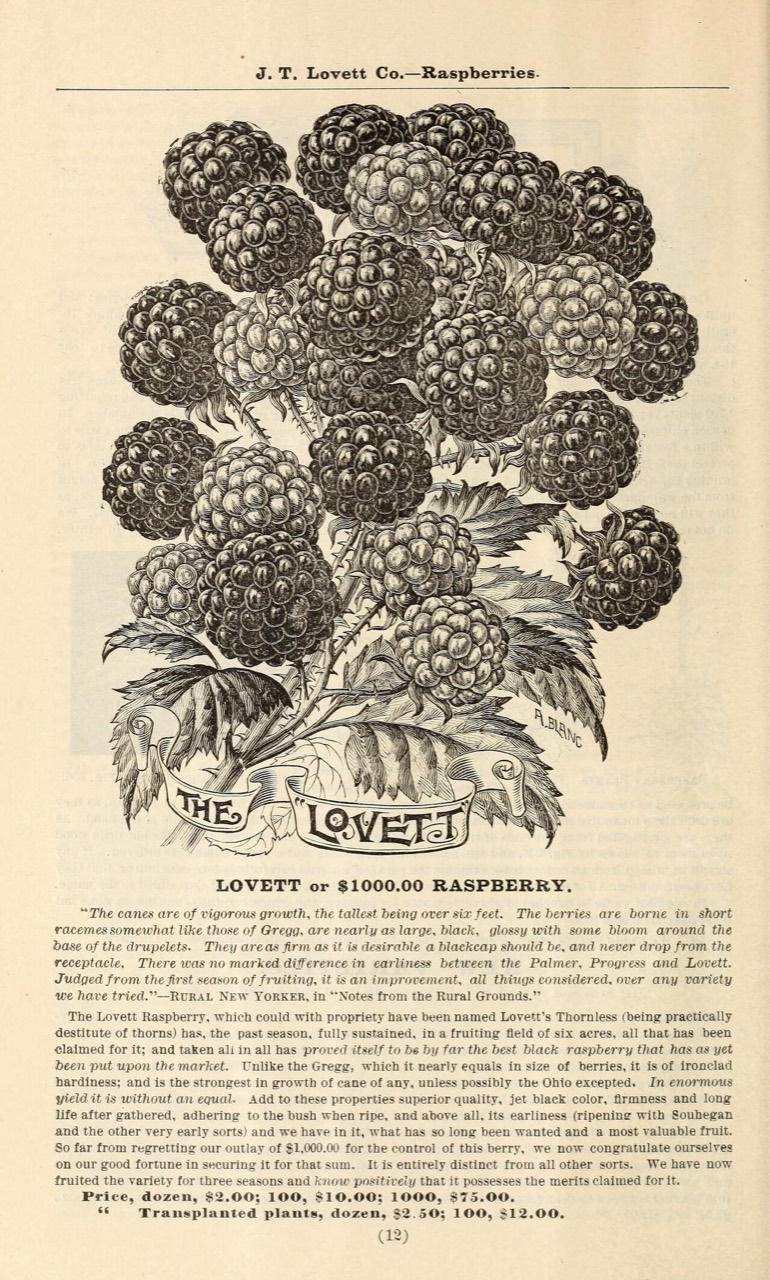
Raspberry is grown as a perennial bramble fruit whose root system persists indefinitely while the above-ground canes have a more limited lifespan. In traditional floricane types, canes grow vegetatively in their first year, overwinter, then flower and fruit in their second year before dying back, so a planting always contains canes of two ages.
Primocane (fall-fruiting) types, by contrast, fruit on the current season's canes, allowing a single annual pruning approach and a later crop. Cultivar choice between these two fruiting habits shapes pruning, trellising, and harvest timing for the life of the planting.
Overview
Raspberry is cultivated as a perennial planting, established once and cropped over multiple years, with management built around the specific fruiting habit — floricane or primocane — of the chosen cultivar.
Production ranges from open-field plantings to protected culture under tunnels, which extends the marketing season and can reduce fruit damage from rain during harvest.
Botanical classification
- Family
- Rosaceae (rose family)
- Genus
- Rubus
- Principal species
- Rubus idaeus (red raspberry)
- Growth habit
- Perennial shrub with a persistent root system producing new canes each year; floricane types fruit on second-year canes, primocane types on first-year canes
Origin and distribution
Raspberry derives from wild Rubus idaeus populations native to temperate Europe and Asia, long selected and improved for larger, more uniform fruit. It is now grown commercially across temperate regions worldwide, with production concentrated where summers are mild.
Climate requirements
Raspberry favors cool to mild temperate climates and is sensitive to high summer temperatures, which can reduce fruit quality and increase stress. Spring frost during flowering is a significant risk to yield.
Most floricane cultivars have a winter chilling requirement to flower and fruit normally the following season, similar in principle to other temperate perennial fruit crops.
Soil requirements
Raspberry performs best on deep, well-drained loams with good structure and moisture-holding capacity. The crop is notably intolerant of waterlogging, which sharply increases the risk of root rot in the perennial root system.
Planting and establishment
Raspberry is established from certified virus-tested canes or tissue-cultured plants, generally trained onto a trellis or wire support system to keep canes upright and fruit accessible for harvest.
- Cultivar selection matched to fruiting habit (floricane or primocane), chilling requirement, and market window
- Trellis and training system suited to the chosen fruiting habit and row spacing
- Pruning timed and targeted differently for floricane (removing spent canes after fruiting) versus primocane types
- Site drainage improvement where native soils are heavier or prone to waterlogging
Nutrient considerations
Nitrogen supports cane growth but must be balanced to avoid excessive vegetative vigor at the expense of fruiting, while potassium contributes to fruit size and quality across the fruiting season.
Water and irrigation
Raspberry is the more drought-sensitive of the caneberries, and the reason is structural: the root system that produces its suckers sits shallow and wide, so the plant is exploring the layer that dries first. Primocane-fruiting types carry the additional difficulty of needing water in late summer, when supply is usually least reliable.
Common diseases and pests
Gray mold (Botrytis) is one of the most significant diseases of raspberry, affecting flowers and ripening fruit especially in humid conditions, and anthracnose can affect canes and fruit. Aphids are a key pest both directly and as virus vectors, and spider mites can build up under hot, dry conditions.
Management combines resistant cultivars, canopy management for airflow, monitoring, and — where justified — locally authorized control products applied according to their labels.
Harvest
Red raspberry differs structurally from blackberry in a way that governs how a planting behaves: it produces new canes from buds on the roots as well as the crown, so it spreads outward from where it was planted and the row has to be managed to a width rather than merely supported. Suckering between rows is routine work, not a sign of anything wrong.
Uses
- Fresh-market punnets, where the hollow receptacle-free fruit is fragile enough to set the whole supply chain
- Individually quick-frozen fruit, the outlet that absorbs the machine-harvested crop
- Purée and juice concentrate for dairy, bakery and beverage manufacture
- Leaf, harvested separately from the fruit crop for herbal infusion
Botanical identity
Species- Accepted name
- Rubus idaeus
- Family
- Rosaceae
- Genus
- Rubus
- Harvested part
- berry
- Agricultural use
- human food
- Crop group
- Fruit
What the authorities say
- World Flora Online — Taxonomic Backbone
- Rubus idaeus
- Plants of the World Online
- Rubus idaeus
Botanical identity here is what the consulted taxonomic authorities publish, on the date they were read. Where authorities disagree, both readings are shown rather than one being chosen silently.
What AgricultureID holds for this crop
- 1 verified extension resources
- 1 pests and diseases naming this crop as a host
- 2 soil references
- 1 climate references
- 1 related crops
Not held
- No crop calendar records — source exists not mapped
- No published cultivars — not researched
- No official variety registrations — source exists not mapped
- No farm economics observations — source exists not mapped
- No market price series — source exists not mapped
An absence here means this corpus holds no such record, not that none exists.
How to read figures on this page
Production, area and trade figures for any crop change from season to season and are compiled by FAO and by national agricultural statistics agencies. Take current numbers from those primary sources, dated to the period you mean, rather than from a secondary summary — including this one.
Crop water requirements are estimated from reference evapotranspiration and local climate data, following methods published by FAO and national agricultural agencies. A requirement quoted without the reference method and the local climate behind it is not a number that can be applied to a field.
Part of
Related crops
- Same genus
- Blackberry
Official extension guidance
1 resource indexed from public extension publishers. Each was written for a particular place; read it at the source.
Long Cane Raspberry Production in Ohio
Factsheet published by Ohio State University Extension for Ohio. It addresses raspberry. The source is organised around “What Is the Long Cane Raspberry Production System?”, “What Is the Yield Potential of Long Cane Raspberry Production?” and “Why Should a Grower Consider the Long Cane Raspberry Production System?”.
Ohio State University Extension · Nutrient management · publisher states no date; reachable 2026-08-27
These are pointers to guidance published by others. Each was written for a particular place and season and is revised by its publisher; read it at the source, and check it applies where you farm.
Authorised inputs (France)
The French register records 70 currently authorised products whose authorised use names this crop, held by 47 authorisation holders. This is a count of what exists on the register, not a recommendation and not a shortlist.
By function
- Fongicide 42
- Insecticide 20
- Acaricide 6
- Herbicide 1
- Nématicide 1
Targets named on the register
- Oïdium(s) 18
- Pourriture grise 18
- Acariens et phytoptes 10
- Chenilles phytophages 8
- Champignons (pythiacées) 7
- Maladies du feuillage 5
Use scope is recorded as the register writes it. Collective terms cover several crops at once and are left unmapped rather than expanded, because expanding one entry into several would invent authorisations that were never granted.
Authorisation is specific to one jurisdiction, one legal object and one moment. It is not a recommendation, and it says nothing about how a product may be used: always read the current official label at the source before acting.
Tools for this
Each tool shows its formula, constants and sources, and starts empty — nothing is filled in from this page.
- Seed-rate calculator
Convert a target plant stand into a seed rate, allowing for germination and establishment.
- Row spacing calculator
Work out in-row spacing and plants per metre of row for a target density.
- Production, area and yield calculator
Relate a harvested area and a yield to a production total, in either direction.
- Growing degree-days calculator
Accumulate heat units against a base temperature.
Relationships
Evidence-backed connections in the knowledge graph.
Susceptible to
Nutrients required
Suitable soils
Climate sensitivity
Irrigation methods
Machinery
Related topics
Scope & limitations
Geographic scope: Global overview. Cultivar, trellising, and chilling-requirement specifics are region- and site-specific.
Climate context: Cool to cool-temperate cane fruit; sensitive to spring frost during bloom and to summer heat stress.
- Fruiting habit (floricane versus primocane) substantially changes pruning and training practice and should be confirmed for the specific cultivar grown.
- Production and cultivar-popularity statistics change over time and should be taken from primary datasets such as FAOSTAT.
Sources
This article draws on the following authoritative sources. See our sources & methodology for how they are selected.
- [1]FAO — Food and Agriculture Organization (opens in a new tab)Authoritative
Food and Agriculture Organization of the United Nations (FAO)
Cited for: Global raspberry production and trade context
- Type:
- Intergovernmental organization
- Jurisdiction:
- Global
- Accessed:
- 2026-07-12
- [2]FAOSTAT — FAO statistical database (opens in a new tab)Authoritative
Food and Agriculture Organization of the United Nations (FAO)
Cited for: Production and area statistics
- Type:
- Intergovernmental organization
- Jurisdiction:
- Global
- Accessed:
- 2026-07-12
- Authoritative
Cited for: Classification and nomenclature
- Type:
- Reference database
- Jurisdiction:
- United States
- Accessed:
- 2026-07-12
- [4]CABI Digital Library — Crop Protection Compendium (opens in a new tab)High
CABI (Centre for Agriculture and Bioscience International)
Cited for: Raspberry disease and pest compendium data
- Type:
- Reference database
- Jurisdiction:
- Global
- Accessed:
- 2026-07-12
- [5]Cornell CALS — Plant pathology and crop resources (opens in a new tab)High
Cornell University College of Agriculture and Life Sciences
Cited for: Cane fruit cultivar and production research
- Type:
- University extension service
- Jurisdiction:
- United States (New York)
- Accessed:
- 2026-07-12