Crop · Vegetable crop
Garlic
Allium sativum
Also known as: Common garlic
Garlic is a bulb crop in the Allium genus, propagated vegetatively from cloves rather than true seed, grown worldwide for its pungent, storable bulb used as a culinary staple and flavoring.
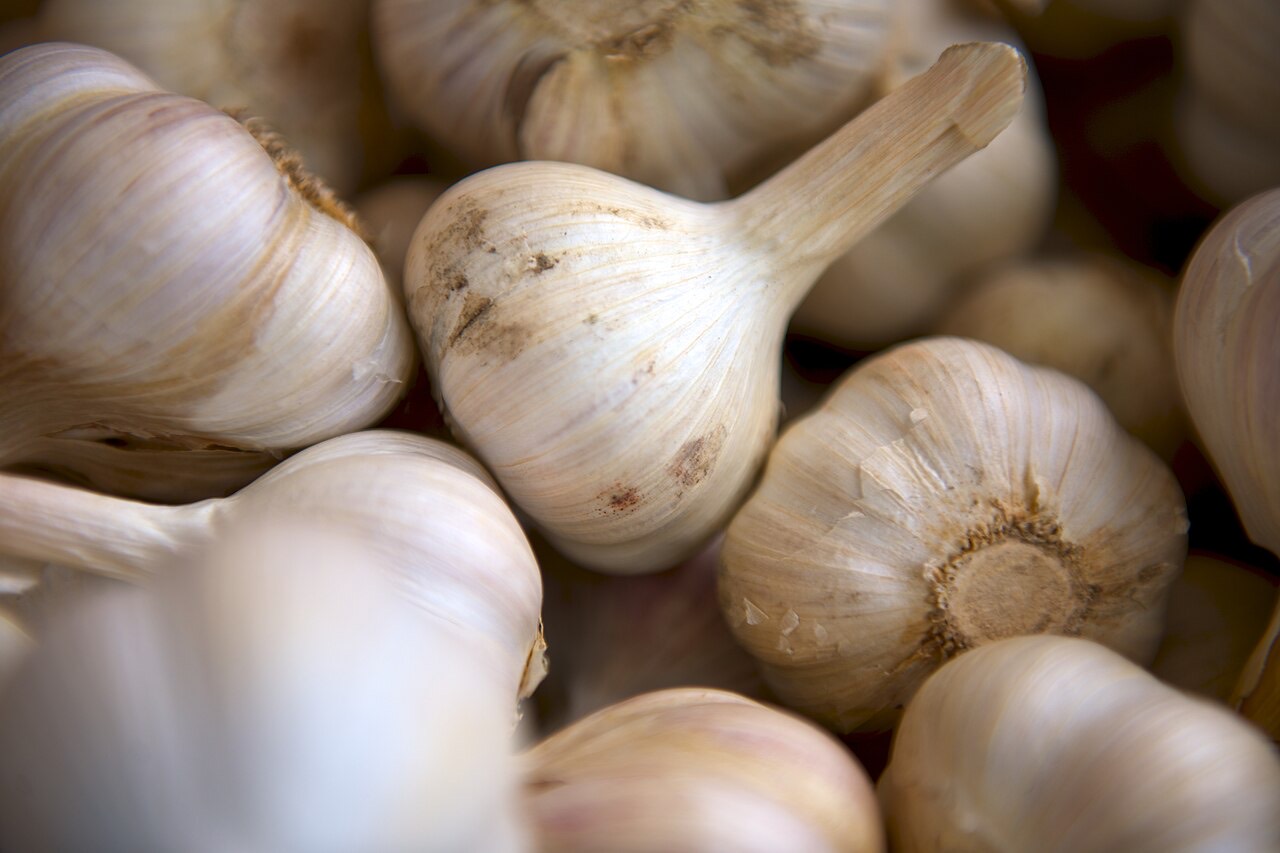
Garlic is grown for its underground bulb, composed of individual cloves, each of which can be planted to produce a new plant. Most cultivated garlic rarely produces viable seed, so commercial production relies on vegetative propagation through cloves rather than sexual reproduction from seed.
Garlic cultivars are broadly grouped into hardneck types, which produce a flowering stalk (scape) and generally fewer, larger cloves, and softneck types, which typically do not produce a scape and form more numerous, smaller cloves; the two groups differ in cold requirement, storage life, and regional adaptation.
Overview
Because garlic is propagated from cloves rather than seed, planting stock quality — freedom from disease and appropriate clove size — is a central concern in production, distinct from most other vegetable crops that rely on true seed.
Like onion, garlic has a shallow, sparsely branched root system, making it comparatively sensitive to short-term water and nutrient shortages near the soil surface.
Botanical classification
- Family
- Amaryllidaceae, subfamily Allioideae (formerly treated as Alliaceae)
- Genus and species
- Allium sativum
- Propagation
- Vegetative, from individual cloves; commercial garlic rarely sets viable seed
- Growth habit
- Bulb-forming perennial grown as an annual, with hardneck types producing a flowering stalk (scape) and softneck types generally not
Origin and distribution
Garlic is believed to have originated in Central Asia and has been cultivated since antiquity across the Mediterranean, the Middle East, and Asia, with historical records of its use in ancient Egypt and other early civilizations.
It is now grown across temperate and subtropical regions worldwide.
Climate requirements
Bulb and clove differentiation in garlic is influenced by exposure to a period of cool temperatures and by day length, broadly similar in principle to the bulbing response in onion, though the specific requirements differ between hardneck and softneck types.
Garlic is generally tolerant of cold during vegetative growth, and cultivar type is matched to local winter temperatures to ensure adequate cold exposure without cold injury.
Soil requirements
Garlic performs best on well-drained, fertile sandy loams free of compaction, which support even bulb development. Its shallow root system makes it comparatively intolerant of both drought stress and waterlogging.
Establishment and crop management
Garlic is established by planting individual cloves at a set depth and spacing, using planting stock selected for size uniformity and freedom from disease. Rotation away from other Allium crops helps manage soilborne disease buildup over time.
- Selection of disease-free, appropriately sized planting cloves
- Cultivar type (hardneck or softneck) matched to local winter temperatures
- Crop rotation away from other Allium species to reduce soilborne disease carryover
- Prompt weed control given the crop’s narrow leaves and shallow rooting
Nutrient considerations
Sulfur is notable in garlic because it is a precursor of the pungent flavor compounds characteristic of the crop, while nitrogen and phosphorus support vegetative growth and bulb development. Requirements depend on soil supply, target yield, and cultivar.
Water and irrigation
Because of its shallow root system, garlic requires regular moisture through vegetative growth and bulb development, with irrigation commonly reduced or withheld in the weeks before harvest to encourage proper curing.
Common diseases and pests
Fusarium basal rot is a significant soilborne disease affecting the bulb base, and downy mildew, which affects Allium crops broadly, can also occur under cool, humid conditions. Thrips are the most important insect pest of garlic in many regions and can also be associated with virus spread.
Management combines the use of clean, disease-free planting stock, rotation away from other Alliums, field monitoring, and, where warranted, locally authorized control measures applied according to their labels.
Harvest
Maturity is signaled by the foliage yellowing and beginning to dry down. Bulbs are lifted and then cured — dried under controlled conditions — before trimming and storage, since proper curing strongly influences storage life and quality.
Uses
- Fresh and dried culinary use as a foundational flavoring across many cuisines
- Processed forms including minced, powdered, and paste products
- Pickled garlic and garlic-based condiments in some markets
- Traditional non-culinary uses recorded in some cultures, alongside its primary role as food
Botanical identity
Species- Accepted name
- Allium sativum
- Family
- Amaryllidaceae
- Genus
- Allium
- Harvested part
- bulb
- Agricultural use
- human food, spice
- Crop group
- Vegetables, Spices and herbs
What the authorities say
- World Flora Online — Taxonomic Backbone
- Allium sativum
- Plants of the World Online
- Allium sativum
Botanical identity here is what the consulted taxonomic authorities publish, on the date they were read. Where authorities disagree, both readings are shown rather than one being chosen silently.
Traded as
This crop is traded as one commodity in this corpus.
No ingested price series for these commodities yet.
What AgricultureID holds for this crop
- 115 crop calendar records
- 1 verified extension resources
- 2 soil references
- 1 climate references
- 4 related crops
Not held
- No published cultivars — not researched
- No official variety registrations — source exists not mapped
- No pests and diseases naming this crop as a host — source exists not ingested
- No farm economics observations — source exists not mapped
- No market price series — source exists not mapped
An absence here means this corpus holds no such record, not that none exists.
How to read figures on this page
Production, area and trade figures for any crop change from season to season and are compiled by FAO and by national agricultural statistics agencies. Take current numbers from those primary sources, dated to the period you mean, rather than from a secondary summary — including this one.
Crop water requirements are estimated from reference evapotranspiration and local climate data, following methods published by FAO and national agricultural agencies. A requirement quoted without the reference method and the local climate behind it is not a number that can be applied to a field.
Part of
Related crops
- Same genus
- Chives, Leek, Onion, Welsh Onion
Planting and harvest calendar
Usual sowing and harvest windows across 115 jurisdictions, covering garlic and garlic — season 1 and garlic — season 2 and garlic — season 3.
Official extension guidance
1 resource indexed from public extension publishers. Each was written for a particular place; read it at the source.
Factsheet published by Penn State Extension for Pennsylvania. It addresses garlic. The source is organised around “Garlic Production”, “Types of Garlic” and “Site Selection and Planting”.
Penn State Extension · Crop establishment, Pest management, Harvest, Storage · publisher states 2023-12-13
These are pointers to guidance published by others. Each was written for a particular place and season and is revised by its publisher; read it at the source, and check it applies where you farm.
Tools for this
Each tool shows its formula, constants and sources, and starts empty — nothing is filled in from this page.
- Seed-rate calculator
Convert a target plant stand into a seed rate, allowing for germination and establishment.
- Row spacing calculator
Work out in-row spacing and plants per metre of row for a target density.
- Production, area and yield calculator
Relate a harvested area and a yield to a production total, in either direction.
- Growing degree-days calculator
Accumulate heat units against a base temperature.
Relationships
Evidence-backed connections in the knowledge graph.
Susceptible to
Nutrients required
Suitable soils
Climate sensitivity
Irrigation methods
Managed with
Harvested commodities
The traded commodities harvested from this crop. A commodity is the harvested lot, described by its own quality, grading, and storage evidence — not by the agronomy of the plant.
Scope & limitations
Geographic scope: Global overview. Cultivar type (hardneck or softneck), planting timing, and input levels are region-specific and depend on local winter temperatures.
Climate context: Cool-influenced bulb crop propagated vegetatively from cloves; grown across temperate to subtropical regions.
- Cultivar type and clove planting timing are region-specific decisions not reduced to universal guidance here.
- Production and trade statistics change annually and should be taken from primary datasets such as FAOSTAT.
- Disease and pest control should follow locally authorized guidance and product labels.
Sources
This article draws on the following authoritative sources. See our sources & methodology for how they are selected.
- [1]FAO — Food and Agriculture Organization (opens in a new tab)Authoritative
Food and Agriculture Organization of the United Nations (FAO)
Cited for: Role of garlic in global vegetable production
- Type:
- Intergovernmental organization
- Jurisdiction:
- Global
- Accessed:
- 2026-07-12
- [2]FAOSTAT — FAO statistical database (opens in a new tab)Authoritative
Food and Agriculture Organization of the United Nations (FAO)
Cited for: Production, area, and trade statistics
- Type:
- Intergovernmental organization
- Jurisdiction:
- Global
- Accessed:
- 2026-07-12
- Authoritative
Cited for: Classification and nomenclature
- Type:
- Reference database
- Jurisdiction:
- United States
- Accessed:
- 2026-07-12
- [4]UC Statewide Integrated Pest Management Program (UC IPM) (opens in a new tab)High
University of California Agriculture and Natural Resources (UC ANR)
Cited for: Integrated pest and disease management for garlic
- Type:
- University extension service
- Jurisdiction:
- United States (California)
- Accessed:
- 2026-07-12
- [5]Cornell CALS — Plant pathology and crop resources (opens in a new tab)High
Cornell University College of Agriculture and Life Sciences
Cited for: Garlic production and disease guidance
- Type:
- University extension service
- Jurisdiction:
- United States (New York)
- Accessed:
- 2026-07-12