Crop · Legume crop
Groundnut
Arachis hypogaea
Also known as: Peanut, Earthnut
Groundnut is an annual legume grown for its oil- and protein-rich seed, distinguished by geocarpy — its pods develop and mature underground — and valued both as a major oilseed and as a widely consumed food crop.
Groundnut has an unusual reproductive biology among cultivated crops: after flowers are pollinated above ground, a stalk-like structure called a peg elongates and pushes the fertilized ovary downward into the soil, where the pod develops and the seeds mature underground, a trait known as geocarpy.
Cultivars are grouped into bunch (erect) and runner (prostrate, spreading) growth habits, which influence row spacing, weed management, and mechanical harvest. As a legume, groundnut forms a symbiotic relationship with compatible rhizobia in root nodules, enabling biological nitrogen fixation.
Overview
Groundnut is grown as an annual oilseed and food legume whose distinctive underground pod development sets it apart agronomically from nearly all other major crops, most notably in its strong preference for loose, easily penetrated soil.
Production spans smallholder systems, especially across parts of Africa and Asia, to large mechanized operations in the Americas, with cultivar choice shaped by market use — confectionery, oil extraction, or roasting.
Botanical classification
- Family
- Fabaceae (legume family)
- Genus and species
- Arachis hypogaea
- Reproductive habit
- Geocarpic: pollinated flowers form a peg that pushes the developing pod underground to mature
| Growth habit | Description | Typical management |
|---|---|---|
| Bunch (erect) | Compact, upright plants with pods clustered close to the main stem | Often suited to closer row spacing and mechanical harvest |
| Runner (prostrate) | Spreading, trailing plants with pods distributed along lateral branches | Typically grown at wider spacing to accommodate spreading growth |
Origin and distribution
Groundnut was domesticated in South America, in the region of present-day Bolivia, Argentina, and Paraguay, and was subsequently spread by European traders to Africa and Asia, where it became deeply integrated into food systems and, in turn, was reintroduced to North America.
It is now grown pantropically and in warm temperate regions worldwide.
Climate requirements
Groundnut is a warm-season crop requiring a long frost-free period to complete its cycle, with germination, pegging, and pod development all favored by warm soil and air temperatures.
The crop is sensitive to cold, particularly during establishment and again during pod-fill, and planting timing is set locally to ensure the growing season provides sufficient warm days for pod maturation.
Soil requirements
Loose, well-drained sandy soils are strongly preferred because pegs must penetrate the soil easily for pods to form normally, and because pods are dug directly from the soil at harvest — heavier or compacted soils impede pegging and complicate clean harvest.
Establishment and crop management
Groundnut is typically direct-seeded from shelled kernels, with row spacing set according to growth habit (bunch or runner). Rotation with cereals is recommended to manage the buildup of soilborne pathogens over time.
- Growth habit selection (bunch or runner) matched to local row-spacing and harvest equipment
- Crop rotation with cereals to manage soilborne diseases
- Maintaining loose, friable soil in the pegging zone through appropriate tillage
- Timely weed management, since groundnut competes poorly with weeds during early growth
Nutrient considerations
Biological nitrogen fixation can supply much of the crop’s nitrogen requirement where nodulation is effective. Calcium availability specifically within the pegging and pod zone is particularly important for groundnut, since calcium for pod and kernel development is absorbed directly by the developing pod rather than primarily through the roots.
Water and irrigation
Flowering, pegging, and pod-fill are all moisture-sensitive stages in groundnut. In some regions, drought stress late in the season has also been linked to an increased risk of fungal contamination associated with aflatoxin, a recognized food-safety concern managed through variety choice, timely harvest, and proper drying and storage.
Common diseases and pests
Root rot can develop in wet or compacted soils, and anthracnose has been documented affecting groundnut foliage and pods in some regions. Thrips are a major pest, feeding directly on foliage and acting as vectors for certain plant viruses, while aphids are also present in many production areas.
Management combines resistant cultivars, crop rotation, field monitoring, and, where warranted, locally authorized control measures applied according to their labels.
Harvest
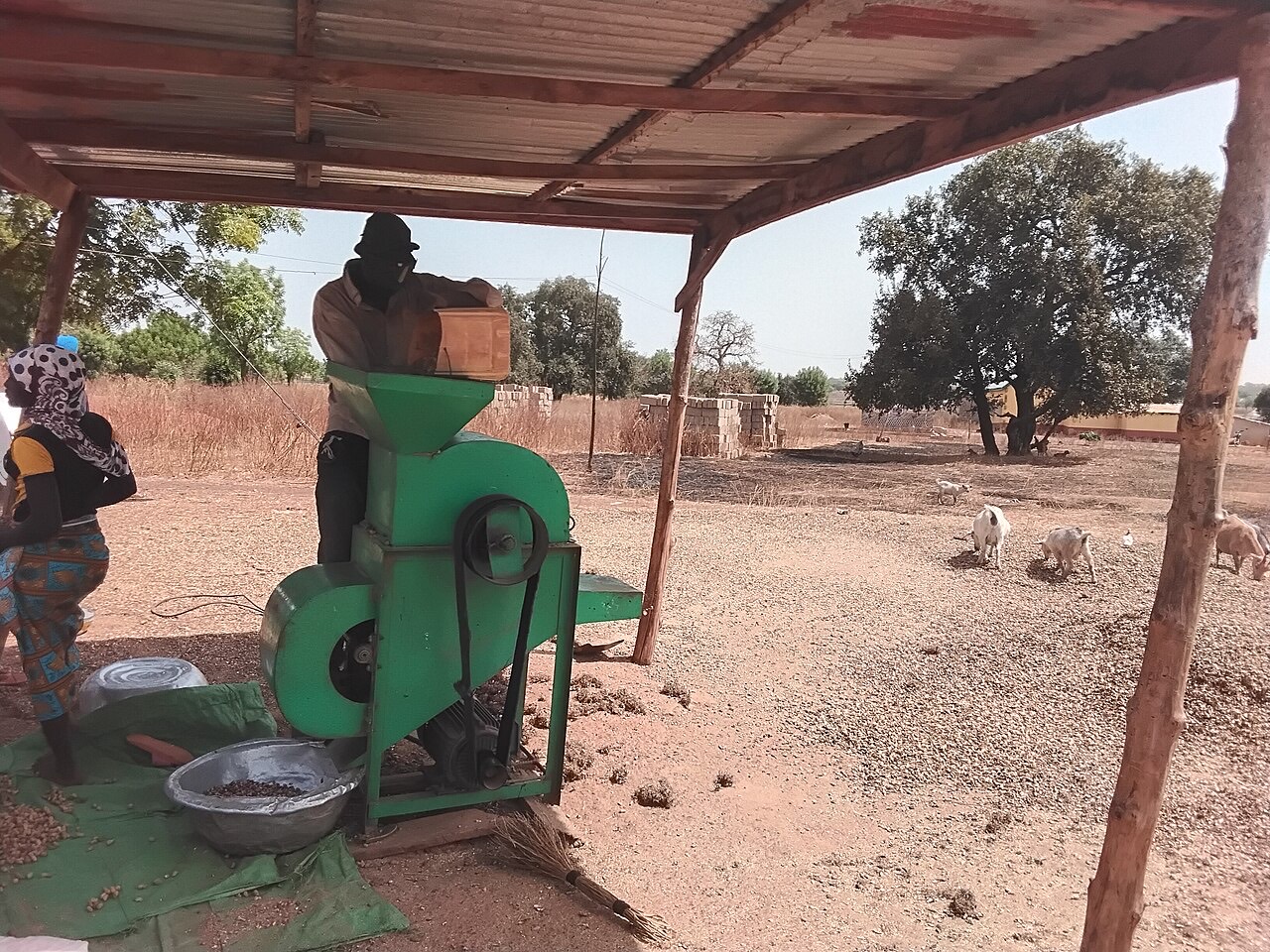
Plants are lifted or dug once pods reach maturity, assessed by internal shell coloration and pod fill, since maturity cannot be judged from the foliage alone. After lifting, pods are dried before threshing, further drying, and storage — a critical step for both quality and safe storage.
Uses
- Crushed for edible groundnut (peanut) oil
- Direct food consumption — roasted, boiled, or processed into peanut butter and confectionery
- Protein meal by-product used in animal feed
- Haulm (vines) used as forage or fodder in some production systems
Botanical identity
Species- Accepted name
- Arachis hypogaea
- Family
- Fabaceae
- Genus
- Arachis
- Harvested part
- seed, oilseed
- Agricultural use
- human food, oilseed, animal feed
- Crop group
- Pulses and grain legumes, Oilseeds
What the authorities say
- World Flora Online — Taxonomic Backbone
- Arachis hypogaea
- Plants of the World Online
- Arachis hypogaea
Botanical identity here is what the consulted taxonomic authorities publish, on the date they were read. Where authorities disagree, both readings are shown rather than one being chosen silently.
Traded as
This crop is traded as one commodity in this corpus.
What AgricultureID holds for this crop
- 196 crop calendar records
- 6 pests and diseases naming this crop as a host
- 2 soil references
- 2 climate references
- 34 farm economics observations
- 338 market price series
- 5 related crops
Not held
- No published cultivars — not researched
- No official variety registrations — source exists not mapped
- No verified extension resources — source exists not ingested
An absence here means this corpus holds no such record, not that none exists.
How to read figures on this page
Production, area and trade figures for any crop change from season to season and are compiled by FAO and by national agricultural statistics agencies. Take current numbers from those primary sources, dated to the period you mean, rather than from a secondary summary — including this one.
Crop water requirements are estimated from reference evapotranspiration and local climate data, following methods published by FAO and national agricultural agencies. A requirement quoted without the reference method and the local climate behind it is not a number that can be applied to a field.
Part of
Fabaceae — the legume family · Oilseeds · Pulses and grain legumes
Related crops
Planting and harvest calendar
Usual sowing and harvest windows across 196 jurisdictions, covering peanut and peanut — season 1 and peanut — season 2 and peanut — season 3.
Cost of production, as forecast
United States national estimates for 2027, published by USDA Economic Research Service.
- Total costs listed
- 1247.94 USD
- Dollars per planted acre
- Operating costs
- 671.37 USD
- Dollars per planted acre
- Allocated overhead
- 576.57 USD
- Dollars per planted acre
A forecast of what a crop will cost to grow is not a record of what it cost. It is the source’s expectation for a year that has not finished.
These are costs only. The source publishes no revenue alongside them, so no margin, profit or break-even price is derived from them here.
Authorised inputs (France)
The French register records 5 currently authorised products whose authorised use names this crop, held by 4 authorisation holders. This is a count of what exists on the register, not a recommendation and not a shortlist.
By function
- Herbicide 5
Targets named on the register
Use scope is recorded as the register writes it. Collective terms cover several crops at once and are left unmapped rather than expanded, because expanding one entry into several would invent authorisations that were never granted.
Authorisation is specific to one jurisdiction, one legal object and one moment. It is not a recommendation, and it says nothing about how a product may be used: always read the current official label at the source before acting.
Tools for this
Each tool shows its formula, constants and sources, and starts empty — nothing is filled in from this page.
- Seed-rate calculator
Convert a target plant stand into a seed rate, allowing for germination and establishment.
- Row spacing calculator
Work out in-row spacing and plants per metre of row for a target density.
- Production, area and yield calculator
Relate a harvested area and a yield to a production total, in either direction.
- Growing degree-days calculator
Accumulate heat units against a base temperature.
Relationships
Evidence-backed connections in the knowledge graph.
Susceptible to
Nutrients required
Suitable soils
Machinery
Related topics
Harvested commodities
The traded commodities harvested from this crop. A commodity is the harvested lot, described by its own quality, grading, and storage evidence — not by the agronomy of the plant.
Scope & limitations
Geographic scope: Global overview. Growth habit selection, sowing timing, and input levels are region-specific and depend on local climate and soil.
Climate context: Warm-season legume requiring a long frost-free period, grown pantropically and in warm temperate regions.
- Growth habit selection and sowing timing are region-specific decisions not reduced to universal guidance here.
- Aflatoxin risk is a recognized food-safety consideration influenced by drought stress, harvest timing, and storage conditions.
- Disease and pest control should follow locally authorized guidance and product labels.
Sources
This article draws on the following authoritative sources. See our sources & methodology for how they are selected.
- [1]FAO — Food and Agriculture Organization (opens in a new tab)Authoritative
Food and Agriculture Organization of the United Nations (FAO)
Cited for: Role of groundnut in global oilseed and food systems
- Type:
- Intergovernmental organization
- Jurisdiction:
- Global
- Accessed:
- 2026-07-12
- [2]FAOSTAT — FAO statistical database (opens in a new tab)Authoritative
Food and Agriculture Organization of the United Nations (FAO)
Cited for: Production, area, and trade statistics
- Type:
- Intergovernmental organization
- Jurisdiction:
- Global
- Accessed:
- 2026-07-12
- Authoritative
Cited for: Classification and nomenclature
- Type:
- Reference database
- Jurisdiction:
- United States
- Accessed:
- 2026-07-12
Cited for: Groundnut research in tropical and semi-arid systems
- Type:
- Research institute
- Jurisdiction:
- Global
- Accessed:
- 2026-07-12
- [5]UC Statewide Integrated Pest Management Program (UC IPM) (opens in a new tab)High
University of California Agriculture and Natural Resources (UC ANR)
Cited for: Integrated pest management for legume crops
- Type:
- University extension service
- Jurisdiction:
- United States (California)
- Accessed:
- 2026-07-12