Crop · Fruit crop
Strawberry
Fragaria × ananassa (garden strawberry)
Also known as: Garden strawberry
Strawberry is a low-growing perennial fruit crop widely grown for fresh consumption and processing. Commercial production ranges from perennial matted-row systems to annual plasticulture, depending on climate and market.
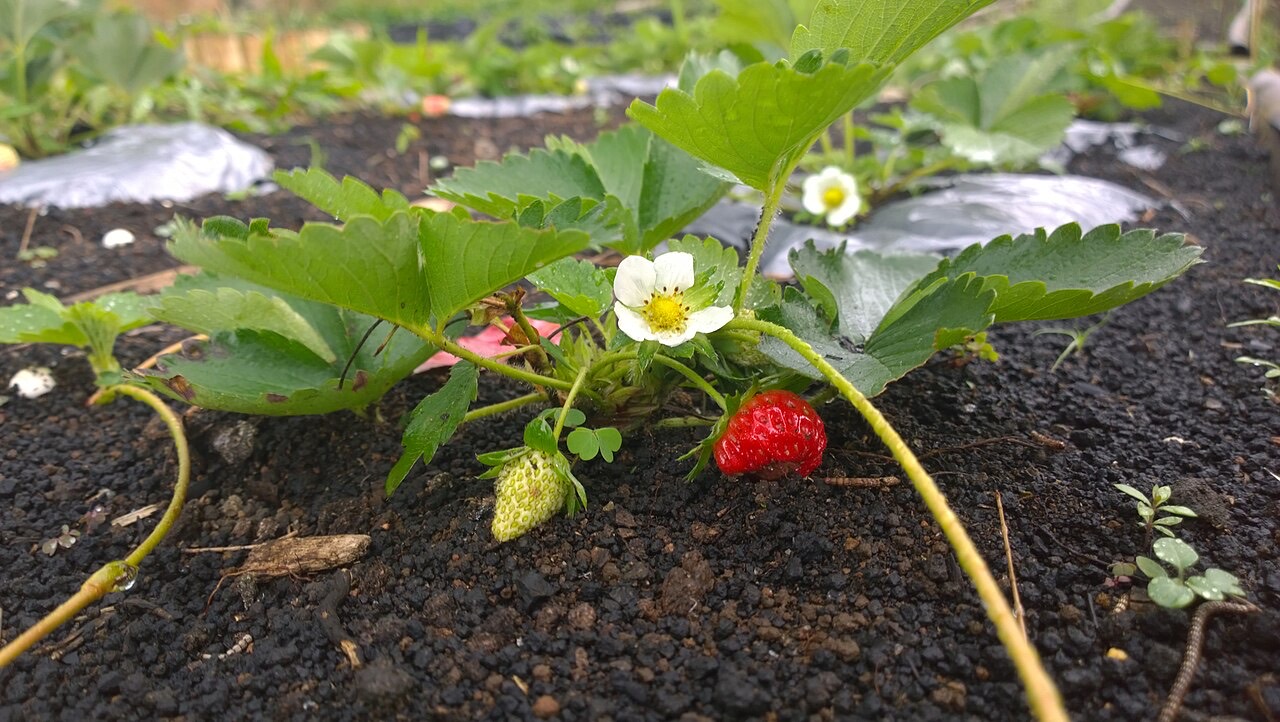
The garden strawberry is a hybrid species that arose from the crossing of two wild American strawberry species, combining large fruit size with wide climatic adaptability. It spreads by runners (stolons) that root to form new daughter plants, a trait exploited both for propagation and, in some systems, for natural stand renewal.
Although botanically perennial, strawberry is frequently grown as an annual in intensive commercial systems, with new plants established each season on raised, plastic-mulched beds. In cooler climates, perennial matted-row systems that crop over several years remain common.
Overview
Strawberry is grown across a wide range of climates, from short-season perennial plantings in cooler regions to intensive annual plasticulture systems in milder climates that allow multiple harvest windows or off-season production.
Cultivars are commonly grouped by their flowering response to day length, including short-day (June-bearing), day-neutral, and everbearing types, which growers select to match their local season and target harvest window.
Botanical classification
- Family
- Rosaceae (rose family)
- Genus
- Fragaria
- Principal species
- Fragaria × ananassa, an octoploid hybrid of Fragaria virginiana and Fragaria chiloensis
- Growth habit
- Low-growing perennial herb spreading by stolons (runners), propagated vegetatively
Origin and distribution
The modern garden strawberry arose in 18th-century Europe from the accidental crossing of Fragaria virginiana, native to eastern North America, and Fragaria chiloensis, native to Chile and the west coast of the Americas, producing a hybrid with notably larger fruit than either parent.
Strawberry is now cultivated commercially across temperate and subtropical regions worldwide.
Climate requirements
Flowering in many strawberry cultivars is triggered by day length and temperature, with short-day types initiating flowers under shortening autumn days and day-neutral types flowering largely independent of day length.
Spring frost during bloom can damage or destroy flowers, and in some production regions, overhead sprinkler irrigation is used specifically to protect blossoms from frost through the release of latent heat as applied water freezes.
Soil requirements
Strawberry prefers well-drained, sandy loam soils with good aeration and a slightly acidic pH, reflecting its relatively shallow, sensitive root system.
Planting and establishment
Strawberry is propagated from runners or, increasingly, from certified plug plants, and established either as an annual planting on plastic-mulched raised beds (plasticulture) or as a perennial matted-row planting that crops over multiple seasons.
- Cultivar selection matched to day-length response and target harvest window
- Use of certified, disease-tested planting material
- Plasticulture systems for annual production versus matted-row systems for perennial cropping
- Row spacing and plant density set according to the chosen system
Nutrient considerations
Nitrogen supports vegetative growth but is managed carefully, since excess nitrogen can promote soft, disease-prone foliage and fruit at the expense of quality. Potassium and calcium both influence fruit firmness and shelf life.
Water and irrigation
Strawberry has a shallow root system and benefits from frequent, relatively light irrigation to maintain even soil moisture, particularly during establishment and fruit development. Drip irrigation under plastic mulch is standard in most intensive commercial systems.
Overhead sprinkler systems are used in some regions both for irrigation and, as noted above, for frost protection during bloom.
Common diseases and pests
Gray mold (Botrytis fruit rot) is one of the most damaging diseases of strawberry, affecting flowers and ripening fruit, particularly in humid or wet conditions. Powdery mildew affects leaves, flowers, and fruit and can be severe in warm, dry climates. Spider mites and thrips are common pests affecting foliage and fruit quality.
Management combines resistant or tolerant cultivars where available, canopy and irrigation management to reduce humidity around fruit, monitoring, and — where justified — locally authorized control products applied according to their labels.
Harvest
Strawberry fruit ripens rapidly and does not continue to ripen after picking, so harvest is done by hand at full color, often every one to three days during the peak season to keep pace with ripening. Rapid cooling after harvest is important given the fruit's high perishability.
Uses
- Fresh-market fruit consumption
- Jam, preserves, and other processed products
- Frozen fruit for food manufacturing and food service
- Juice and flavoring uses
Botanical identity
Interspecific hybridsingle source- Accepted name
- Fragaria × ananassa
- Family
- Rosaceae
- Genus
- Fragaria
- Harvested part
- berry
- Agricultural use
- human food
- Crop group
- Fruit
What the authorities say
- Plants of the World Online
- Fragaria × ananassa
The garden strawberry is a hybrid of Fragaria chiloensis and F. virginiana, and both authorities carry the hybrid name. Plants of the World Online resolves it as Fragaria × ananassa; the corpus previously recorded the same name and the mark is retained because it is part of the identity. World Flora Online returns no placement for the hybrid, so this identity rests on one authority.
Botanical identity here is what the consulted taxonomic authorities publish, on the date they were read. Where authorities disagree, both readings are shown rather than one being chosen silently.
Traded as
This crop is traded as one commodity in this corpus.
What AgricultureID holds for this crop
- 9 crop calendar records
- 6 verified extension resources
- 6 pests and diseases naming this crop as a host
- 2 soil references
- 1 climate references
- 324 market price series
Not held
- No published cultivars — not researched
- No official variety registrations — source exists not mapped
- No farm economics observations — source exists not mapped
- No related crops — not applicable
An absence here means this corpus holds no such record, not that none exists.
How to read figures on this page
Production, area and trade figures for any crop change from season to season and are compiled by FAO and by national agricultural statistics agencies. Take current numbers from those primary sources, dated to the period you mean, rather than from a secondary summary — including this one.
Crop water requirements are estimated from reference evapotranspiration and local climate data, following methods published by FAO and national agricultural agencies. A requirement quoted without the reference method and the local climate behind it is not a number that can be applied to a field.
Part of
Planting and harvest calendar
Usual sowing and harvest windows across 9 jurisdictions, covering strawberry and strawberry — season 1 and strawberry — season 2.
Official extension guidance
6 resources indexed from public extension publishers. Each was written for a particular place; read it at the source.
Managing strawberry Neopestalotiopsis- Avoiding unhealthy plug plants is key
Factsheet published by University of Maryland Extension for Maryland. It addresses strawberry. The source is organised around “Managing strawberry Neopestalotiopsis: Avoiding unhealthy plug plants is key” and “Vegetable and Fruit News-2026 (Volume 17, Issue 5)”.
University of Maryland Extension · Pest management · publisher states 2026-06-12
Selecting, Storing, and Serving Ohio Strawberries
Factsheet published by Ohio State University Extension for Ohio. It addresses strawberry. The source is organised around “Low Sugar Strawberry Freezer Jam”, “Search form” and “HYG-5531”.
Ohio State University Extension · Storage · publisher states no date; reachable 2026-08-27
Strawberry Disease - Gray Mold
Factsheet published by Penn State Extension for Pennsylvania. It addresses strawberry. The source is organised around “Disease Cycle” and “Disease Management”.
Penn State Extension · Disease management · publisher states 2026-04-02
Sustainable Practices for Plasticulture Strawberry Production in the South
Factsheet published by NC State Extension for North Carolina. It addresses strawberry. The source is organised around “What Are Sustainable Practices?”, “Why Incorporate Sustainable Practices Into Plasticulture Strawberry Production?” and “Sustainable Practices for Strawberry Production: Description and Use”.
NC State Extension · Disease management · publisher states 2009-03-18
Verticillium Wilt of Strawberry
Factsheet published by Ohio State University Extension for Ohio. It addresses strawberry. The source is organised around “Causal Organism”, “Search form” and “PLPATH-FRU-32”.
Ohio State University Extension · Disease management · publisher states no date; reachable 2026-08-27
Who has been in my strawberries? Slugs and sap beetles, two common pests
Factsheet published by University of Maryland Extension for Maryland. It addresses strawberry. The source is organised around “Who has been in my strawberries? Slugs and sap beetles, two common pests”, “Monitoring and Thresholds” and “Recommended Other Resources:”.
University of Maryland Extension · Pest management · publisher states 2024-10-23
These are pointers to guidance published by others. Each was written for a particular place and season and is revised by its publisher; read it at the source, and check it applies where you farm.
Authorised inputs (France)
The French register records 135 currently authorised products whose authorised use names this crop, held by 66 authorisation holders. This is a count of what exists on the register, not a recommendation and not a shortlist.
By function
- Fongicide 78
- Insecticide 27
- Herbicide 15
- Acaricide 9
- Stimul. Déf. Plantes - Maladies 3
- Nématicide 2
Targets named on the register
- Pourriture grise et sclérotinioses 29
- Oïdium(s) 29
- Maladies des taches brunes 16
- Acariens 14
- Mildiou(s) 9
- Chenilles phytophages 9
Use scope is recorded as the register writes it. Collective terms cover several crops at once and are left unmapped rather than expanded, because expanding one entry into several would invent authorisations that were never granted.
Authorisation is specific to one jurisdiction, one legal object and one moment. It is not a recommendation, and it says nothing about how a product may be used: always read the current official label at the source before acting.
Tools for this
Each tool shows its formula, constants and sources, and starts empty — nothing is filled in from this page.
- Seed-rate calculator
Convert a target plant stand into a seed rate, allowing for germination and establishment.
- Row spacing calculator
Work out in-row spacing and plants per metre of row for a target density.
- Production, area and yield calculator
Relate a harvested area and a yield to a production total, in either direction.
- Growing degree-days calculator
Accumulate heat units against a base temperature.
Relationships
Evidence-backed connections in the knowledge graph.
Susceptible to
Suitable soils
Climate sensitivity
Irrigation methods
Managed with
Farming systems
Harvested commodities
The traded commodities harvested from this crop. A commodity is the harvested lot, described by its own quality, grading, and storage evidence — not by the agronomy of the plant.
Scope & limitations
Geographic scope: Global overview. Production system (annual plasticulture versus perennial matted-row) is climate- and region-specific.
Climate context: Temperate fruit crop with cultivar-dependent day-length flowering response; vulnerable to spring frost during bloom.
- Choice between annual and perennial production systems is climate- and market-specific and not resolved here.
- Production statistics change annually and should be taken from primary datasets such as FAOSTAT.
Sources
This article draws on the following authoritative sources. See our sources & methodology for how they are selected.
- [1]FAO — Food and Agriculture Organization (opens in a new tab)Authoritative
Food and Agriculture Organization of the United Nations (FAO)
Cited for: Global strawberry production context
- Type:
- Intergovernmental organization
- Jurisdiction:
- Global
- Accessed:
- 2026-07-12
- [2]FAOSTAT — FAO statistical database (opens in a new tab)Authoritative
Food and Agriculture Organization of the United Nations (FAO)
Cited for: Production and area statistics
- Type:
- Intergovernmental organization
- Jurisdiction:
- Global
- Accessed:
- 2026-07-12
- Authoritative
Cited for: Classification and nomenclature
- Type:
- Reference database
- Jurisdiction:
- United States
- Accessed:
- 2026-07-12
- [4]CABI Digital Library — Crop Protection Compendium (opens in a new tab)High
CABI (Centre for Agriculture and Bioscience International)
Cited for: Strawberry disease and pest compendium data
- Type:
- Reference database
- Jurisdiction:
- Global
- Accessed:
- 2026-07-12
- [5]UC Statewide Integrated Pest Management Program (UC IPM) (opens in a new tab)High
University of California Agriculture and Natural Resources (UC ANR)
Cited for: Integrated pest management guidelines for strawberry
- Type:
- University extension service
- Jurisdiction:
- United States (California)
- Accessed:
- 2026-07-12