Crop · Tree fruit crop
Peach
Prunus persica
Also known as: Nectarine
Peach is a temperate deciduous stone fruit grown for fresh and processed fruit, encompassing both fuzzy-skinned peach and smooth-skinned nectarine, with cultivars bred across a wide range of chilling requirements.
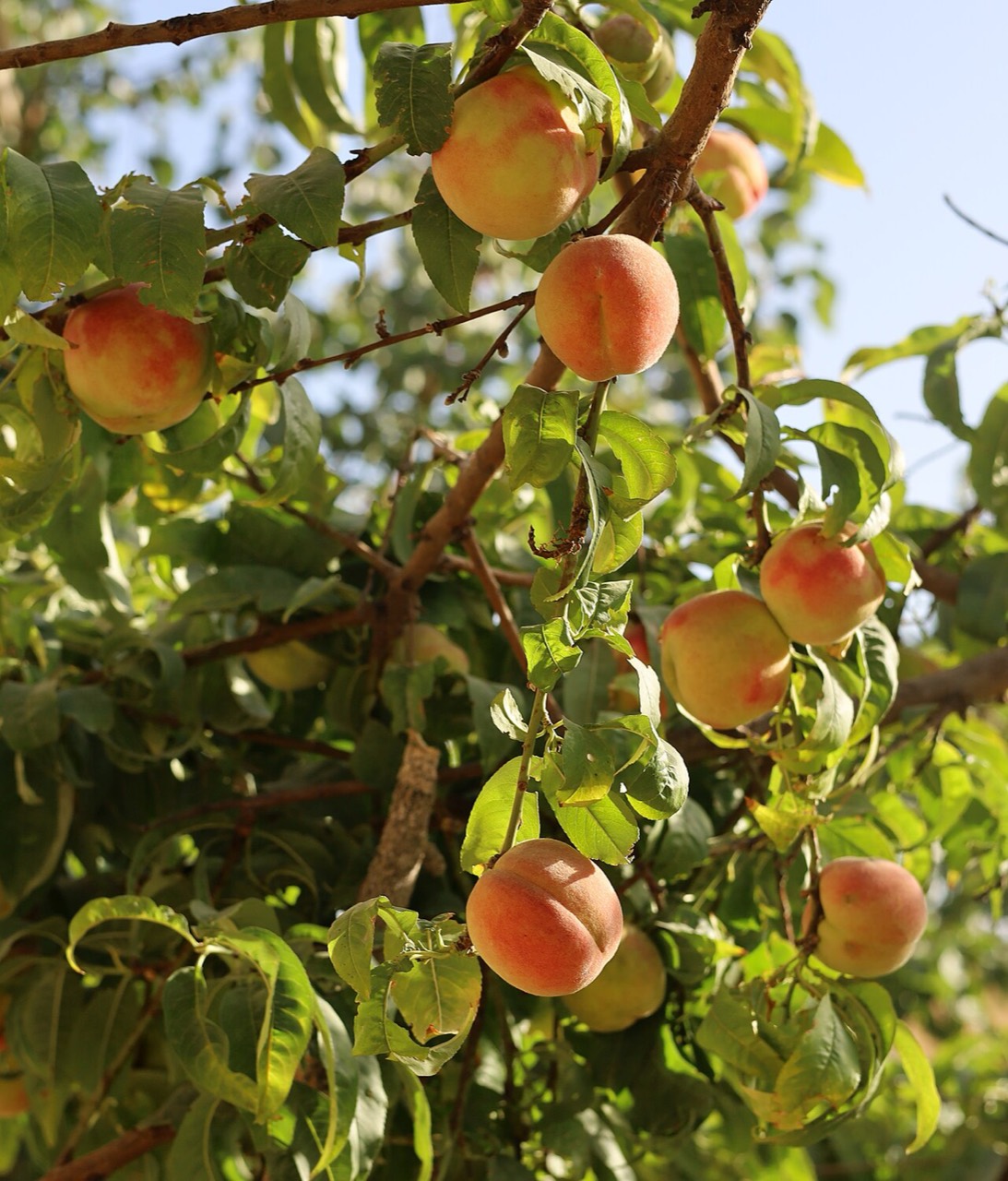
Peach rootstock choice is dominated by what is in the soil rather than by tree size. Replanting peach after peach runs into peach tree short life and into ring nematode, and the rootstocks that matter commercially — Nemaguard and its relatives — are chosen for nematode resistance first. The species includes both the familiar fuzzy-skinned peach and the smooth-skinned nectarine, which is a peach variant distinguished mainly by a single gene affecting skin texture rather than a separate species.
Unlike sweet cherry, most peach cultivars are self-fertile and do not require a separate pollinizer variety to set a commercial crop, simplifying orchard pollination design. Extensive breeding has also produced peach cultivars spanning a wide range of chilling requirements, from high-chill types suited to cold-winter climates to low-chill types adapted to subtropical growing regions, making peach one of the more climatically adaptable temperate tree fruits.
Overview
Peach is grown as a grafted, long-lived perennial tree, generally shorter-lived and faster-cropping than some other tree fruit species. Production spans both fuzzy-skinned peach and its smooth-skinned nectarine variant, grown for fresh-market and processing markets.
Because peach is propagated clonally, rootstock and cultivar decisions made at establishment shape orchard management for the productive life of the planting, with cultivar chilling requirement being a particularly important factor in matching varieties to a given climate.
Botanical classification
- Family
- Rosaceae (rose family)
- Genus
- Prunus
- Principal species
- Prunus persica (peach)
- Growth habit
- Deciduous tree, commercially propagated by grafting a fruiting cultivar onto a selected rootstock
- Nectarine
- A smooth-skinned variant of peach arising from a genetic difference in skin texture, grown and managed similarly to fuzzy-skinned peach
Origin and distribution
Peach originated in China, where it has a long history of cultivation, before spreading along historical trade routes through Central Asia into the Middle East, Europe, and eventually worldwide.
It is now grown commercially across temperate and subtropical regions on multiple continents.
Climate requirements
Peach trees require a period of winter chilling to break dormancy and flower normally; the chilling requirement varies substantially by cultivar. Extensive breeding has produced peach cultivars spanning a wide range of chilling requirements, from high-chill types for cold-winter climates to low-chill types adapted to subtropical areas, making peach one of the most climatically adaptable temperate tree fruits.
Peach blooms early enough to be the orchard crop most often caught by spring frost in continental climates, and it does so on wood that also has to survive winter cold. The two hazards are not independent: a mild autumn that delays hardening leaves the same buds exposed to both, which is why peach acreage retreats from continental interiors towards lake and coastal margins.
Soil requirements
Peach is grown on light-textured soils more often than the other stone fruits, and the reason is a disorder rather than a preference. Peach tree short life kills established trees outright, usually in the third to sixth year, and the recognised predisposing factors are a cluster: ring nematode populations, bacterial canker, winter injury to the bark, pruning too late in the dormant season, and soils below about pH 6.
Orchard establishment and management
Establishing a peach orchard begins with choosing a rootstock and cultivar combination suited to the site, market, and local chilling accumulation. Most peach cultivars are self-fertile, unlike sweet cherry, which simplifies pollination planning, though orchards still benefit from insect pollinator activity.
- Rootstock selection for size control, anchorage, and site adaptation
- Cultivar selection matched to local chilling accumulation, from high-chill to low-chill types
- Training and pruning system matched to planting density
- Summer pruning and fruit thinning to manage fruit size and canopy light penetration
Nutrient considerations
Nitrogen supports the vigorous annual shoot growth typical of peach, which fruits on one-year-old wood and therefore depends on regular renewal growth. Potassium supports fruit size and quality, while calcium status is linked to fruit firmness.
Water and irrigation
Peach fruit sizes in a short final swell, and water stress in the three to four weeks before harvest costs size that cannot be recovered afterwards. The opposite error is as costly: heavy irrigation close to harvest dilutes soluble solids and softens fruit, so the schedule is usually eased back as maturity approaches rather than sustained.
Peach responds strongly to summer pruning and fruit thinning practices that improve light penetration and reduce fruit load, which growers combine with irrigation scheduling to influence fruit size; specific pruning and thinning intensities are managed according to cultivar and local conditions rather than a universal formula.
Common diseases and pests
Brown rot is the disease that decides whether a peach crop reaches market. It infects blossoms in spring, survives in mummified fruit and cankers through the season, and then moves through ripening fruit quickly enough that a warm wet week before harvest can take a block that looked clean. Peach leaf curl is the other characteristic disease, and it is unusual in being controllable only before bud swell — once symptoms appear the season's treatment window has already closed.
Management combines resistant or tolerant cultivars, orchard sanitation, monitoring, and — where justified — locally authorized control products applied according to their labels.
Harvest
Peach fruit ripens over a relatively short window and is generally hand-picked at a maturity stage assessed through background color and firmness, since the fruit is climacteric and continues to soften after harvest. Multiple picking passes are common within an orchard block as fruit ripens unevenly.
Uses
| Feature | Peach | Nectarine |
|---|---|---|
| Skin | Fuzzy | Smooth |
| Species relationship | Prunus persica | A skin-texture variant of Prunus persica |
| Typical use | Fresh, canning, processing | Mainly fresh market |
- Fresh-market eating peaches and nectarines
- Canned and processed fruit
- Juice and juice blends
- Dried peach products in some regions
Botanical identity
Species- Accepted name
- Prunus persica
- Family
- Rosaceae
- Genus
- Prunus
- Harvested part
- fruit
- Agricultural use
- human food
- Crop group
- Fruit
What the authorities say
- World Flora Online — Taxonomic Backbone
- Prunus persica
- Plants of the World Online
- Prunus persica
Botanical identity here is what the consulted taxonomic authorities publish, on the date they were read. Where authorities disagree, both readings are shown rather than one being chosen silently.
What AgricultureID holds for this crop
- 7 crop calendar records
- 3 verified extension resources
- 2 pests and diseases naming this crop as a host
- 2 soil references
- 2 climate references
- 5 related crops
Not held
- No published cultivars — not researched
- No official variety registrations — source exists not mapped
- No farm economics observations — source exists not mapped
- No market price series — source exists not mapped
An absence here means this corpus holds no such record, not that none exists.
How to read figures on this page
Production, area and trade figures for any crop change from season to season and are compiled by FAO and by national agricultural statistics agencies. Take current numbers from those primary sources, dated to the period you mean, rather than from a secondary summary — including this one.
Crop water requirements are estimated from reference evapotranspiration and local climate data, following methods published by FAO and national agricultural agencies. A requirement quoted without the reference method and the local climate behind it is not a number that can be applied to a field.
Part of
Related crops
- Same genus
- Almond, Apricot, Cherry, Plum, Sour Cherry
Planting and harvest calendar
Usual sowing and harvest windows across 7 jurisdictions, covering peach.
Official extension guidance
3 resources indexed from public extension publishers. Each was written for a particular place; read it at the source.
2026 North Carolina Peach and Nectarine Disease and Pest Management Guide
Guide published by NC State Extension for North Carolina. It addresses peach. The source is organised around “Misuse of Pesticides” and “2026 Peach and Nectarine Disease and Pest Management Guide”.
NC State Extension · Pest management, Disease management · publisher states no date; reachable 2026-08-27
Are Your Peaches Ready to Harvest? (FS-1182)
Factsheet published by University of Maryland Extension for Maryland. It addresses peach. The source is organised around “Are Your Peaches Ready to Harvest?”, “Color Changes” and “Fruit shape”.
University of Maryland Extension · Harvest · publisher states 2025-04-10
Tree Fruit Insect Pest - Green Peach Aphid
Factsheet published by Penn State Extension for Pennsylvania. It addresses peach. The source is organised around “Description and Life Cycle”, “Monitoring and Management” and “Vector of plum pox virus”.
Penn State Extension · Pest management, Disease management · publisher states 2026-02-25
These are pointers to guidance published by others. Each was written for a particular place and season and is revised by its publisher; read it at the source, and check it applies where you farm.
Tools for this
Each tool shows its formula, constants and sources, and starts empty — nothing is filled in from this page.
- Seed-rate calculator
Convert a target plant stand into a seed rate, allowing for germination and establishment.
- Row spacing calculator
Work out in-row spacing and plants per metre of row for a target density.
- Production, area and yield calculator
Relate a harvested area and a yield to a production total, in either direction.
- Growing degree-days calculator
Accumulate heat units against a base temperature.
Relationships
Evidence-backed connections in the knowledge graph.
Susceptible to
Suitable soils
Climate sensitivity
Irrigation methods
Machinery
Farming systems
Scope & limitations
Geographic scope: Global overview. Rootstock, cultivar chilling requirement, and site suitability are region- and site-specific.
Climate context: Temperate to subtropical deciduous stone fruit; breeding has produced cultivars across a wide range of chilling requirements, but bloom-time frost remains a risk.
- Rootstock, cultivar chilling-hour specifics, and thinning intensity are cultivar- and region-specific decisions not covered by universal values here.
- Production and cultivar-popularity statistics change over time and should be taken from primary datasets such as FAOSTAT.
Sources
This article draws on the following authoritative sources. See our sources & methodology for how they are selected.
- [1]FAO — Food and Agriculture Organization (opens in a new tab)Authoritative
Food and Agriculture Organization of the United Nations (FAO)
Cited for: Global peach production and cultivation context
- Type:
- Intergovernmental organization
- Jurisdiction:
- Global
- Accessed:
- 2026-07-12
- [2]FAOSTAT — FAO statistical database (opens in a new tab)Authoritative
Food and Agriculture Organization of the United Nations (FAO)
Cited for: Production and area statistics
- Type:
- Intergovernmental organization
- Jurisdiction:
- Global
- Accessed:
- 2026-07-12
- [3]CABI Digital Library — Crop Protection Compendium (opens in a new tab)High
CABI (Centre for Agriculture and Bioscience International)
Cited for: Peach pest and disease compendium data
- Type:
- Reference database
- Jurisdiction:
- Global
- Accessed:
- 2026-07-12
- [4]UC Statewide Integrated Pest Management Program (UC IPM) (opens in a new tab)High
University of California Agriculture and Natural Resources (UC ANR)
Cited for: Integrated pest management guidelines for peach
- Type:
- University extension service
- Jurisdiction:
- United States (California)
- Accessed:
- 2026-07-12
- [5]Cornell CALS — Plant pathology and crop resources (opens in a new tab)High
Cornell University College of Agriculture and Life Sciences
Cited for: Peach cultivar and orchard management research
- Type:
- University extension service
- Jurisdiction:
- United States (New York)
- Accessed:
- 2026-07-12
- Authoritative
Cited for: Classification and nomenclature
- Type:
- Reference database
- Jurisdiction:
- United States
- Accessed:
- 2026-07-12