Crop · Tree fruit crop
Cherry
Prunus avium (sweet cherry); Prunus cerasus (sour/tart cherry)
Also known as: Sweet cherry
Cherry is a temperate deciduous stone fruit grown as sweet cherry for fresh eating and sour/tart cherry mainly for processing, both propagated by grafting and requiring substantial winter chilling.
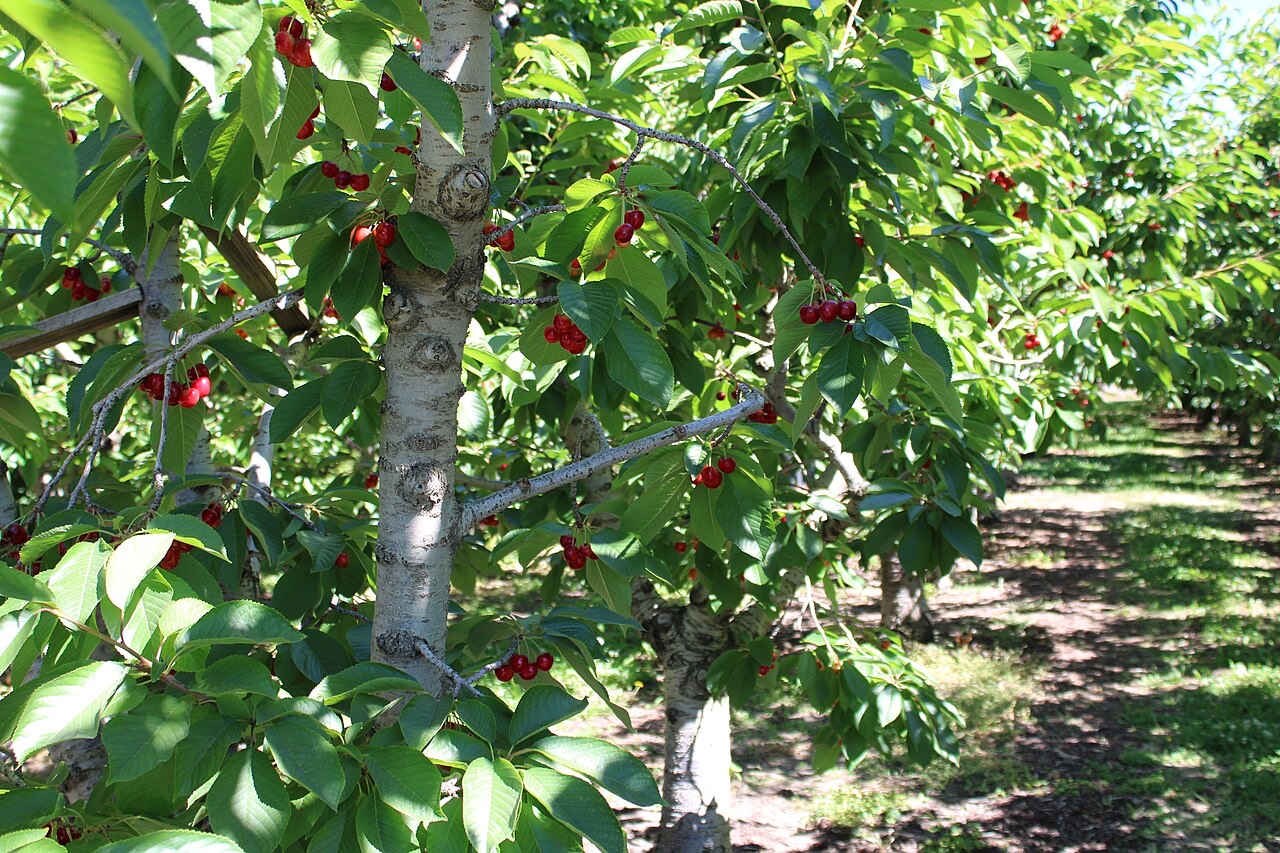
Cherry orchards are established from grafted trees combining a fruiting cultivar with a rootstock chosen for size control, anchorage, and site adaptation, as is standard for tree fruit crops. Two distinct species are grown commercially: sweet cherry (Prunus avium), used mainly for fresh consumption, and sour or tart cherry (Prunus cerasus), used predominantly for processing into juice, dried fruit, and baked-good fillings.
Sweet cherry cultivars are largely self-incompatible, meaning most varieties cannot set a commercial crop with their own pollen and require a compatible pollinizer variety planted nearby, an important consideration in orchard design. Cherry also blooms relatively early in many growing regions, making spring frost a significant production risk.
Overview
Cherry is grown as a grafted, long-lived perennial tree. Commercial production is divided between sweet cherry, grown mainly for the fresh market, and sour or tart cherry, grown mainly for processing, with each species having distinct orchard management traditions.
Because cherry is propagated clonally and cropped over many seasons, decisions on rootstock, cultivar, and — for sweet cherry — pollinizer variety are made once at establishment and shape orchard management for the life of the planting.
Botanical classification
- Family
- Rosaceae (rose family)
- Genus
- Prunus
- Principal species
- Prunus avium (sweet cherry) and Prunus cerasus (sour or tart cherry)
- Growth habit
- Deciduous tree, commercially propagated by grafting a fruiting cultivar onto a selected rootstock
Sweet cherry and sour cherry differ not only in fruit use but in tree habit and pollination biology: sweet cherry trees tend to be more vigorous and largely self-incompatible, while many sour cherry cultivars are self-fertile, simplifying orchard pollination design for that species.
Origin and distribution
Sweet cherry and sour cherry both originate from regions spanning Europe and western Asia, with long histories of cultivation and selection across these areas before spreading to other temperate regions worldwide.
Commercial production of both species is now established across temperate regions on multiple continents.
Climate requirements
Cherry trees require a period of winter chilling to break dormancy and flower normally; the chilling requirement varies by cultivar, but cherry is generally noted as having a comparatively high chilling requirement among stone fruits, which restricts the species to genuinely cold-winter temperate climates compared with some other Prunus crops.
Cherry tends to bloom relatively early in many growing regions, making spring frost during bloom one of the most significant climate risks for the crop, since flowers and young fruitlets are frost-sensitive.
Soil requirements
Cherry is the least tolerant of wet ground of the common stone fruits, and the tolerance that exists is supplied by the rootstock rather than the cultivar. Mazzard, a Prunus avium seedling, is compatible with every sweet cherry scion and offers no protection against a high water table; Colt tolerates periodic waterlogging and is less susceptible to Phytophthora. On any site where drainage is uncertain, that choice is made before the cultivar is.
Orchard establishment and management
Establishing a cherry orchard begins with choosing a rootstock and cultivar combination suited to the site and market. For sweet cherry, orchard design must also account for pollinizer compatibility, since most sweet cherry cultivars are self-incompatible and require a different, cross-compatible variety planted nearby to set a commercial crop; sour cherry cultivars are more commonly self-fertile.
- Rootstock selection for size control, anchorage, and site adaptation
- Pollinizer selection for sweet cherry, given widespread self-incompatibility among cultivars
- Training and pruning system matched to planting density and species
- Frost-management planning given the crop's relatively early bloom in many regions
Nutrient considerations
Potassium supports fruit size and quality in cherry, while calcium status is closely linked to fruit firmness, a particularly important quality trait for sweet cherry given its susceptibility to rain-induced cracking near harvest. Boron plays a role in flowering and fruit set.
Water and irrigation
Cherry is unusual among orchard fruit in being damaged by water arriving from above rather than below. Rain on ripening fruit is absorbed through the skin and splits it, and a single event close to harvest can render a block unmarketable, which is why orchards in wet climates are covered and why harvest date is often set by the forecast rather than by maturity alone.
Cherries are notably susceptible to rain-induced fruit cracking as fruit approaches maturity, since ripening fruit absorbs water rapidly through the skin. This makes rainfall near harvest, rather than irrigation alone, a major fruit-quality risk that growers manage through cultivar choice, canopy management, and, in some regions, protective covers.
Common diseases and pests
Spotted wing drosophila changed cherry management wherever it arrived. Unlike the fruit flies that infest damaged or overripe fruit, it has a serrated ovipositor and lays into sound ripening fruit, so the crop is vulnerable through the whole colouring period rather than only at the end of it. Bacterial canker is the other characteristic problem, and it is one of the factors implicated in the sudden death of established trees.
Management combines resistant or tolerant cultivars, orchard sanitation, monitoring, and — where justified — locally authorized control products applied according to their labels.
Harvest
Cherry fruit does not continue to ripen appreciably after picking, so harvest timing is based on maturity indicators such as color, size, and firmness, with fruit picked at or near full ripeness for fresh-market sweet cherry. Sour cherry grown for processing is often mechanically harvested, while fresh-market sweet cherry is typically hand-picked with the stem attached to reduce injury and extend shelf life.
Uses
| Feature | Sweet cherry (Prunus avium) | Sour/tart cherry (Prunus cerasus) |
|---|---|---|
| Primary use | Fresh eating | Processing (juice, dried, baking) |
| Self-compatibility | Largely self-incompatible; needs a pollinizer | Many cultivars are self-fertile |
| Typical products | Fresh fruit, some canning | Juice, dried fruit, pie and baking fillings |
- Fresh-market eating cherries (sweet cherry)
- Juice and juice blends
- Dried and canned fruit
- Pie fillings and other baked-good ingredients
What this page covers
genus conceptThis page covers sweet cherry, Prunus avium, which is what "cherry" means in a fresh fruit market. Sour cherry is a separate tetraploid species with its own page, its own self-fertility and its own harvest method, and the two are not interchangeable in any respect except the word.
The page covers several cultivated species of one genus. Each is a real, separately verifiable taxon; the page exists because the trade name covers all of them.
| Taxon | In this corpus | Role |
|---|---|---|
| Prunus cerasusSour cherry | held as a verified taxon | Tetraploid, of hybrid origin, self-fertile, shake-harvested into water and processed rather than sold fresh. Published in Wave 39; this page listed its name as an alternative name until Wave 41 removed it. |
When a taxon here earns its own page: A second cherry earns its own page when self-fertility, harvest method and market all differ from sweet cherry, which is the case for Prunus cerasus and for nothing else the corpus holds in the group.
Botanical identity
Species- Accepted name
- Prunus avium
- Family
- Rosaceae
- Genus
- Prunus
- Harvested part
- fruit
- Agricultural use
- human food
- Crop group
- Fruit
What the authorities say
- World Flora Online — Taxonomic Backbone
- Prunus avium
- Plants of the World Online
- Prunus avium
Botanical identity here is what the consulted taxonomic authorities publish, on the date they were read. Where authorities disagree, both readings are shown rather than one being chosen silently.
What AgricultureID holds for this crop
- 3 crop calendar records
- 2 verified extension resources
- 1 pests and diseases naming this crop as a host
- 2 soil references
- 2 climate references
- 5 related crops
Not held
- No published cultivars — not researched
- No official variety registrations — source exists not mapped
- No farm economics observations — source exists not mapped
- No market price series — source exists not mapped
An absence here means this corpus holds no such record, not that none exists.
How to read figures on this page
Production, area and trade figures for any crop change from season to season and are compiled by FAO and by national agricultural statistics agencies. Take current numbers from those primary sources, dated to the period you mean, rather than from a secondary summary — including this one.
Crop water requirements are estimated from reference evapotranspiration and local climate data, following methods published by FAO and national agricultural agencies. A requirement quoted without the reference method and the local climate behind it is not a number that can be applied to a field.
Part of
Related crops
- Same crop concept
- Sour Cherry
Planting and harvest calendar
Usual sowing and harvest windows across 3 jurisdictions, covering cherry (all varieties).
Official extension guidance
2 resources indexed from public extension publishers. Each was written for a particular place; read it at the source.
Ornamental Cherry Pest Management Calendar
Factsheet published by NC State Extension for North Carolina. It addresses cherry. The source is organised around “Table Legend”, “Other Resources” and “Ornamental Cherry Pest Management Calendar”.
NC State Extension · Pest management · publisher states no date; reachable 2026-08-27
Ornamental Cherry Trees: Identify and Manage Problems
Factsheet published by University of Maryland Extension for Maryland. It addresses cherry. The source is organised around “About flowering cherry trees”, “Growing ornamental cherry trees in Maryland” and “Spacing and mature size”.
University of Maryland Extension · Pest management, Disease management · publisher states 2023-03-30
These are pointers to guidance published by others. Each was written for a particular place and season and is revised by its publisher; read it at the source, and check it applies where you farm.
Authorised inputs (France)
The French register records 112 currently authorised products whose authorised use names this crop, held by 59 authorisation holders. This is a count of what exists on the register, not a recommendation and not a shortlist.
By function
- Fongicide 54
- Insecticide 48
- Acaricide 4
- Régulateur de croissance 3
- Attractif phéromone (confusion sexuelle) 1
- Répulsif 1
Targets named on the register
- Moniliose(s) et pourriture grise 24
- Bactériose(s) 19
- Pucerons 19
- Coryneum et polystigma 19
- Stad. Hivern. Ravageurs (1) 14
- Acariens et phytoptes 11
Use scope is recorded as the register writes it. Collective terms cover several crops at once and are left unmapped rather than expanded, because expanding one entry into several would invent authorisations that were never granted.
Authorisation is specific to one jurisdiction, one legal object and one moment. It is not a recommendation, and it says nothing about how a product may be used: always read the current official label at the source before acting.
Tools for this
Each tool shows its formula, constants and sources, and starts empty — nothing is filled in from this page.
- Seed-rate calculator
Convert a target plant stand into a seed rate, allowing for germination and establishment.
- Row spacing calculator
Work out in-row spacing and plants per metre of row for a target density.
- Production, area and yield calculator
Relate a harvested area and a yield to a production total, in either direction.
- Growing degree-days calculator
Accumulate heat units against a base temperature.
Relationships
Evidence-backed connections in the knowledge graph.
Suitable soils
Climate sensitivity
Irrigation methods
Machinery
Farming systems
Related topics
Scope & limitations
Geographic scope: Global overview. Rootstock, cultivar, pollinizer, and chilling requirements are region- and site-specific.
Climate context: Temperate deciduous stone fruit with a comparatively high winter chilling requirement among stone fruits; vulnerable to spring frost given relatively early bloom.
- Rootstock, pollinizer pairing, and chilling-hour specifics are cultivar- and region-specific decisions not covered by universal values here.
- Production and cultivar-popularity statistics change over time and should be taken from primary datasets such as FAOSTAT.
Sources
This article draws on the following authoritative sources. See our sources & methodology for how they are selected.
- [1]FAO — Food and Agriculture Organization (opens in a new tab)Authoritative
Food and Agriculture Organization of the United Nations (FAO)
Cited for: Global cherry production and cultivation context
- Type:
- Intergovernmental organization
- Jurisdiction:
- Global
- Accessed:
- 2026-07-12
- [2]FAOSTAT — FAO statistical database (opens in a new tab)Authoritative
Food and Agriculture Organization of the United Nations (FAO)
Cited for: Production and area statistics
- Type:
- Intergovernmental organization
- Jurisdiction:
- Global
- Accessed:
- 2026-07-12
- [3]CABI Digital Library — Crop Protection Compendium (opens in a new tab)High
CABI (Centre for Agriculture and Bioscience International)
Cited for: Cherry pest and disease compendium data
- Type:
- Reference database
- Jurisdiction:
- Global
- Accessed:
- 2026-07-12
- [4]UC Statewide Integrated Pest Management Program (UC IPM) (opens in a new tab)High
University of California Agriculture and Natural Resources (UC ANR)
Cited for: Integrated pest management guidelines for cherry
- Type:
- University extension service
- Jurisdiction:
- United States (California)
- Accessed:
- 2026-07-12
- [5]Cornell CALS — Plant pathology and crop resources (opens in a new tab)High
Cornell University College of Agriculture and Life Sciences
Cited for: Cherry cultivar and orchard management research
- Type:
- University extension service
- Jurisdiction:
- United States (New York)
- Accessed:
- 2026-07-12
- Authoritative
Cited for: Classification and nomenclature
- Type:
- Reference database
- Jurisdiction:
- United States
- Accessed:
- 2026-07-12